How Do You Create a Game App With No Code
Ever had a brilliant game idea scribble on a napkin, only to stuff it in a drawer because you thought, "But I'm not a coder"? That old excuse is officially dead and buried. The answer to "how do you create a game app" has completely changed, and it no longer starts with learning a complex programming language. It starts with your idea and a platform like MakeGamesWithAI.com, where you can turn that idea into a playable game with AI in under a minute. Our platform lets you build, share, and even compete on global leaderboards without writing a single line of code.
Your Game Idea Is Closer to Reality Than You Think
Seriously. That barrier between your concept and a playable game has been obliterated. You don't need to stare at a mountain of code anymore. Instead, you can bring your vision to life in minutes, focusing purely on what makes a game fun, not the technical grunt work.

From Text Prompt to Playable Game
Platforms like MakeGamesWithAI.com have torn down the "no coders allowed" sign. Here, you don't write code—you write a simple prompt. Just imagine typing out your dream game: "a 2D platformer where a ninja cat collects glowing sushi," and then watching the AI spin up a fully working prototype right before your eyes. This isn't science fiction anymore; it's the new reality of game development.
Your job title just got a major upgrade from "wannabe coder" to Game Director. You're the one calling the shots, guiding the AI, and tweaking its creations until the game in your head is the game on the screen. And it's not just a toy for beginners; this is a seriously powerful tool for seasoned pros who want to prototype and explore new ideas at lightning speed.
The biggest shift in game development isn't just about speed; it's about accessibility. AI-powered tools empower you to test ideas, find what's fun, and build a complete game without ever seeing a single line of code.
The Power of No-Code Development
This new approach plugs directly into the massive no-code movement, which is all about letting people build amazing things without a computer science degree. For game dev, this is a game-changer. It means you get to pour all your energy into the stuff that actually matters to players:
- Engaging Gameplay: Is the core loop actually fun? Are the challenges just right?
- Compelling Worlds: Does your game world feel alive and worth exploring?
- Unique Characters: Is the hero someone you want to root for (and control)?
By stripping away the technical headache, you're free to answer these creative questions. You can experiment with different mechanics, swap out art, and adjust the difficulty just by "chatting" with the editor. The whole process is built to keep you in that creative zone.
If you're curious to see just how far you can take this, our blog has plenty more on the world of no-code game dev, showcasing what creators are building without touching traditional programming.
By the time you're done with this guide, you won't just know how to make a game app; you'll have a clear, step-by-step plan to build your very first one. So, let's forget the intimidating software and the soul-crushing learning curves. We're diving straight into the fun part—turning your idea into something people can actually play. Let's do this.
Nailing Down Your Game's Core Concept
Every legendary game, from the most epic RPGs to those infuriatingly addictive one-tap wonders, started with a single, killer idea. This is the fun part. It's where you take that half-baked concept bouncing around your head and turn it into a real blueprint for fun. Before you can even think about how to make a game, you need to answer a much more important question: "What is this thing even about?"
Think big, but start small and sharp. What does the player do? Are they a ghost trying to solve their own murder by flinging teacups around a spooky mansion? Or maybe a space-pizza delivery pilot weaving through an asteroid field on a tight deadline? The clearer your core idea, the better the magic you'll get out of a tool like MakeGamesWithAI.com.
Picking a Genre and a "Core Loop"
Your game's genre is its skeleton. It gives your story and gameplay a familiar shape, setting expectations for the player right from the start. What kind of vibe are you going for?
- A Platformer? Perfect for tales of exploration and acrobatics. Think of a squirrel trying to climb a giant, magical tree to find the last-ever golden acorn.
- A Puzzle Game? This is for those brain-tickling challenges. How about a time-traveling detective who has to rearrange events in the past to stop a crime from ever happening?
- An RPG (Role-Playing Game)? The best choice for deep stories and character growth. Picture a young alchemist hunting for rare ingredients to cure their village of a mysterious magical plague.
The genre you pick directly informs your core mechanic—that one central action the player does over and over again. For Super Mario Bros., it's jumping. For Tetris, it's rotating and dropping blocks. Your first game should orbit around one simple, satisfying action that’s easy to grasp but hard to put down.
The Power of a Simple Plan
Look, you don't need a hundred-page design bible, but you absolutely need to sketch out a basic plan. This little document is your "game design document," and it's what you'll feed the AI. Think of it as a recipe. The AI is a brilliant chef, but it can't cook your signature dish without your list of ingredients.
This is where the game has truly changed for creators. Not long ago, making even a basic game was a logistical and financial nightmare. The mobile app world has seen costs skyrocket, with the average app projected to cost around $52,000 to develop by 2025. Ouch.
But here’s the good news: the rise of accessible tools is turning the tables. The global market for low-code platforms hit a whopping $28.75 billion in 2024, and it’s only going up. This proves that people are ditching the old, complex ways for faster, smarter methods. If you want to see just how much the industry is shifting, check out these fascinating mobile app growth statistics.
The secret to actually finishing your first game isn't genius or a huge budget. It's keeping your scope small. A complete, polished, ten-minute game is infinitely better than an unfinished masterpiece sitting on your hard drive.
Keeping Your Scope in Check (Seriously)
Scope creep is the number one killer of indie game dreams. It’s that seductive whisper that says, "You know what would be cool? Just one more feature…" before you know it, your simple idea has become a bloated, unmanageable monster. For your first game, you have to fight this urge like your life depends on it.
So, what does a realistic scope look like for a first-timer?
- One Core Mechanic: Nail one thing. Make that jump feel amazing or that one puzzle mechanic incredibly satisfying.
- One Playable Character: Just one hero with a clear goal. Don't worry about a huge cast just yet.
- One to Three Levels: Focus on creating a short, complete experience. It needs a beginning, a middle, and an end.
By keeping your vision tight, you practically guarantee you'll get to the finish line and have something to share. This is the sweet spot for a platform like MakeGamesWithAI.com, which absolutely shines at spinning focused ideas into playable games in record time. Get this foundation right, and the rest of the process will be a joy, not a slog.
Bringing Your World to Life with AI Prompts
Alright, let's get to the good stuff. You've got your grand idea, your hero is sketched out, and the vision for your game is crystal clear. Now we're going to plug all of that creative genius into the engine at MakeGamesWithAI.com and watch your blueprint spring to life as a playable game—in minutes.
This is a whole new ballgame. Making a game app has shifted from wrestling with lines of code to being a creative director. Your main tool isn't some clunky software; it's the humble text prompt. Picture yourself as a film director working with an insanely fast and talented effects team. Your words are the commands that build the world.
From Vague Ideas to Killer Prompts
Here's the secret sauce: the quality of your game is a direct reflection of the quality of your prompts. A lazy, vague instruction? You'll get a bland, generic result. But a detailed, evocative prompt? That’s where the magic happens.
You want to be specific, but not so rigid that you choke the AI's creativity. Give it a clear target, then let it surprise you.
Let’s look at a few examples:
- For your character: Instead of just "a hero," try something like, "a chubby, cheerful pixel-art hamster wearing a tiny red cape." See the difference?
- For the world: Don't settle for "a forest." Paint a picture: "a spooky, bioluminescent mushroom forest with glowing purple rivers and floating islands."
- For the gameplay: Go beyond "a platformer." Define the action: "a fast-paced platformer where the player must bounce on enemy heads to recharge their double-jump ability."
This handy infographic breaks down that initial thinking process. Nail down your Goal, Genre, and Scope before you even start writing prompts. It's the foundation for everything.
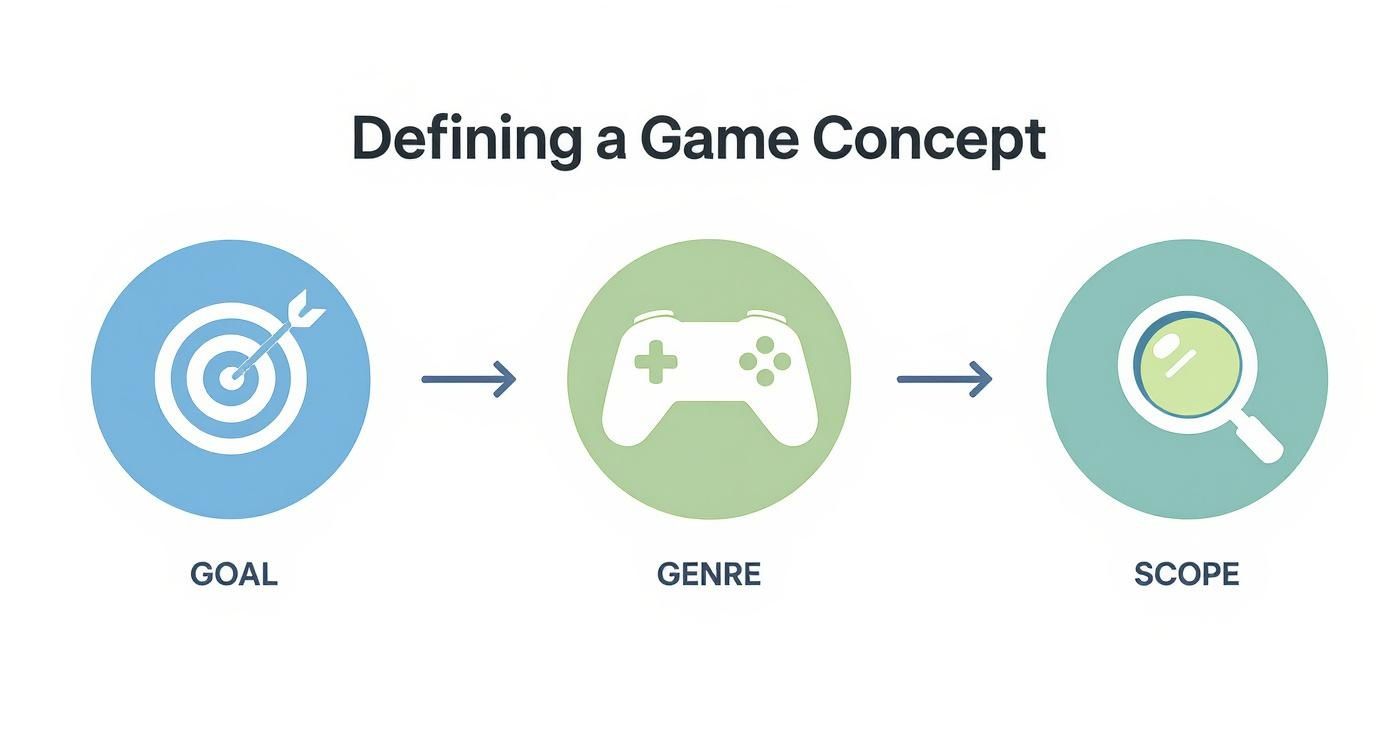
When these three elements are locked in your mind, your prompts become laser-focused, and the AI knows exactly what you're aiming for.
The First Build and the Joy of Tweaking
Once your first killer prompt is ready, you’ll hit "generate" and see something wild happen. In less than 60 seconds, MakeGamesWithAI.com spits out a fully playable prototype. I'm not talking about a screenshot; this is a real game with physics, controls, and your core ideas already working.
But that first version is just your starting point. The real fun is in the iteration cycle.
Jump right in and play it. Is it fun? Is the jump a little floaty? Are the enemies way too hard?
Your first generation isn't meant to be perfect. Think of it as a testable hypothesis. Your job is to find the fun, and AI lets you do that at a speed that was pure science fiction just a few years ago.
Based on how it feels, you just start refining your prompts. The conversational editor lets you make changes on the fly:
- "Make the player jump 20% higher."
- "Change the background to a snowy mountain theme."
- "Add a collectible that gives the player a temporary speed boost."
Each tweak generates a new version, letting you evolve the game in real time. This loop—create, test, tweak, repeat—is the very heart of modern no-code game development.
Crafting the Perfect AI Prompt
Getting the AI to produce exactly what's in your head is an art. It’s all about learning how to phrase your requests. Small changes in your wording can lead to massive differences in the final game. Here's a quick guide to get you started.
AI Prompting Techniques for Game Creation
| Game Element | Basic Prompt Example | Advanced Prompt Example | Expected Outcome Difference |
|---|---|---|---|
| Player Character | "A brave knight" | "A pixel-art knight with oversized, glowing blue armor and a comically small helmet." | The advanced prompt yields a character with distinct visual personality and charm, not a generic template. |
| Environment | "A castle level" | "A crumbling, haunted castle at dusk, with gothic architecture, broken stained glass, and eerie green fog." | The basic prompt gives a standard castle; the advanced one creates a specific mood, atmosphere, and art style. |
| Game Mechanic | "Player can shoot" | "Player shoots bouncing energy orbs that ricochet off walls twice before disappearing. Add a cooldown of 1 second." | The advanced prompt defines a unique, tactical mechanic with clear rules, moving beyond a simple point-and-shoot. |
| Enemy Behavior | "Add some enemies" | "Add small, fast-moving slime enemies that patrol platforms and jump at the player when they get close." | This specifies not just the enemy's appearance but its AI behavior, making the gameplay more dynamic and challenging. |
As you can see, detail and descriptive language are your best friends. The more you give the AI to work with, the closer it will get to your vision on the very first try.
Thinking Like an AI-Powered Developer
This new way of working is catching on like wildfire. Believe it or not, an incredible 87% of game developers are already using AI in some part of their process. It’s not some fringe tool anymore; it's becoming a core part of the toolbox.
Looking forward, 64% of industry leaders expect generative AI to be everywhere, with some projecting AI will handle over 50% of game development tasks within the next decade.
Embracing this means you spend less time getting bogged down in technical roadblocks and more time on what actually matters: creative problem-solving and making a fun game. It’s a complete shift in how to create a game app, putting your vision front and center. For a deeper dive into this new world, check out our other articles on all things related to AI game development.
With AI prompts, you're not just building a game; you're sculpting it. You start with a rough block of digital clay and, through constant feedback and refinement, you shape it into the polished, engaging experience you pictured from the start.
Playtesting and Climbing the Ranks
You did it. You took that little spark of an idea, fed it to the AI wizards at MakeGamesWithAI.com, and now you have a real, playable game. It’s a huge milestone! But before you blast the link out to all your friends, we need to talk about the most crucial—and honestly, the most fun—part of the process: seeing if your game is actually good.
It’s time to put on your demolition expert hat. We're about to find all the cracks, smooth out the rough spots, and polish this thing until it gleams.
This is the QA phase, but forget the stuffy corporate vibe. Your job is to channel your inner gremlin. Be the player who jumps on every weird ledge, mashes all the buttons at once, and generally tries to break the universe you just built.

Hunting for Bugs and Finding the Fun
First things first: play your own game. A lot. But don't just play to win—play to discover. You’re on a mission to find anything that gets in the way of a good time.
Here's a little hit list to get you started:
- Game-Breakers: Can you fall through the floor? Get stuck in a wall? Does the game just give up and crash if you do something weird? These are your public enemy number one.
- Frustration Points: Is that one jump basically impossible? Do the controls feel like you're steering a boat through molasses? Sand down those rough edges.
- The Difficulty Curve: Does your game go from "a gentle stroll" to "punishing nightmare" in ten seconds flat? Or is it just boringly easy? A great game knows how to ramp up the challenge without scaring players away.
- The Fun Factor: This is the big one. What’s the absolute best part of your game? Is it the bouncing mechanic? The chain reactions? Find that core bit of joy and double down on it.
Once you’ve played it to death, grab a friend (or two, or three) and just watch them play. Seriously. Don't say a word. Their fresh eyes will immediately zero in on problems you've become completely blind to. This feedback isn't just helpful; it's pure gold.
Tap into the Built-in Global Leaderboard
Okay, so your game is stable, smooth, and genuinely fun to play. Now it's time to add the secret sauce that turns a fun distraction into a full-blown obsession: competition.
One of the coolest things about building with MakeGamesWithAI.com is that every single game comes with a fully-functional global leaderboard baked right in. You don't have to code it, you don't have to set it up—it's just there.
With the flick of a switch, your game is no longer a solo adventure; it’s a worldwide tournament. Suddenly, every single point matters. Players aren't just trying to beat your game anymore. They're trying to beat everyone.
This one feature is a massive engine for replayability. Trust me, when a player sees they’re just a few points shy of the top 10, that "play again" button is getting smashed.
A well-designed scoring system is the engine of competition. It gives players a clear goal and a compelling reason to master your game's mechanics, turning a five-minute distraction into an hours-long obsession.
Designing an Addictive Scoring System
To really make that leaderboard sing, your scoring system needs some personality. It shouldn't just be a boring counter. It needs to reward skill, guts, and clever play.
Think about how you can spice up your scoring:
- Reward Speed: How about a time bonus? Players who blaze through a level should get a nice point cushion. This instantly creates a "speedrun" culture around your game.
- Encourage Combos: Can you give extra points for chaining actions together, like stomping three enemies without touching the ground? This kind of system rewards mastery and precision.
- Value Collectibles: Make those shiny objects count. Maybe some are worth a few points, but you could hide a few rare ones that give a massive score injection.
When you weave these elements together, your scoring system becomes part of the game itself—a challenge that's fair, deep, and incredibly addictive. Your little project transforms into a shared arena where people from all over the world can compete for glory and bragging rights.
Don't believe me? Go check out the global leaderboards right now. New high scores are being set as we speak. This is how your simple creation taps into a huge, competitive community.
It's Time to Share Your Game with the World
You’ve done it. You’ve wrestled with prompts, squashed bugs, and turned a wild idea into a genuinely fun game. The moment of truth has arrived. It's time to get your creation into the hands of real players and see what they think.
Forget the bureaucratic nightmare of submitting to the big app stores for now. Seriously, that's a whole different beast. There's a much faster, more direct way to get instant feedback and start building a community. We’re going to publish straight to the MakeGamesWithAI.com community portal. This approach lets you skip the long review queues and technical headaches, allowing you to share your game with a single click.
Your Simple "Go Live" Checklist
You don't need a huge marketing budget to get your game noticed. You just need a bit of polish and a clear, exciting message. Your mission is simple: make someone stop scrolling and think, "Whoa, that looks fun."
Here’s a quick checklist to get your game ready for its grand debut on the MakeGamesWithAI games portal:
- Nail the Description: This is your elevator pitch. Start with a hook. Don't just say "it's a platformer." Say, "You're a ninja cat collecting glowing sushi in a fast-paced, gravity-defying adventure!" Keep it punchy, exciting, and all about the action.
- Grab Some Killer Screenshots: A good screenshot is worth a thousand words of hype. Jump into your favorite levels and snap a few pictures of the most exciting moments. Show off that awesome character design, a ridiculously tricky jump, or a screen packed with shiny collectibles. Make it look like a game people need to play.
- Record a Short Gameplay Clip: If you can, a quick 15-30 second video is pure marketing gold. Nothing sells a game better than seeing it in motion. You can post this little clip on social media when you share the link to your game.
Once you have these assets ready, publishing is literally as simple as pressing a button. You’ll get a unique, shareable link you can blast out everywhere.
Now, Go Spread the Word
With that shiny new link in hand, it’s time to make some noise. You don’t have to be a social media wizard—just be genuinely excited about what you’ve built.
Post your game link on places like Twitter, TikTok, or even in Reddit communities dedicated to indie games. A simple, honest message works wonders. Something like, "Hey everyone, I just made my first game using AI! I'd love to see if you can beat my high score," is super effective. Tapping into that global leaderboard is a great way to spark a little friendly competition.
The goal of your first launch isn't to hit #1 on the charts. It's about getting feedback, building your confidence, and—most importantly—seeing real people have fun with something you made. Every comment and every new high score is a huge win.
A Quick Peek at Making Money
As you get a few games under your belt, you might start wondering how you could actually earn some money from your hobby. While your first project should be all about the creative experience, it’s smart to know the basics for the future.
The king of mobile game monetization is in-app purchases (IAPs). This is where players can buy digital goods inside your game—think cool cosmetic skins, extra lives, or special power-ups to get past a tough spot.
The potential is massive. In 2024 alone, players spent an absolutely staggering $82 billion on mobile game IAPs. That market saw a 4% year-over-year increase in spending, which tells us that players are more than willing to pay for content they find valuable. If you want to dive deeper into the numbers, SensorTower has some great insights on mobile game revenue.
Thinking about monetization might feel a long way off, and that's okay. But just knowing how it works can subtly influence your designs for the better. For instance, if you're building a platformer, you might start thinking about how you could add optional cosmetic hats for your character down the line. If you're really getting into that genre, you should check out our guide on how to make a platformer game for more ideas.
And just like that, you've gone from a simple idea to a published game. You dreamed it, you built it, you tested it, and now you’ve shared it. You have a finished product and the skills to do it all over again. Congratulations
Common Questions About Making Your Own Game App
So, you’re thinking about diving into game development. It's a huge, exciting world, but let's be honest, it can also feel a little intimidating. You've got this killer idea buzzing in your head, but a few nagging questions are probably holding you back.
Don't worry, we've all been there. Let’s tackle those common hang-ups head-on so you can move forward and start creating something awesome.
How Long Does It Really Take to Create a Game App with AI?
This is the million-dollar question, isn't it? The answer is probably a lot faster than you think. How long it takes really boils down to how complex your game is, but the initial creation part—getting something playable—is where AI tools just leave traditional methods in the dust.
Using a platform like MakeGamesWithAI.com, you can literally go from a simple text prompt to a working prototype in minutes. Seriously. A simple but polished game, like a fun little single-level platformer, might only take a few days of focused tweaking and testing before it feels ready to share.
Now, if you're dreaming bigger—maybe a game with multiple worlds, a cast of quirky enemies, and an actual story—you're probably looking at a few weeks. The key difference is that AI handles the grunt work. This means your time is spent on the fun stuff, like refining the gameplay and adding your own creative flair, not wrestling with code until 3 AM.
Do I Need to Be an Artist to Make a Good-Looking Game?
Nope. Not at all. This is one of the biggest myths that stops talented people from even trying. In the old days, if you couldn't draw, you had two choices: spend a fortune hiring an artist or get stuck with ugly placeholder graphics. AI has completely torn down that wall.
Think of yourself as the creative director, not the pixel artist. Your job is to bring the vision to life with your words.
- Want a hero? Describe them: "a charming pixel-art fox wearing a tiny adventurer's backpack, exploring a glowing mushroom forest."
- Need a world? Paint a picture: "a crumbling sky-castle with floating islands connected by vine bridges and purple waterfalls."
The AI takes your prompts and generates the characters, backgrounds, and items for you. Sure, having a good eye for design helps when you're polishing things up, but the platform gives you all the artistic firepower you need to get started. It's a game-changer for anyone who has a great idea but can't draw a stick figure to save their life.
Can I Actually Make Money from a Game I Create with AI?
Yes, absolutely. Monetizing a game made with AI is a totally realistic goal. While your first game should be about learning the ropes and just having fun, it's smart to know what's possible down the line.
The two most common ways to earn money are:
- In-App Purchases (IAPs): This is where players can buy digital goodies, like cool cosmetic skins for their character, helpful power-ups to get past a tough spot, or even new levels.
- In-App Ads: You can also bring in revenue by showing ads to players, usually between levels or in a way that doesn't mess up their game experience.
Modern tools are making it easier than ever to plug these features into your game. You can turn your creative hobby into a real side hustle if your game takes off.
The biggest mistake you can make is trying to build a massive, feature-heavy game on your first attempt. It's the fastest path to burnout and an unfinished project. Start small, finish something, and build from there.
What's the Biggest Mistake First-Time Game Developers Make?
Without a doubt, the number one dream-killer for new developers is scope creep. It’s that sneaky little voice in your head that whispers, “You know what would be really cool? Adding a multiplayer mode… and a crafting system… and customizable pets!”
It's so easy to get carried away by big, exciting ideas. But trying to do too much, too soon is the fastest way to get overwhelmed and give up. Your first goal should be simple: create a complete, fun game. That's it. Master one core mechanic. Build one fantastic level.
Once you’ve actually finished and published that smaller game, you can take everything you learned and pour it into your next, more ambitious project. The MakeGamesWithAI.com/games community is a great place to see what's possible and get inspired by others who started right where you are.
You’ve got the ideas, you’ve got the tools, and now you’ve got the answers. The only thing left to do is start creating. Make Games With AI is ready to turn your concept into a real game in under a minute. Start building your first game for free today!