Your Guide to the Modern Game Dev Market
Think of the game development world as a modern-day gold rush, but instead of pickaxes and dynamite, the tools are creativity and imagination. It’s a massive, multi-billion dollar playground where fresh ideas are king, and thanks to some incredible new tech, the doors are swinging wide open for everyone. At MakeGamesWithAI, we provide the tools to turn your ideas into playable games in minutes, complete with global leaderboards to share with the world.
Tapping Into the Booming Game Dev Market
Welcome to the wild, wonderful world of game development! If you think you need to be a coding wizard or have a giant studio to make a game, think again. The game dev market today is a whole new ballgame, and platforms like MakeGamesWithAI are basically your fast-pass to the front of the line. We give anyone the power to build a real, playable game in minutes, just by describing what you want. You can start building for free at https://makegameswithai.com/.

This isn't some small-time hobby; we're talking about one of the most explosive sectors in entertainment, period. The numbers are frankly staggering. In 2025, the game development market is valued at USD 1.83 billion. But get this—it's projected to rocket to USD 3.45 billion by 2030, growing at a blistering pace of 13.54% every year. You can dig into these market projections for yourself to see the full picture.
So, what does all this crazy growth actually mean for you? Simple. It means there’s a huge, eager audience out there, starving for the next cool thing to play.
The Game Dev Market at a Glance
Let's break down the key forces fueling this incredible growth and what they mean for aspiring creators like you.
| Growth Driver | Key Statistic | Impact on Creators |
|---|---|---|
| Massive Market Growth | Expected to reach USD 3.45 billion by 2030 | A larger, more diverse audience is actively seeking new games to play, creating more opportunities for niche and indie titles to succeed. |
| Mobile Gaming Dominance | Over 2.8 billion mobile gamers worldwide | The single largest player base is accessible with games that are easy to pick up and play, lowering the barrier to reaching a massive audience. |
| Rise of AI & No-Code | AI can now generate game assets, mechanics, and code from text | Technical skill is no longer the main gatekeeper. Your unique idea and creativity are now your most valuable assets. |
These trends aren't just numbers on a chart; they represent a fundamental shift. The very definition of who can be a "game developer" is changing right before our eyes.
A New Era for Creators
The old walls are crumbling. For decades, making a game meant getting stuck in the technical weeds. Now, that’s changing. This shift has thrown the doors open for a whole new generation of creators—artists, writers, teachers, and anyone with a spark of an idea.
The most powerful weapon a new creator has is a unique idea. With AI tools, the how is no longer the hardest part. The focus is finally back where it belongs: on creativity and pure fun.
We see this happening every single day at MakeGamesWithAI. Our community gallery at https://makegameswithai.com/games is packed with amazing games built by people who had never touched a line of code. They started with a simple sentence and ended up with a real game they could share with the world, complete with leaderboards to get some friendly competition going.
This is all possible because of a few key developments:
- AI-Powered Tools: Platforms that can actually understand a plain-English description and turn it into working game mechanics.
- No-Code Development: The entire process happens without ever having to look at or write traditional code.
- Instant Publishing: You can share your creation with a single click. No messing with servers or hosting.
What This Guide Covers
Think of this guide as your treasure map to this exciting new territory. We're going to break down all the different arenas—from your phone screen to your PC and console—and pull back the curtain on how games actually make money. We'll explore the rising power of AI in game creation and give you a practical playbook for getting your masterpiece in front of players.
The opportunity is real. The tools are here. Let’s dive in and show you how to stake your claim. See for yourself what our community has been cooking up by exploring the games made with our platform.
Choosing Your Arena in Game Development
Jumping into game development is like walking into a massive stadium. Inside, you'll find different arenas: Mobile, PC, Console, Web, and even the Cloud. Each one has its own rules, a completely different crowd, and a unique path to victory. Picking the right place to fight is the first big decision you'll make, and it can set the tone for your entire project.
Thankfully, you don't have to be locked into just one. Modern tools are getting more flexible. Something like MakeGamesWithAI, for example, is built to help you create awesome experiences that work great on the web, which is a fantastic way to get your game in front of tons of people without any friction. Start making your web-based game for free at https://makegameswithai.com/.
You wouldn't bring a chess master to a boxing ring, right? It's the same idea. A quick, five-minute arcade game is going to feel totally out of place on a platform where people expect 100-hour epics. Let's break down these arenas so you know where your idea fits best.
The Mobile Juggernaut
Let's be clear: mobile gaming is the undisputed heavyweight champion of the market. It’s the easiest arena to access, with billions of potential players carrying a powerful gaming device in their pockets. The audience here wants quick, satisfying hits of fun they can enjoy in short bursts—while waiting for the bus, on a lunch break, or just chilling on the couch.
The numbers are just staggering. Mobile gaming pulls in a whopping 49% of all video game revenue on the planet. To put that in perspective, North America is on track to generate $1,896 million in 2025, but the Asia-Pacific region is the real beast, clocking in at an incredible $188.8 billion. If you're curious, you can dig into more global video game market insights to really grasp the scale.
But here’s the catch. That massive audience means you're fighting in a very crowded room. To succeed on the App Store or Google Play, you need more than a good game. You need smart monetization, a steady stream of updates, and a killer marketing plan to get noticed among the millions of other titles.
The PC and Console Powerhouses
If mobile gaming is a series of quick sprints, PC and console gaming is a full-blown marathon. This is the home of deep, immersive worlds that players can get lost in for dozens, or even hundreds, of hours. Your audience on platforms like Steam, PlayStation, and Xbox is generally more dedicated. They're often willing to pay a premium price upfront for a polished, high-quality game.
These players expect a lot in return. They want rich stories, complex gameplay, and gorgeous graphics. They’re true enthusiasts who follow gaming news, devour reviews, and love to connect with the developers behind their favorite games. Building for them can take a lot more time and effort, but the reward is a loyal fanbase that will stick with you for years. A great starting point is picking the right tool for the job; understanding the best 2D game engines available will give you a solid foundation for crafting these bigger experiences.
The biggest difference is player investment. A mobile player might give your game five minutes to win them over. A PC or console player has already dropped cash on your game and is ready to invest their time—you just have to give them a good reason to.
The Emerging Frontiers: Web and Cloud
Finally, we have the web and the cloud, the exciting new frontiers of gaming. Web games, which you can play right in your browser, have the lowest barrier to entry imaginable. No downloads, no installations. Just click a link, and you're playing. This makes them perfect for games you want to go viral or for reaching people who don't necessarily call themselves "gamers."
Cloud gaming services like GeForce Now or Xbox Cloud Gaming are completely rewriting the rules. They let players stream high-end PC and console games to almost any device. For a developer, this is huge. It means your graphically intense masterpiece could one day be played on a cheap tablet or an ancient laptop.
Both of these arenas are all about one thing: accessibility. They’re about bringing incredible games to more people in more places than ever before. For a new creator, this is an amazing space to make a splash.
How Games Actually Make Money
Building a brilliant game is half the fun, but let’s talk about the other half: getting paid. This is where monetization comes in, and trust me, it’s a lot more art than science. It's not just about slapping a price tag on your creation; it’s about picking the right engine to power your studio so you can keep making awesome stuff.
Every creator, especially if you're just starting out with a tool like MakeGamesWithAI, needs to have this conversation with themselves early. The way you choose to make money will ripple through every part of your game, from its core design to how you tell the world about it. The good news? The games you create with us can be published instantly to our community at https://makegameswithai.com/games, giving you a ready-made audience to test your ideas.
Premium: Pay Once, Play Forever
This is the old-school classic, the one we all grew up with. Premium is as straightforward as it gets: players pay one price upfront and get the whole game. Done. It's like buying a book or a movie ticket—a clean, honest exchange that builds a ton of trust.
You'll see this model everywhere on platforms like Steam and the Nintendo Switch, especially for indie darlings that tell a complete story. It's perfect for games with a real beginning, middle, and end. The catch? You have to convince someone to open their wallet before they've even played. That means you need a killer trailer, glowing reviews, and a hook that grabs them from the first second.
The Free-to-Play Revolution
Then there's the undisputed king of mobile gaming: Free-to-Play (F2P). This model completely flips the script. You give the game away for free, knocking down the biggest barrier to entry and letting potentially millions of people give it a shot. The cash comes later, through in-app purchases (IAPs)—optional goodies like cool-looking skins, time-savers, or extra lives.
This strategy didn't just change the game; it remade the entire industry. It’s what fuels many of the highest-grossing titles on the planet. In fact, the market for virtual goods has exploded to a staggering $70 billion globally, making it the most common monetization method today. If you want to see the numbers behind this massive shift, this deep dive into the global games market is a great read.
The secret to good F2P is a delicate balancing act. Your purchases have to feel like a fair value-add, not a tollbooth you have to pay to keep having fun.
A great F2P game lives by a simple rule: a player should never have to pay to win, but they should want to pay to express themselves or enhance their fun.
Subscriptions and Ad-Supported Models
A couple of other models are making serious waves. Subscription services, like Xbox Game Pass, have become the "Netflix for games." Players pay a flat monthly fee and get access to a massive library of games. For a developer, landing your game on a service like this can be a huge win, offering a guaranteed paycheck and instant exposure to millions of eager players.
Figuring out which path to take often boils down to who you're making the game for and where they play. This flowchart nails the fundamental decision you have to make right at the start.
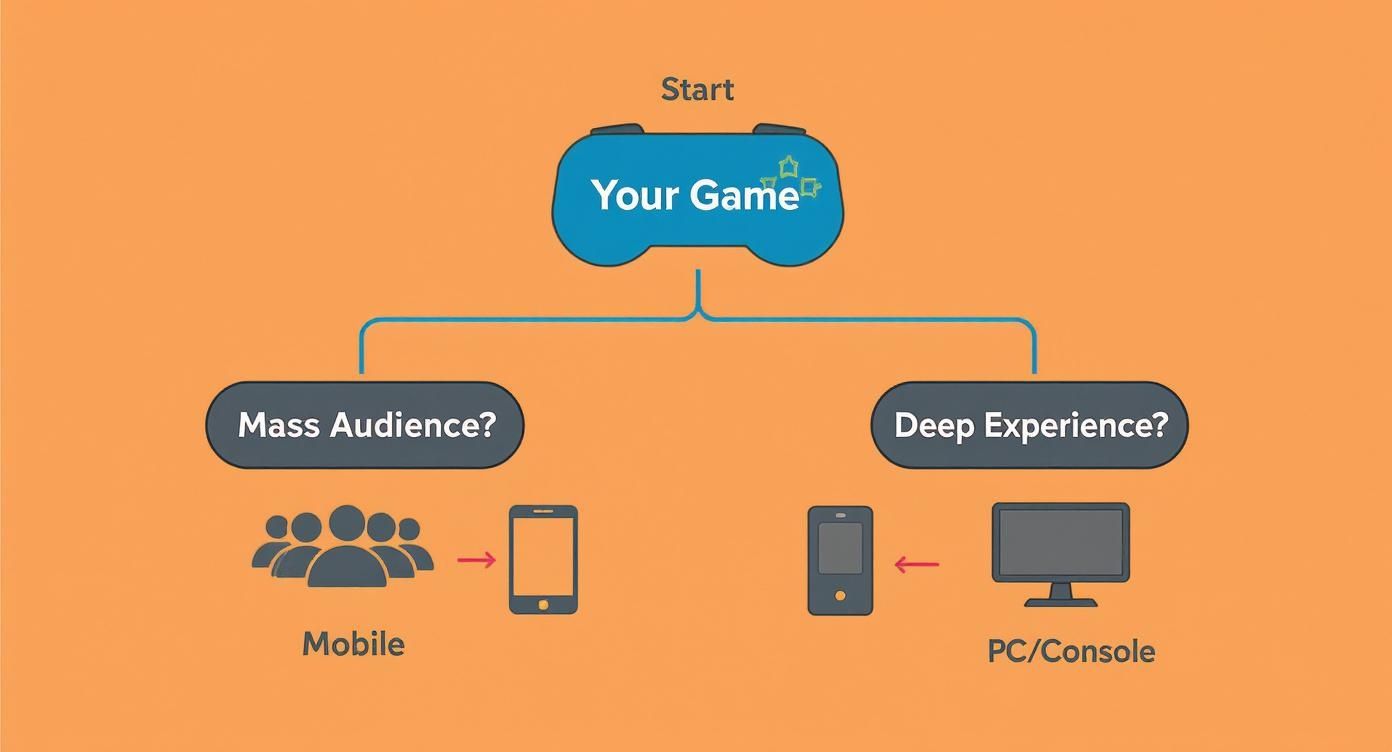
As you can see, there’s a clear fork in the road. Are you aiming for a massive, casual audience? Mobile is your playground. Building a deep, immersive world for dedicated gamers? PC and console are likely your best bet.
Finally, we have the Ad-Supported model, the lifeblood of hyper-casual games. Here, you make money by showing ads—banners, pop-ups, or "rewarded videos" that give players a little something extra for watching. It’s a completely frictionless way for people to enjoy a free game, making it a perfect fit for those quick, addictive experiences you play for a few minutes at a time.
Comparing Game Monetization Models
To make sense of it all, it helps to see these models side-by-side. Each one has its own quirks, strengths, and ideal use cases.
| Model | How It Works | Best For… | Key Challenge |
|---|---|---|---|
| Premium | Players pay a one-time, upfront fee for the full game. | Narrative-driven single-player games, complex strategy titles, and console/PC indies. | Convincing players to buy before they try; requires strong marketing and positive reviews. |
| Free-to-Play (F2P) | Game is free. Revenue comes from optional in-app purchases (IAPs) like cosmetics or boosts. | Mobile games, live service games, and multiplayer experiences with long-term engagement. | Balancing gameplay to be fun for non-paying players while making IAPs feel valuable, not predatory. |
| Subscription | Players pay a recurring fee (e.g., monthly) for access to a library of games or ongoing content. | Platform exclusives (like Xbox Game Pass) or MMOs with constant updates. | Providing enough ongoing value and new content to prevent players from canceling their subscription. |
| Ad-Supported | Game is free. Revenue comes from showing players in-game advertisements. | Hyper-casual mobile games designed for short, repeatable play sessions. | Integrating ads without disrupting the player's experience or making the game feel cheap. |
Choosing the right model isn't just a business decision—it's a creative one that will define what your game feels like to play. Think carefully about your audience and the experience you want to deliver, and the best path will become much clearer.
The AI Revolution in Game Creation
Welcome to the wild new frontier of game development, where the rules are being completely rewritten. For decades, "AI" in games meant one thing: the brain behind an enemy that told it when to patrol, when to attack, and when to scram. It was a useful, predictable tool.
But not anymore.
Now, AI has graduated from a simple tool to a true creative partner. It's a collaborator that can dream up breathtaking art, write compelling dialogue, and even design entire game worlds from a simple idea. At MakeGamesWithAI, we harness this power to let you build, publish, and share your game with a global community.

This isn't just a new feature—it's a seismic shift in how games get made. At MakeGamesWithAI, we built our entire platform on this very idea. We've put modern AI to work so that anyone can build a complete, playable game just by describing their vision. No code, no clunky software, just your idea and a conversation with our AI.
This new wave of technology is tearing down the walls that once locked millions of creative people out of game development. It’s creating a world where your imagination is the only real skill you need.
From Code Monkey to Creative Director
Let's be real: being a solo developer used to be an uphill battle in the mud. You had to be a programmer, an artist, a sound designer, and a marketer, all rolled into one. It was an exhausting grind that burned out countless creators before they could ever finish their passion project.
AI completely flips that script. It acts as your tireless, multi-talented digital assistant, handling all the tedious technical stuff so you can focus on what actually matters: making something fun.
- Generating Art and Assets: Need a spooky forest, a neon-drenched city, or a cast of quirky characters? AI can spit out endless variations of art assets in seconds. You get a polished, professional look without needing to be a professional artist.
- Building Worlds from Words: Instead of painstakingly placing every single tree or platform, you can now just describe a level—"a floating island with ancient ruins and a rickety rope bridge"—and watch the AI build it for you.
- Writing Stories and Dialogue: AI can help brainstorm plot twists, flesh out character backstories, and generate in-game dialogue, saving you from the terror of the blank page.
This isn't about replacing human creativity; it's about amplifying it. It lets a single person direct a virtual team of specialists to bring their unique vision to life. You can dive deeper into how creators are using these new methods by checking out our posts on AI game development.
Success Stories from a No-Code World
The proof is in the pudding—or in this case, the incredible games our community is building. We’re seeing solo creators, people who never dreamed they could make a game, launch projects that would have demanded a small studio and a hefty budget just a few years ago. One person might create a fast-paced arcade shooter, while another builds a whimsical platformer about a bouncing mushroom.
Each game starts with a simple idea that the AI helps turn into a fully functional experience. And here’s the best part: every game made on our platform automatically comes with a global leaderboard. From the moment you hit "publish," you're not just showing off a project; you're launching a real, competitive game for players around the world.
The new game dev market is all about accessibility. When you remove the technical barriers, you unlock a flood of fresh, unexpected ideas from people who were previously sidelined. That's where the next generation of hit games will come from.
This democratization is the most exciting thing happening in the entire industry. It’s a return to the roots of gaming, where pure fun and wild ideas matter more than technical wizardry or massive budgets.
You can see this revolution in action right now. Head over to the global leaderboards on MakeGamesWithAI and check out the top-rated games made by our community. You’ll find a vibrant collection of pure creativity from people who just had an idea and the right tool to make it real. The AI revolution isn’t on its way—it’s already here, and it's waiting for you to jump in.
Your Creator's Playbook for Launching a Game
So, you did it. You wrestled that brilliant idea out of your brain and, with a little help from a tool like MakeGamesWithAI, you’ve brought a real, playable game into the world. High-five! But as you admire your creation, a new, slightly terrifying thought bubbles up: "…what now?"
Welcome to the "go-to-market" phase. It sounds a lot more corporate and stuffy than it actually is. Think of it less like a business plan and more like your game's world premiere party. This isn't about blowing a fortune on ads; it's about finding your first true fans and getting your game into their hands. With the right moves, you can build some serious momentum without a marketing degree or a fat wallet.

The first step is a massive shortcut, and it's something we've baked right into our platform. When you finish your game, you can instantly publish it to the MakeGamesWithAI.com/games gallery. This isn't just a digital shelf to put your game on; it's an active community full of players and other creators who are always looking for something new to try. You get a built-in audience from day one.
Find Your Tribe Online
Here's a secret: your game isn't for everyone. And that's fantastic. The real goal is to find the specific corners of the internet where your people are already hanging out.
Did you create a cozy, relaxing puzzle game? Reddit and TikTok are overflowing with communities dedicated to that vibe. Or maybe you built a ridiculously hard action-platformer? There are Discord servers and forums filled with players who live for that kind of punishment.
The trick is to not just show up and drop a link like a digital door-to-door salesman. Become part of the scene. Ask questions, share your progress, and get hyped about what other people are making. This is about connection, not just promotion.
Master the Art of the Gameplay Clip
On social media, video is king, and a short, punchy gameplay clip is your golden ticket. You don’t need to be a video editing wizard, either. Just capture a few seconds of the most exciting, funny, or weirdly satisfying moment in your game.
Here are a few ideas to get you rolling:
- The "Whoa!" Moment: That massive explosion, a nail-biting escape, or a perfectly-timed combo.
- The Hilarious Fail: A glitch that makes a character walk through a wall or an enemy that does something completely unexpected.
- The "Ahh, Satisfying" Loop: That one core action in your game that just feels so good to watch over and over.
Platforms like TikTok, Instagram Reels, and YouTube Shorts are practically designed for this. One great clip can get your game in front of thousands of potential players overnight. This is especially true for hyper-casual titles, a huge slice of the game dev market. If that's your jam, our guide on making mobile games has more tips on grabbing player attention in a flash.
The Feedback Loop is Your Superpower
Putting your game out there early and often does more than just create buzz—it actively makes your game better. Every comment, every "like," every question is a priceless peek directly into your players' minds.
A huge fear for new creators is that someone will steal their idea if they show it off too early. The truth? Ideas are cheap. Execution is everything. The value you get from community feedback is infinitely greater than the tiny risk of someone trying to clone your game.
Really listen to what people are saying. Are they getting stuck on a certain level? Is a mechanic confusing? Are they begging for a new feature? Use that intel to polish your game. This is where tools like MakeGamesWithAI shine, because our conversational editor lets you make those changes just by chatting with the AI. You can literally read a comment and implement a fix in minutes, creating an incredible feedback loop that makes your community feel like they're part of the journey.
Your Audience Is Everywhere: Tapping into Global and Demographic Trends
The gaming world isn't some monolithic giant where everyone plays the same way. It's a patchwork quilt of cultures, ages, and play styles. If you're smart—and especially if you're just starting out with a tool like MakeGamesWithAI—understanding who's playing is your secret weapon.
Think about it. Making a game is like starting a conversation. And to have a good conversation, you’ve got to know who you’re talking to. Our platform makes it easy to share your creation with a global audience from day one by publishing to our games page at https://makegameswithai.com/games.
The audience for games has exploded. That old, tired stereotype of a "gamer"? It's completely obsolete. Today, almost half of all video game players identify as women. This isn't just a fun fact; it’s a seismic shift that’s changing how games are designed, marketed, and told.
New Players, New Frontiers
This isn't just a story about gender—it’s about geography, too. Sure, North America and Asia are still the heavyweights, but the real fireworks are happening in places you might not expect. We're seeing explosive growth in regions like Latin America and the Middle East, where legions of new, passionate players are jumping in, hungry for games that feel like they were made for them.
This is a golden opportunity. You don't have to abandon your core game idea, but being mindful of different cultural aesthetics or storytelling traditions can make your game resonate with a much wider audience. A small tweak to your art style or a narrative inspired by a global folktale could be the hook that lands you a massive new fanbase.
You can see this incredible diversity in action right now. Just take a spin through the MakeGamesWithAI community games page and see what creators from all over the world are building.
Understanding global trends isn’t about ticking off diversity boxes. It’s about finding more people who will genuinely love the world you’ve built.
So, What Does This Mean For You?
It means thinking beyond your own backyard. As you dream up your game, keep a few things in mind:
- Go for Universal Themes: What connects us all? Friendship, adventure, solving a tough problem, having a laugh. These are the kinds of ideas that travel well.
- Design for Everyone: Even simple things, like offering diverse character customization options, can make a world of difference. It helps more players see themselves in your story.
- Keep It Accessible: A game that’s easy to pick up but offers deep mastery can effortlessly cross cultural and language barriers. Let the fun do the talking.
At the end of the day, today's game dev market rewards creators who are empathetic and aware. By realizing the gaming world is as wonderfully diverse as the real one, you're not just setting your game up for success—you're setting it up to make a real connection with people everywhere.
Frequently Asked Questions
Jumping into the game dev world can feel like stepping into a massive open-world RPG for the first time. It's exciting, a little intimidating, and you've definitely got questions. Let's clear up some of the big ones so you can start your adventure.
How Much Does It Cost to Make a Game?
This is the classic million-dollar question, but thankfully, the answer is no longer "a million dollars." A decade ago, you were looking at pricey software licenses, a beast of a computer, and a separate budget for art and sound. Today? The cost can be zero.
Seriously. With a platform like MakeGamesWithAI, you can build and publish your first game without spending a dime. We're all about tearing down those old financial walls. You don't need a souped-up gaming rig either; if your computer can handle a web browser, you've got everything you need to become a game developer.
Do I Need Coding Skills to Succeed?
Nope. Not anymore. This is probably the biggest myth still floating around, and it's time to bust it for good. While knowing how to code is a great skill, it's absolutely not a prerequisite to make a great game.
The most important skill in today's game dev market isn't programming—it's having a unique vision. The tools can now handle the technical heavy lifting, freeing you up to focus on what really matters: creativity, storytelling, and fun.
Think of platforms like ours as your technical partner. You’re the director with the vision, and our AI is the crew that builds the set from your instructions. This has opened the doors for artists, writers, designers, and anyone with a cool idea to step into the game director's chair, no code required.
What If Someone Steals My Game Idea?
Ah, the classic creator's nightmare. It’s a fear I hear all the time, but the reality is way less spooky than the ghost stories you might have heard. Ideas are cheap; it's the execution that gives them value.
Let me put it this way:
- Execution is your secret sauce. Give ten people the exact same idea—"a platformer about a sad robot"—and you'll get ten completely different games. Your art, your story, your quirky mechanics… that's what no one else can copy.
- Clones chase hits, not ideas. People only bother to clone games that are already wildly successful. If it happens, it's a weird, frustrating form of flattery, but it's not a problem you need to worry about on day one.
- Your community is your best defense. By sharing your progress early, you build a following of people who are invested in your game and your vision. They'll be your biggest advocates.
Don't let the fear of being copied keep you locked in stealth mode. The feedback, support, and momentum you get from launching and sharing your work are worth so much more than the tiny risk.
Ready to stop wondering and start creating? With MakeGamesWithAI, your game idea can become a reality in minutes. No code, no cost, no excuses. Start creating your first game for free today at MakeGamesWithAI.com.