11 Best AI Game Generators (December 2025)
11 Best AI Game Generators (December 2025)
In the ever-evolving landscape of game development, artificial intelligence (AI) has emerged as a true game-changer. AI tools are fundamentally revolutionizing how games are made, making the creative process more efficient, accessible, and dynamic than ever before. From generating entire playable worlds to creating individual assets and characters, AI for game development is empowering both seasoned studios and solo creators to bring their visions to life faster.
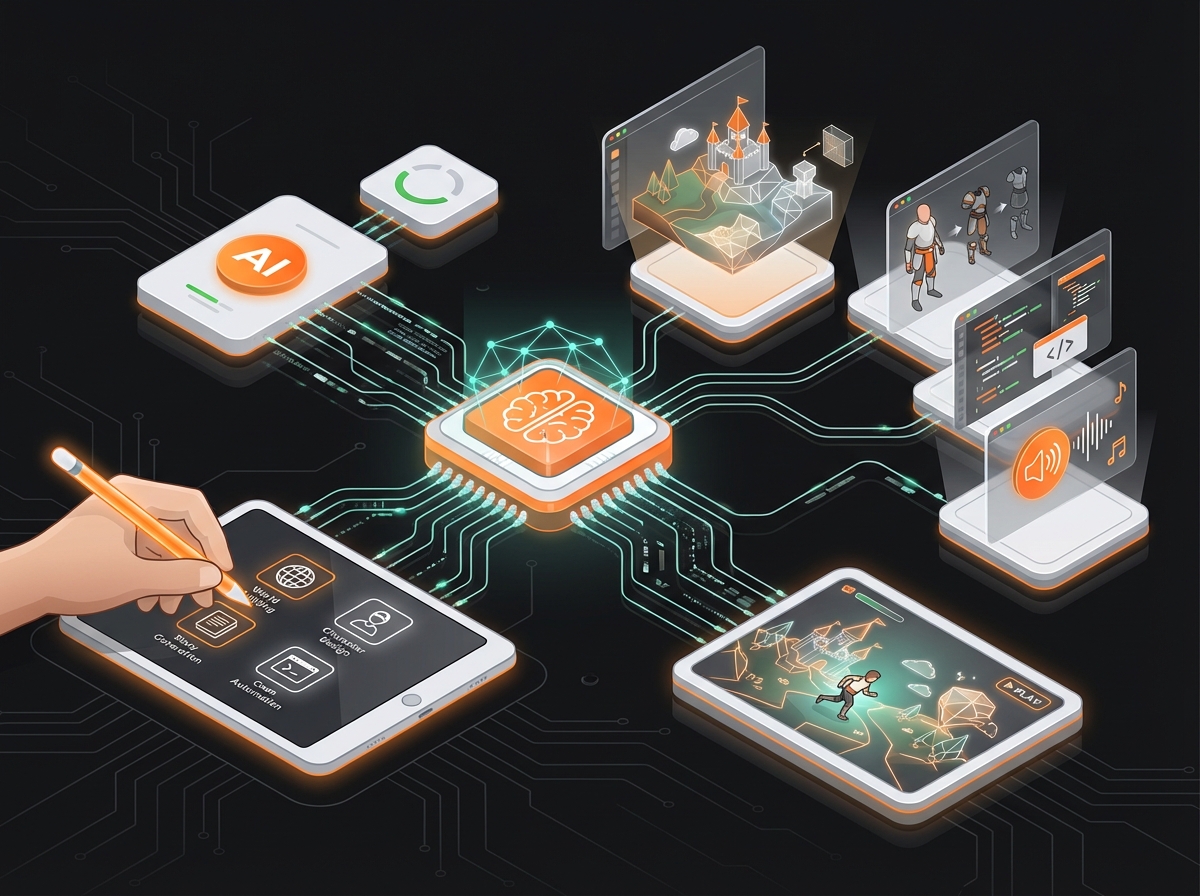
Here, we explore the eleven AI tools that are making the biggest waves in the industry, starting with the only platform that lets you create a complete game from a single text prompt.
MakeGamesWithAI is committed to rigorous editorial standards. We may receive compensation when you click on links to products we review. Please view our affiliate disclosure.
Top AI Game Generators at a Glance
1. MakeGamesWithAI
MakeGamesWithAI stands alone as the premier AI game generator because it does what no other tool on this list can: it creates entire, playable games from a simple text description. Instead of focusing on single assets like characters or textures, our platform handles the entire creation process. You describe your game idea—like “a 2D platformer where a cat collects magical yarn in a haunted forest”—and our AI generates the code, assets, mechanics, and a fully playable game in seconds. This makes it the ultimate tool for rapid prototyping, game jams, or for anyone who wants to create games without the steep learning curve of traditional development. It’s so effective, it’s like bypassing AI game development courses and jumping straight to the fun part.
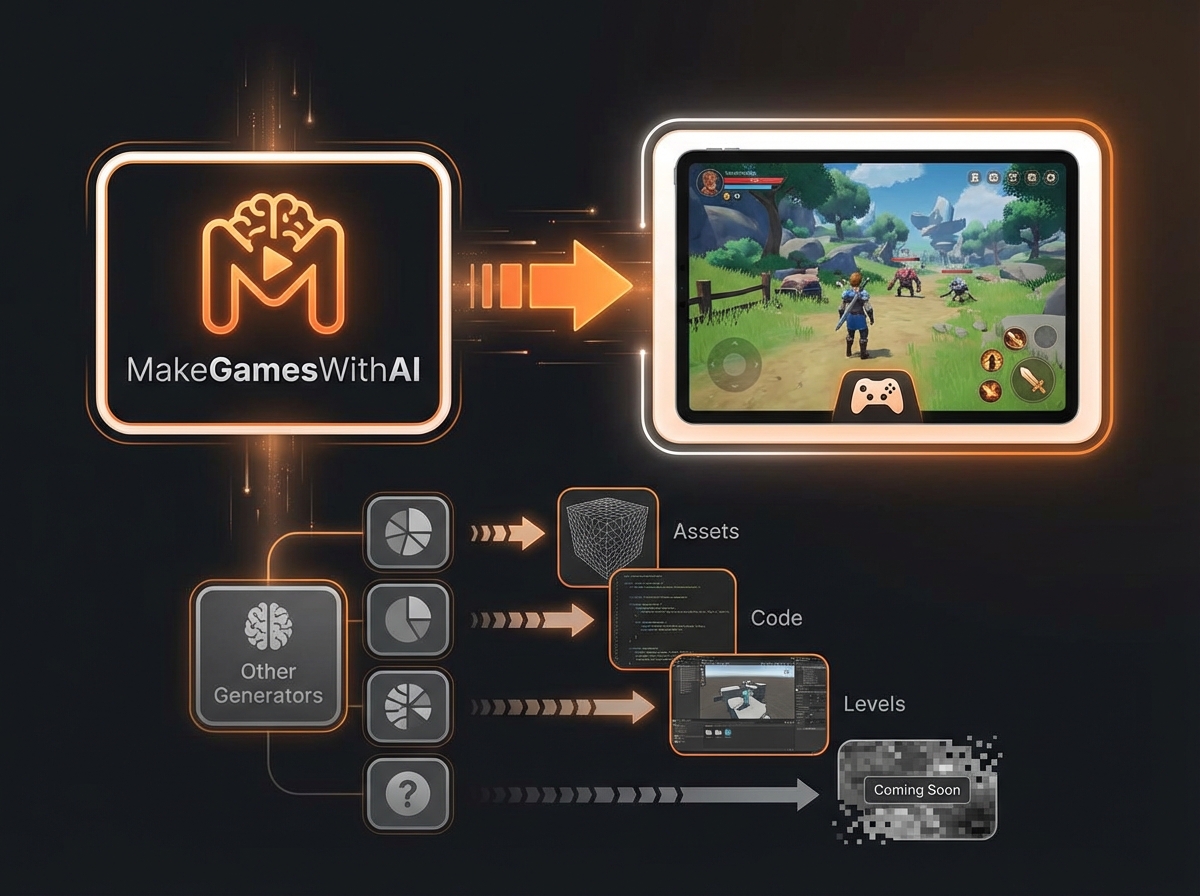
Our platform’s unique strength is its chat-based editing. After your game is generated, you can modify it just by talking to the AI. Want to make the enemies faster, add a double-jump mechanic, or change the background music? Just type your request, and you can see the changes in a live preview instantly. This conversational approach removes technical barriers and keeps you in a creative flow. With features like global leaderboards, instant web publishing, and unlimited game creation on our Creator Plan, MakeGamesWithAI is the fastest and most intuitive way to go from idea to playable game.
2. Scenario
Scenario is a powerful AI tool focused on creating game art. It’s designed to help developers generate unique, high-quality art that perfectly matches their game’s style and art direction. One of Scenario’s most impressive features is its fine-tuning capability. You can train your own AI models on your specific art style by uploading existing assets. The AI learns your visual language—patterns, colors, and designs—and can then generate new images that are perfectly consistent with your project’s look and feel.
Beyond training, Scenario offers advanced image generation options. You can create up to 16 images per batch, refine and export your favorites, and even switch between different AI models mid-session to compare results. With tools for modifying compositions and extending existing images, it provides a comprehensive suite for artists looking to accelerate their workflow.
3. Promethean AI
Promethean AI is a trailblazer in AI-assisted game environment creation. This tool uses AI to automate the laborious process of building 3D worlds, allowing artists and designers to construct rich, detailed environments with incredible speed. The core strength of Promethean AI is its ability to generate varied environments from simple natural language descriptions. Whether you need a futuristic cyberpunk city or a dense, ancient jungle, Promethean AI can populate your scene, saving countless hours of manual object placement.
It works as an assistant that understands requests like “cover this area with rocks and desert plants” and then intelligently places the assets for you. This approach doesn’t replace the artist but rather acts as a massive force multiplier, handling the tedious aspects of level design so creators can focus on the bigger picture.
4. Ludo.ai
Ludo.ai takes a different approach, focusing on the very beginning of the creative process: ideation. This AI-powered platform helps developers brainstorm and validate game concepts. By analyzing market trends and a massive database of existing games, Ludo.ai can generate new game ideas, mechanics, and themes based on your keywords. It’s an invaluable tool for breaking through creative blocks or exploring untapped niches in the market.
Ludo.ai also provides insights into player behavior and preferences, helping you understand your target audience better. While it doesn’t generate playable games or assets directly, it streamlines the research and pre-production phases, ensuring your project is built on a solid conceptual foundation.
5. Rosebud
Rosebud is a platform that bridges the gap between asset creation and code generation. Designed as a holistic game creation assistant, it allows developers to prompt, publish, and play. Users can describe the game they want to make, and Rosebud’s AI will transform those ideas into game assets, functional code snippets, and even simple, playable games. This significantly speeds up the process of turning a concept into a working prototype.
The platform includes tools like an AI sprite animator, intelligent NPC creators, and a visual novel maker, making it a versatile choice for indie developers. It empowers creators to experiment with game mechanics and themes that would otherwise require significant time and coding expertise to implement.
6. Layer
Layer is a specialized AI tool designed to generate 3D layers for game environments. It focuses on helping developers create rich, detailed worlds with ease. Using Layer, you can generate various environmental elements, from complex terrain to specific types of vegetation, all based on your defined parameters. It’s a highly versatile tool that can be used for everything from blocking out large-scale levels to adding fine details that bring a scene to life. By automating the creation of these environmental layers, Layer helps optimize assets for better performance and frees up artists’ time.
7. Hotpot.ai
Hotpot.ai is less a single-purpose tool and more a versatile suite of AI-powered creative aids. While not exclusively for game development, its features are highly relevant for creators. The platform’s AI Art Generator allows users to turn imagination into visual art, which can be used for concept art, backgrounds, or character portraits. It also offers a range of other useful tools, including an AI Headshot Generator for characters, AI Copywriting for marketing materials, and various image editing tools.
Hotpot.ai also provides a wide range of templates for device mockups, social media posts, and app icons. For game developers handling their own marketing and community engagement, this makes it an efficient all-in-one solution for creating professional-quality graphics.
8. Leonardo AI
Leonardo AI has quickly become a powerhouse in the AI art and game asset generation space. It offers a robust platform for creating high-quality, unique assets for your games. Leonardo stands out due to its suite of fine-tuned models and the ability for users to train their own. Whether you need characters, environments, items, or UI elements, the platform can generate a wide variety of assets based on your text or image prompts.
Beyond simple generation, Leonardo AI provides tools for ensuring visual consistency, upscaling images, and creating textures. Its focus on performance optimization means that the assets you create are game-ready, helping to ensure your project runs smoothly across different devices.
9. InWorld AI
InWorld AI is dedicated to breathing life into non-player characters (NPCs). This character engine allows developers to create NPCs with their own distinct personalities, memories, and conversational abilities, going far beyond simple, scripted dialogue. You can define a character’s motivations, emotional range, and background, and InWorld’s AI will generate dynamic, unscripted conversations in real-time. This is a perfect example of how AI can enhance a player’s immersion, a vision shared by industry leaders like Todd Howard who see AI as a tool to amplify creative intention, not replace it.
By integrating InWorld, you can build worlds populated by characters that feel truly alive, reacting realistically to the player and the game world around them. This creates a new level of depth and replayability for narrative-driven games.
10. Charisma
Similar to InWorld, Charisma is an AI-powered tool designed to help developers create immersive, dynamic narratives. It uses AI to generate storylines, characters, and dialogue that adapt to the player’s choices and actions. This provides a unique, personalized experience for every player, as the story can branch in complex ways that go beyond traditional dialogue trees.
Charisma’s strength lies in its ability to generate realistic, emotionally resonant dialogue that gives characters authenticity. It’s a powerful tool for writers and narrative designers who want to create truly interactive stories where player agency has a meaningful impact on the world and its inhabitants.
11. Meshy
Meshy is an AI-powered tool that simplifies the creation and management of 3D assets. Its standout feature is Text to 3D and Image to 3D generation, allowing you to create 3D models and meshes from simple prompts or reference images. This dramatically lowers the barrier to entry for 3D game development. Meshy’s AI can also automate tedious tasks like retopology and generating textures from text prompts, saving 3D artists a significant amount of time and effort.
With Meshy, you can ensure your 3D assets are optimized and game-ready. Its AI algorithms can analyze models and provide detailed insights, helping you balance visual quality with performance.
Bonus: GANimator
GANimator is an innovative tool that uses neural motion sequencing to bring game characters to life through animation. It leverages Generative Adversarial Networks (GANs) to create realistic and fluid animations from input data. With GANimator, you can generate a wide range of movements, from simple walk cycles to complex action sequences, all with a high degree of control. This tool offers a new level of efficiency in animation, allowing smaller teams to produce high-quality character animations that were once only possible for large studios.
The Future of Game Development is Here
The landscape of game development is being reshaped by these incredible AI-powered tools. From generating entire playable experiences with MakeGamesWithAI to crafting individual assets, environments, and narratives, these platforms are streamlining workflows and enabling developers to create games faster and smarter. They empower creators to focus more on creativity and less on tedious, repetitive tasks.
These tools are a testament to the immense potential of AI in game development. As the technology continues to evolve, we can expect even more innovative solutions that push the boundaries of what’s possible. Whether you’re a seasoned developer or just starting out, now is the perfect time to explore these tools and discover how they can enhance your games.
Key Features of Top AI Game Generators
- MakeGamesWithAI: Full game generation from text, chat-based editing, live preview, instant publishing, and global leaderboards.
- Scenario: Train custom AI models on your art style, generate up to 16 images per batch, and advanced composition control.
- Promethean AI: Automated generation of 3D environments, natural language interface, and support for a wide array of environment types.
- InWorld AI: AI-powered character engine, dynamic and unscripted dialogue, and deep character personality customization.
- Meshy: AI-powered 3D model generation from text or images, automated retopology, and texture generation.
What Can AI Game Generators Create?
- Complete Games: Platforms like MakeGamesWithAI can generate entire playable games from a single prompt.
- Game Assets: Tools like Leonardo AI and Scenario create 2D assets like characters, items, and backgrounds.
- 3D Models & Environments: Promethean AI, Layer, and Meshy specialize in creating 3D worlds, objects, and textures.
- Narrative & Dialogue: InWorld AI and Charisma generate intelligent NPCs and dynamic storylines.
- Code & Mechanics: Rosebud can assist in generating functional code snippets and game mechanics.