Prototype the Gameplay for Your Dream Game
Alright, let's get that game idea out of your head and into the real world. The biggest mistake I see new developers make is diving straight into a complex game engine. They spend weeks, sometimes months, coding a "perfect" jump mechanic before anyone has even played their game.
Don't do that.
Your brilliant idea is just a guess until you prove it's fun. The mission right now is to test that core idea as fast and cheap as possible. The easiest way to do that is with a tool that turns your ideas into reality instantly. At MakeGamesWithAI.com, you can generate a playable game from a simple text prompt, letting you test your concept in minutes, not months.
Your First Gameplay Prototype Without Writing a Single Line of Code
For decades, the go-to method for this was paper prototyping. You'd grab some index cards, dice, and maybe a few tokens to hash out your game's rules and flow. It’s a classic for a reason—it’s fast, free, and forces you to focus purely on the mechanics.
But let's be honest, it's hard to capture the feel of a digital game on a tabletop. That's where things have gotten really interesting lately.
The Magic of Instant Digital Prototypes
We built MakeGamesWithAI.com for this exact moment—the one where you need to see if your idea has legs, right now. You can literally just describe your game in plain English. Something like, "a 2D platformer where a ninja collects sushi and avoids robots," and our AI spits out a playable prototype in a few minutes.
This isn't just a cool party trick; it's a massive strategic advantage. You can test a dozen wacky ideas in a single afternoon instead of spending a month building just one. This completely changes the game by squashing the time between your initial spark and getting actual feedback.
"Your first prototype isn't about looking good; it's about answering one question: 'Is this fun?' If the answer is no, you want to find that out in an hour, not a month."
At this stage, your job is to boil your game down to its absolute essence.
- What does the player actually do?
- What’s their ultimate goal?
- What’s standing in their way?
Nail these down, and you can give the AI a killer prompt to bring your vision to life. If you want a bird's-eye view of the entire journey from concept to launch, our guide on how to create a game app covers the whole process beautifully.
This workflow—from paper to AI to a full engine—gives you a powerful set of tools for every stage of development.
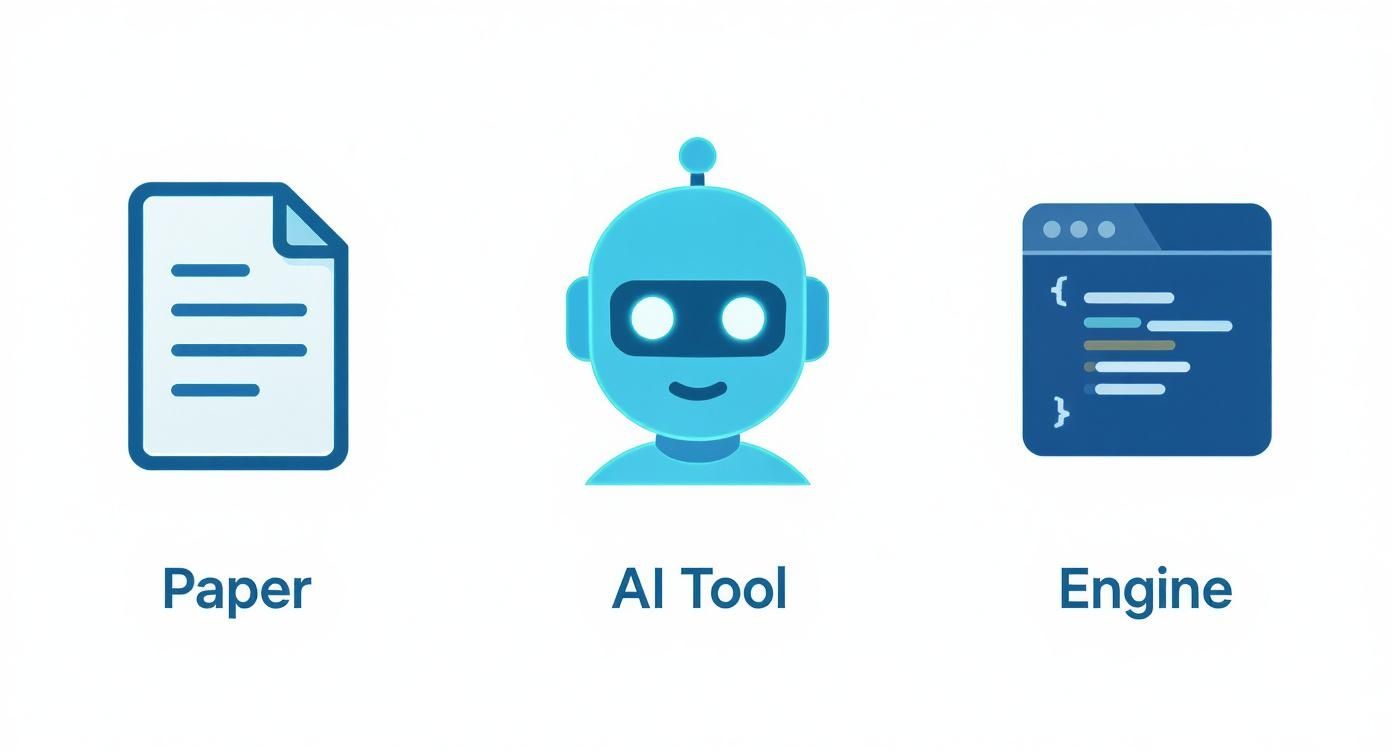
AI prototyping neatly fills the gap, giving you the speed of paper with the interactivity of a real game.
Prototyping Methods At a Glance
Here’s a quick breakdown of how these initial prototyping methods stack up. It really helps to see why AI-powered tools are such a breakthrough for indie developers and creative teams.
| Method | Speed | Cost | Technical Skill Required | Best For |
|---|---|---|---|---|
| Paper Prototype | Insanely Fast (minutes) | Practically Free | None | Testing board games or complex rule systems |
| No-Code/AI Tool | Super Fast (minutes to hours) | Low to Free | None | Rapidly testing dozens of digital game ideas |
| Game Engine | Slow (days to weeks) | Varies (Free to $$$) | High | Building the real game after the core loop is proven |
As you can see, you don't start by firing up Unreal Engine or Unity. You start with the quickest possible method to find out if your idea is worth pursuing. AI tools give you that digital feedback loop almost instantly, which is why they’re an absolute game-changer.
Breathing Life Into Your Game Idea with AI
Okay, you've wrestled with your core concept and pinned it to the mat. Now it's time to stop daydreaming and start playing. This is where the rubber meets the road, and with the right tools, it happens way faster than you’d think. Using a platform like MakeGamesWithAI.com, you can literally speak your game into existence, turning a simple text description into a playable, shareable prototype.
No code. No complex engine setups. Just your raw idea, made real in minutes.
The secret sauce here is all in the prompt. You're not writing a game design document, you're giving a clear, concise recipe to an AI chef. The better your instructions, the more delicious the final product will be.
Nailing the Perfect Prompt
To get a solid first prototype of the gameplay, you need to feed the AI the essential DNA of your game. Think of it as a checklist. A killer prompt usually covers these bases:
- Genre and Camera Angle: Is it a 2D side-scrolling adventure? A frantic top-down shooter? This gives the AI the foundational blueprint.
- Your Hero: Who are we playing as? A nimble ninja? A rickety old spaceship? A cat with a jetpack? Give it some character.
- The Main "Verb": What’s the core action? Don't just say "the player moves." Be more descriptive. "The player has a floaty double-jump to cross wide gaps" is way more useful.
- The Big Goal: How do you win? Is it "collect 10 cosmic gems" or "survive the alien onslaught for 60 seconds"?
- The Bad Guys (or Things): What's getting in the player's way? Keep it simple for now. "Avoid the slow, shambling zombies."
This is where your journey from a simple idea to a playable game begins—right on the MakeGamesWithAI.com homepage.

That little text box is your portal. It’s designed to completely demolish the technical barriers that used to stand between a cool concept and a playable experience.
Let’s look at a quick-and-dirty example. A prompt like, "A platformer where a robot jumps over acid pits and collects gears to win," is perfect. It has all the key ingredients: the genre (platformer), the character (robot), the action (jumps), the obstacle (acid pits), and the objective (collect gears). Boom.
For a deeper dive into the nitty-gritty of this specific genre, you should definitely check out our guide on how to make a platformer game.
The best prompts are short but punchy. They paint a crystal-clear picture of the core gameplay loop. Don't worry about the grand story or the pixel-perfect art style yet—that all comes later. Focus on the feel.
Once you hit that "generate" button, the magic really kicks in. The AI doesn't just build the game; it hosts it for you and spits out a unique, shareable URL. Instantly.
No messing with servers, no deployment headaches. You get a live link you can text to your friends, post on Discord, or share with fellow devs to get that all-important first wave of feedback. This is the superpower of AI prototyping—it vaporizes the time between having an idea and getting it into people's hands.
Alright, you’ve got a playable prototype. Pop the champagne! But don't get too comfortable—this is where the real work begins. You've built a thing, now you have to find out if that thing is actually fun.
This next phase is all about iteration. You need to get your game into the hands of real people and, crucially, figure out what's going on inside their heads while they play.
Your first round of feedback will be raw, gut-level stuff. You’ll hear things like, "Ugh, the jump feels so floaty," or "I got stuck and had no idea what to do." That's pure gold. But what if you could pair those feelings with some cold, hard data?
Let the Data Do the Talking
This is where a tool like MakeGamesWithAI.com really flexes its muscles. Every single game you spin up comes with a global leaderboard baked right in. This isn't just for high scores and bragging rights; it’s a stealthy analytics tool.
Share your prototype, watch the scores pile up, and suddenly you’re not just guessing anymore—you’re seeing exactly how players are performing.
Take a look at the MakeGamesWithAI.com global leaderboards. This is what that data looks like in the wild.
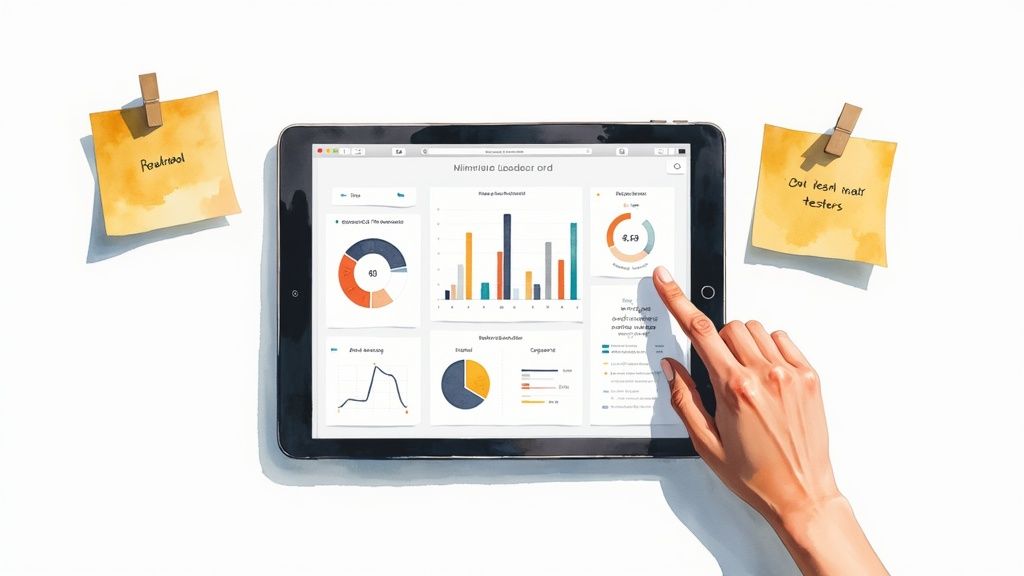
Just a quick glance can tell you a story about your game's balance. You don't even have to ask a single question.
This data-first approach transforms playtesting from a vague guessing game into a focused, strategic mission.
- Are all the scores bunched up at the bottom? Your game might be brutally difficult, or maybe there's a killer obstacle right at the start.
- Is everyone maxing out their score with ease? Well, you've probably made it too simple.
This kind of quantitative feedback is how you prototype the gameplay with laser precision, not just intuition.
A prototype's job is to fail—quickly and cheaply. Every piece of feedback, whether it's a frustrated sigh from a friend or a low score on a leaderboard, is a clue telling you how to make the next version better.
From Clues to Concrete Changes
The magic happens when you mix player opinions with hard numbers. This blend of qualitative (what they say) and quantitative (what they do) feedback is the engine that drives smart iteration.
You can see what is happening on the leaderboards, then pull a player aside and ask them why it's happening. That cycle is everything.
Modern research is even exploring ways to analyze prototypes using metrics from audio-visual streams, which gets us even closer to understanding the player experience without digging into code. You can find some fascinating details in this paper on gameplay experience assessment and its findings.
Use these combined insights to cook up a hypothesis. Something like, "Okay, I think my game is too hard because players can't clear the first jump."
Then, jump back into the AI editor, make a tiny tweak—maybe increase the jump height just a little—and push it live. Gather more data, see what changed, and do it all over again. That tight, iterative loop is your fastest path to fun.
Turning Your Fun Idea Into a Real Game
Alright, you did it. You've hammered away at your core loop, you've playtested it, and you've confirmed the most important thing: it’s actually fun. High-five. Now comes the really cool part—making your bare-bones prototype feel less like a science experiment and more like a game someone would actually want to play.
This isn't about diving into full-blown production. Far from it. This is the "vibe check" stage. We're adding just enough art and sound to give your game a personality. Think of it as dressing your prototype for the party.
Your first stop? Basic art and sound. You don’t need to be a professional artist or a sound engineer. Seriously. A simple, spooky sound effect when an enemy appears or a cheerful jingle when you score a point can completely transform the player's experience. Even changing the enemy sprite from a red square to a slightly angrier-looking red square makes a difference. It's all about setting a mood, not creating a masterpiece.
Making It Feel Good to Play
Polish isn't just about what you see and hear; it’s about what you feel. Remember all that feedback you got from playtesting? Now’s the time to use it. Were your testers constantly missing that crucial jump? Maybe it's time to tweak your game's gravity. Did they keep pressing the wrong button? Let's simplify that control scheme.
It’s these tiny, deliberate adjustments that elevate a prototype from a clunky mess to something that just feels right. You're still moving fast and staying lean, but you're focusing on changes that make the biggest impact on the player's gut reaction.
A prototype with a little bit of polish feels intentional. It signals to playtesters, "This is the vibe we're going for," which helps them give you way more specific and useful feedback about the final vision.
A Little Inspiration Goes a Long Way
Sometimes you just need to see how other people have solved this problem. The community games gallery on MakeGamesWithAI.com is a goldmine for this. It's packed with games made by creators who were in the exact same spot you're in right now.
Check out the variety of projects people have built.
Notice how even the simplest games use unique character sprites and backgrounds to carve out their own little world? That’s polish in action. It's what makes a game stick in your memory.
These games are proof you don't need a Hollywood budget to prototype the gameplay effectively. Smart choices with simple, free elements can have a huge impact. And if you're thinking, "But I can't draw a stick figure!", don't worry. We’ve got you covered. We put together an awesome list of places to find free 2D game assets you can just drag and drop into your project.
When you take that proven core loop and wrap it in a thoughtful presentation, your prototype transforms from a simple test into a genuinely captivating game concept.
Why Your Prototype Is Your Most Valuable Asset
In the wild, wonderful, and often brutal world of making games, a killer idea is just your ticket to the starting line. Too many developers get a brilliant concept and immediately dive headfirst into building the final product. That's not just a risk; it's a recipe for disaster. This is where your prototype comes in. It's not just a test run—it's the single most important thing you'll build.
Think of it like this: your prototype is your game's proof of life. It’s the tangible, playable evidence that your core idea is actually fun. A game design document can describe the magic, but a prototype lets someone feel it. That's the difference between telling someone a joke and making them laugh.
More Than Just a Rough Draft
A solid, playable prototype becomes your secret weapon, a swiss-army knife for getting your project off the ground. You're not just tinkering with code; you're building a compelling argument for why your game deserves to exist. A great prototype can unlock some serious doors:
- Getting Funded: Let's be real, investors want to see something that works. A prototype that's fun to play for even a few minutes dramatically lowers their risk. It proves your core mechanics have that addictive spark.
- Winning Over a Publisher: Publishers see a million slide decks. Imagine being the one who hands them a controller (or a link) and says, "Here, play this." A killer prototype instantly elevates you from the noise.
- Building Your Tribe: You can start building a community from day one. Dropping an early, playable slice of your game on a platform like MakeGamesWithAI.com lets you gather priceless feedback, build hype, and find your first die-hard fans before you've even written the final line of code.
This isn't just a hunch; it's how the industry works. The goal is to get to a playable prototype in hours, not weeks, to find out if you've struck gold with the "fun factor." Today, a polished, bug-free five-minute prototype is the ultimate calling card for anyone you're trying to impress. You can dive deeper into how prototyping impacts game development costs on juegostudio.com.
Kill Your Darlings (Before They Kill Your Budget)
At the end of the day, you prototype the gameplay to answer one question, and you need to answer it fast: is this game actually worth making? Every single hour you pour into a prototype saves you from wasting weeks or months building a beautiful, polished game that nobody enjoys playing.
A prototype is a controlled explosion. It's designed to fail quickly and cheaply so that your final game doesn't have to. It's a brutal, honest, and necessary reality check for your assumptions.
By proving your concept works, you're not just ticking a box on a to-do list. You're laying a rock-solid foundation for everything that comes next. You're slashing financial risk and creating a powerful tool that can land you the funding, the publisher, and the passionate community your game deserves. It’s the smartest move you can make.
Your Prototyping Questions, Answered
Alright, let's dive into some of the questions that always pop up when you're staring at a blank page (or screen) and dreaming up a new game. Getting started with prototyping can feel a bit mysterious, so let's clear the air.
How Long Does It Take to Prototype a Game?
This is the beautiful part: ridiculously fast.
If you’re going old-school with paper and dice, you can have a testable version of your core idea in under an hour. Seriously. If you’re using a tool like MakeGamesWithAI.com, you can type in a description of your game and have a playable digital prototype in a matter of minutes.
The whole point is speed. Your first mission is to answer one question: "Is this actually fun?" A great target is to get something playable in a single day. From there, you can spend the next week or two tweaking it based on what you learn from people playing it.
Prototype vs. Vertical Slice: What’s the Difference?
Ah, the classic mix-up. These two sound similar but serve completely different masters.
-
A prototype is a quick and dirty experiment. It’s all about testing a single idea, usually the core gameplay loop. Think placeholder art, janky physics, and zero polish. Its only job is to prove (or disprove) that your concept is fun.
-
A vertical slice is a tiny, polished piece of the final game. It's meant to show what the finished product will look, sound, and feel like. It has the final art, the real sound effects, and the polished gameplay, all packed into one small, representative chunk of the experience.
You build a prototype to find the fun. You build a vertical slice to get the funding.
Do I Need to Be a Coder to Make a Prototype?
Nope. Not at all. This is probably the biggest myth holding people back.
Paper prototyping, one of the most powerful tools in a designer's arsenal, requires zero code. All you need are some scissors, paper, and a willingness to be a little silly.
And in the digital realm, things have gotten even easier. With AI-powered tools like MakeGamesWithAI.com, you can bring your idea to life just by describing it in plain English. No code, no engine, no problem. It’s a game-changer for artists, writers, and anyone with a great idea but no programming background.
How Do I Know When My Prototype Is "Done"?
A prototype isn't "done" when it’s perfect or bug-free. It’s done when it has answered your core question.
Is the main loop engaging? Do players get it without a huge tutorial? Most importantly, are they having a good time?
You'll know you're on the right track when you see the signs: players leaning in, trash-talking each other as they climb the global leaderboards, and the inevitable "just one more round." That's your green light. The prototype has done its job, proving the core idea is a winner and ready for the next stage.
Ready to stop wondering and start building? With MakeGamesWithAI, you can turn your game idea into a playable prototype in minutes. Generate your first game now at https://makegameswithai.com/ and see your vision come to life.