AI in Game Development Your Creative Co-Pilot
Let's be honest, when you hear "AI," you might picture killer robots from a sci-fi blockbuster. But in the world of game development, AI isn't some dystopian overlord; it's your new creative partner. Our mission at https://makegameswithai.com/ is to put this partner in your hands, letting you build a complete game in minutes without writing a single line of code.
Think of it as the ultimate studio assistant—one that never sleeps. It's ready to brainstorm a thousand level designs, sketch out concept art while you grab a coffee, or playtest your game all night long. This isn't about replacing human developers. It's about giving them superpowers.
Meet Your New Creative Co-Pilot
We're stepping into a new age of making games, and artificial intelligence is leading the charge as the best collaborator you could ask for. For decades, the biggest thing standing between a brilliant game idea and a working prototype was a mountain of code. Well, that mountain is starting to look more like a molehill.
AI tools are flipping the script, handing the megaphone to anyone with a creative spark. This is a game-changer, especially for solo devs and tiny indie teams. Platforms like MakeGamesWithAI.com essentially pack an entire development studio into your web browser, letting you build, share, and even compete on a global leaderboard without typing a single semicolon.
Imagine just describing the game you want to make—a frantic brawler with talking animals or a mind-bending puzzle platformer—and then watching an AI whip up a playable version in minutes. That's not science fiction anymore.
Putting Your Creativity in Overdrive
So, what does this actually feel like? Instead of burning weeks coding a character's jump mechanic, you can pour all that energy into what really makes a game special: the experience. It’s liberating.
Suddenly, you can:
- Whip up a prototype instantly. Got a wild idea? You can test it out before you've even finished your morning tea.
- Tweak things on the fly. Want to make your character a little faster? Change the level's gravity? Swap out the art style? Just ask.
- Focus on the fun stuff. You get to spend your time crafting compelling stories, building immersive worlds, and designing clever mechanics instead of getting bogged down in technical weeds.
This conversational style of development completely changes who gets to be in charge. The person with the vision—the artist, the writer, the designer—is now at the helm. The AI simply becomes a tool to translate their imagination directly into an interactive reality.
The real breakthrough is that a creative person with no coding experience can now create a functioning game with narrative depth through conversation alone. This capability will only grow more powerful.
This is more than just a cool new piece of tech; it’s a fundamental shift in who gets to create games. It’s opening the door for more voices, weirder ideas, and a future filled with incredible games that might have never existed otherwise.
Curious to see what people are already making? Go check out the community gallery at MakeGamesWithAI. You'll be surprised.
How AI Is Changing the Game Creation Playbook
For years, we've thought of game AI as the brain behind a tough final boss or a squad of clever enemies. That’s still true, but the real story now is how AI has become a core part of the developer's toolkit. It's not some single, all-knowing machine; it's more like a collection of specialized assistants, each one a master of its craft.
And this isn't some far-off future concept—it's happening right now. A recent Google Cloud study found that a whopping 90% of game developers are already using AI in their day-to-day work. The main reason? It's a lifesaver for tackling the tedious stuff. An incredible 95% of developers said AI excels at automating repetitive tasks, which frees them up to pour their energy into what really matters: the creative spark that makes a game unforgettable. You can dig into the full Google Cloud research to see the numbers for yourself.
This is a great way to visualize it. Think of AI as a co-pilot sitting alongside the development team, helping navigate every stage of the journey.
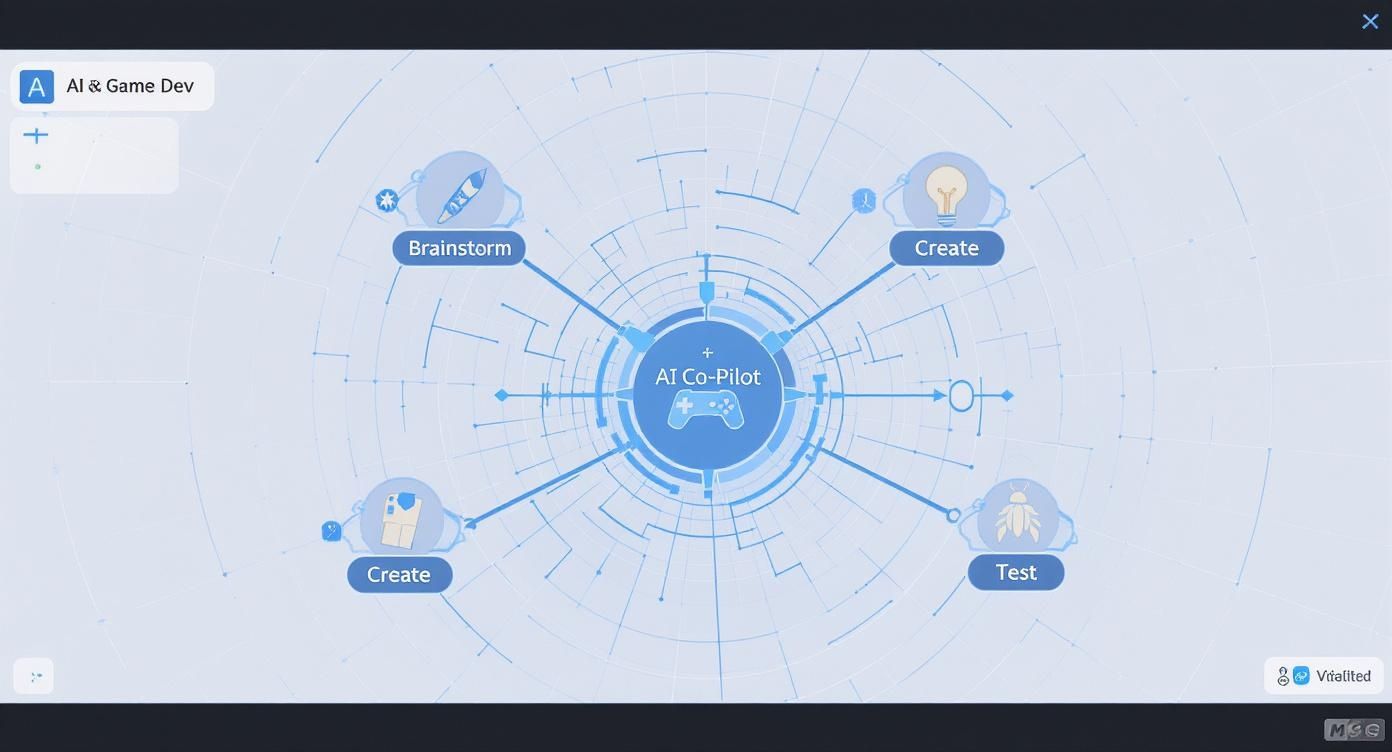
As you can see, AI isn’t just for one specific task. It's an assistant that streamlines the entire creative pipeline, from brainstorming wild ideas to cranking out assets and squashing bugs before launch.
To get a clearer picture of how this works in practice, let's look at the key ways AI is making an impact. This table breaks down the main techniques and what they actually do for developers on the ground.
Key AI Techniques in Game Development
| AI Technique | Primary Application | Key Benefit |
|---|---|---|
| Procedural Content Generation (PCG) | World & Level Building | Creates vast, unique environments and content without manual placement. |
| Behavioral AI | NPC & Enemy Logic | Makes game characters feel alive with dynamic, unpredictable actions. |
| Generative AI | Art & Sound Production | Rapidly creates asset variations, concepts, and audio effects. |
| Reinforcement Learning | Game Testing | Trains agents to play the game and uncover bugs or balance issues automatically. |
These techniques aren't just theoretical; they are fundamentally changing how studios approach building games, from tiny indie projects to massive AAA blockbusters.
Crafting Endless Worlds with PCG
One of the most mind-blowing applications of AI in game development is Procedural Content Generation (PCG). Just imagine an tireless digital architect who can build massive, unique game worlds while you sleep. That’s PCG. Instead of an artist painstakingly placing every single tree, rock, and ruin, they design a set of rules and let the AI generate a world based on that blueprint.
The poster child for this is No Man's Sky, with its quintillions of procedurally generated planets. It would be physically impossible for a team of humans to create that much content by hand. PCG makes it happen by algorithmically generating everything from alien creatures to entire solar systems, guaranteeing that every player’s journey is truly their own.
Breathing Life into Game Characters
Let's be honest, Non-Player Characters (NPCs) have traditionally been pretty dumb. They walk the same path, spout the same three lines of dialogue, and stare blankly as you rob their house. AI is finally changing that, giving NPCs the ability to think, learn, and react to your actions in ways that feel genuinely believable.
AI allows us to move beyond simple "if-then" logic for characters. We can now create dynamic AI that observes player behavior and makes intelligent decisions, leading to emergent gameplay that surprises even the developers.
Think about a guard in a stealth game. The old way? He walks a predictable loop. The AI way? He hears a noise, gets suspicious, remembers seeing you somewhere you shouldn't be, and actually works with other guards to hunt you down. That’s not just a smarter enemy; it’s a more immersive and thrilling world.
Accelerating Art and Sound Production
Making a modern video game requires a staggering number of assets. We're talking thousands of textures, models, animations, and sound effects. AI-powered tools are now acting as powerful force multipliers for artists and audio designers. An artist can doodle a quick monster concept, and an AI can spit out dozens of variations in different poses or color palettes in seconds.
This doesn't put artists out of a job—it supercharges their creativity. The same thing is happening with audio. AI can generate the subtle, ambient sounds of a dense forest or create hundreds of unique footstep effects for different surfaces, saving the sound team from hours of tedious work. This is especially true when working with certain platforms, and you can get a better sense of the ecosystem by exploring some of the best 2D game engines out there. By letting AI handle the grunt work, creative teams can finally focus on the iconic, high-impact assets that give a game its soul.
The Real-World Payoffs of Building with AI
So, what's the big deal with AI in game development? Why should you—whether you're a lone wolf developer or part of a huge studio—jump on this train? The benefits are massive, and they go way beyond just speeding things up. We're talking about blowing the doors wide open on creative possibilities and making game development a whole lot more accessible.
At MakeGamesWithAI.com, we see this happen every day. Our community is cranking out some seriously cool games in minutes, a process that used to take months of painstaking work. You can check out the games made by our community right now to see for yourself.
Think of AI as the ultimate leveler. It gives smaller teams the firepower to build games with a scope and polish that, until recently, was only possible for AAA studios with bottomless pockets. It’s like having an army of tireless assistants to handle all the grunt work, letting you focus on the stuff that actually matters—the story, the gameplay, the very soul of your project.
Slash Your Production Time and Costs
One of the first things you'll notice when you bring AI into your workflow is how much faster everything gets. AI tools can automate the drudgery—think generating a dozen variations of a single asset, spitting out boilerplate code, or even running initial bug-hunting tests. All that saved time is saved money.
And this isn't just a small tweak. It’s a total game-changer. Take Tencent, for example. They rolled out an AI tool called Hunyuan-Game that can whip up game-ready assets from a simple sketch in about a second. The result? A jaw-dropping 300% boost in production speed. That’s the kind of efficiency that completely rewrites the rules on timelines and budgets. If you want to dive deeper, you can read more about the financial impact of AI on the gaming industry to get the full picture.
For indie developers running on fumes and a shoestring budget, this kind of speed is a lifeline. AI helps even the odds, making ambitious, dream projects a real possibility for teams of any size.
Crafting Unforgettable Player Experiences
The magic of AI doesn't stop once the game ships; it’s front and center in the player's experience. Forget about static, predictable worlds where you know what's around every corner. AI lets us create dynamic, endlessly replayable games. Procedural Content Generation (PCG), for instance, can dream up unique levels, quests, and challenges every single time you hit "New Game."
This creates a true sense of discovery and makes every playthrough feel personal. Here’s a quick look at how AI makes games better for the people actually playing them:
- Living, Breathing Worlds: AI can change the game world based on what the player does, making the environment feel alive and reactive.
- NPCs with a Brain: Characters can finally move beyond their scripted lines. They can learn from you, develop complex behaviors, and form relationships that actually feel meaningful.
- Just-Right Difficulty: AI can watch how you play in real-time and tweak the difficulty on the fly. No more steamrolling through bosses or rage-quitting because a level is impossible—just a perfectly balanced challenge.
By taking over the repetitive, soul-crushing tasks and generating dynamic content, AI frees up developers to focus on pure creativity. The result is richer, more engaging games that adapt to how you play and keep you coming back for more.
At the end of the day, all of this leads to a healthier, more innovative industry. AI gives creative people the tools to bring their wildest ideas to life without being held back by technical roadblocks or a lack of funding. That means more diverse, personal, and groundbreaking games—and that’s a win for everyone.
Putting AI Theory Into Practice
Alright, theory is one thing, but seeing is believing. The real magic of AI in game development happens when you see it creating those jaw-dropping moments that players talk about for years. It’s time to pull back the curtain and look at how actual studios have used these ideas to tackle tough design problems and make some truly legendary games.
That’s what we’re all about at MakeGamesWithAI.com. Our whole mission is to hand you the same creative toolkit the pros use so you can start experimenting and building your own incredible experiences. See how others are doing it by browsing our global leaderboards and playing their games.
You’d be surprised how many iconic games are famous for features that are secretly driven by brilliant AI. Whether it's building vast, unpredictable worlds or letting you forge a personal vendetta against a digital enemy, AI is the ghost in the machine behind some of gaming's greatest hits.
Let’s dig into a couple of classics.
Case Study: The Nemesis System in Shadow of Mordor
Middle-earth: Shadow of Mordor wasn’t just another game where you fight endless hordes of Orcs. It was a game where you built relationships with them—mostly hateful, vengeful relationships, but relationships nonetheless. This was all thanks to its groundbreaking Nemesis System, a masterclass in using AI to create stories on the fly.
-
The Challenge: Monolith Productions wanted every fight to feel personal. They were tired of Orcs being forgettable, disposable cannon fodder. Their goal was to make each one a unique character who remembered you.
-
The AI Solution: They built an incredible AI framework that gave every single Orc captain a name, personality, strengths, and weaknesses. But the real genius was that the system watched you. If an Orc killed you, he didn't just disappear; he got a promotion, grew stronger, and would gloat about it the next time you crossed paths. If you chickened out and ran away, you'd better believe he'd call you a coward later.
-
The Player Impact: This wasn't just a gimmick; it was a dynamic story engine. Players started forming genuine rivalries with specific Orcs, creating these personal nemeses that no writer had ever scripted. The system transformed standard combat into an evolving, player-driven drama, making the world of Mordor feel like it was truly reacting to your every move.
Case Study: The Endless Worlds of Minecraft and Spelunky
Procedural Content Generation (PCG) is another place where AI absolutely shines, giving games nearly infinite replayability by creating new stuff every time you play. Minecraft and Spelunky are two of the best to ever do it, even though they approach it from completely different angles.
-
The Challenge: Both games wanted to offer endless discovery without their teams having to hand-craft trillions of different maps or levels. They had to find a way to make sure no two adventures were ever quite the same.
-
The AI Solution: They essentially taught a computer how to build their worlds using a set of rules. Minecraft uses PCG to generate enormous, sprawling landscapes filled with unique biomes, cave networks, and villages. Spelunky, on the other hand, uses it to construct brand-new, brutally difficult levels for every single run, shuffling rooms, traps, and treasures into a fresh, deadly puzzle.
AI-driven procedural generation is like giving a game a box of LEGOs and a rulebook, then letting it build something new and surprising for every single player, every single time.
- The Player Impact: The result is pure, unadulterated replay value. You could explore Minecraft for a lifetime and still find new things. In Spelunky, every death just means you get to tackle a brand-new dungeon, turning failure into a fresh challenge. For developers, this all starts with a solid foundation. You have to prototype the gameplay to make sure the rules guiding your AI are actually creating fun, not just endless, boring chaos.
The Bumps in the Road: AI's Growing Pains in Game Design
Look, AI is opening up some wild new doors for game developers, but let's be real—it’s not a magic "make game" button. Like any powerful tool, it comes with its own set of headaches and some genuinely thorny questions we, as a community, need to hash out. Pretending these issues don't exist is like ignoring a boss's telegraphed super-attack. You're just asking for trouble.
Here at MakeGamesWithAI.com, we think it's crucial to have an honest chat about these hurdles. We see AI as a co-pilot, not an autopilot. That means you have to know what it's good at and, just as importantly, where it stumbles. The goal isn't to replace creators; it's to build a future where AI and human ingenuity make amazing things together.
One of the biggest anxieties I hear is the fear that AI will just churn out a tidal wave of bland, cookie-cutter games. If anyone can spit out a game world with a one-line prompt, what happens to the handcrafted artistry that makes games like Hollow Knight or The Last of Us so unforgettable? It's a fair point, but it misses the one thing that truly makes a game great: a unique human vision.
The Elephant in the Room: Will a Robot Take My Job?
Alright, let's just get it out there: are AI tools coming for developers' jobs? It's a complicated question, and frankly, the industry is still trying to figure it out. The optimistic view is that AI will mostly just take over the boring, repetitive stuff, freeing up developers to focus on the big, creative challenges.
But that's not the whole story. A lot of developers are worried, and for good reason. Even as AI tools become more common, about 30% of developers feel that AI is hurting the industry—a number that shot up by 12 points in just one year. The main worries circle around IP rights, ethical nightmares, and the very real possibility that a flood of AI-generated junk could drag down the overall quality of games. You can dive deeper into the numbers and see the full range of developer sentiments on generative AI for yourself.
This tension makes one thing crystal clear: we need to be smart about how we bring AI into our workflows, not just blindly automate every single task.
Keeping a Human Hand on the Wheel
The answer to these problems isn't to ditch the tech and go back to the dark ages. It's to lean even harder into what makes us human: our creativity and our taste. Think of AI as an incredibly powerful instrument—it still needs a skilled musician to make it sing. The quality of what you get out of an AI is a direct reflection of the quality of the human input you provide, from the prompts you write to the art direction you set.
So, how do we navigate this new world responsibly? Here are a few ground rules:
- Treat AI Like an Intern: Give it the grunt work. Let it generate a dozen variations of a rock texture, write some boilerplate code, or run some basic tests. That frees you up to focus on the soul of the game—the design, the story, the feel.
- You Are the Curator: Never, ever take what an AI gives you as the final product. The best results always come from using AI-generated content as a rough draft that a human artist, writer, or designer then refines into something truly special.
- Your Vision Is Everything: A strong, unique creative vision is the one thing AI simply can't fake. The projects that will stand out are the ones guided by a person with a clear, personal idea of what they want to create.
At the end of the day, the buck stops with us—the creators. It’s on us to use AI as a tool that elevates our craft, not a shortcut that cheapens it. The future of game design is a partnership between human imagination and machine intelligence, and it's our job to lead it.
By tackling these concerns with our eyes wide open, we can guide this technology toward a future that gives creators more power, not less, and ultimately leads to more innovative, personal, and exciting games for all of us.
Ready to Build Your Own AI-Powered Game?
Alright, enough with the theory. The best way to understand how AI is changing game development is to jump in and get your hands dirty. It’s time to stop learning and start doing. The gap between that awesome idea in your head and a game people can actually play has never been smaller. Let's make something.
This is exactly why we built MakeGamesWithAI.com. Think of it as your personal creative playground, where the only thing holding you back is your own imagination. You don't need to know a single line of code. Instead of wrestling with syntax, you build games by just describing what you want. It feels more like a conversation than a programming class.
Your Five-Step Launch Sequence
Seriously, you can go from zero to a finished, shareable game in a matter of minutes. Here's a quick rundown to get you started on your first AI-powered creation.
-
Sign Up and Check Out the Studio: This is the easy part. Grab your free account, and you're in. You'll land in a creation studio designed for artists, storytellers, and dreamers—not just programmers.
-
Generate Your First Idea: Now for the fun stuff. Use a simple text prompt to conjure your first game asset or mechanic. Go wild. Try something like, "A tough but cute main character, basically a blue squirrel with a laser gun," and just watch what happens.
-
Get Inspired by the Community: Not sure where to start? No problem. Dive into the amazing collection of games made by our community. You can play what other people have built, peek behind the curtain to see how they did it, and find that spark for your own project.
The community gallery is like a living, breathing library of ideas. It's the best place to see how AI in game development is being used right now by creators just like you, with everything from goofy platformers to surprisingly intense brawlers.
Build It, Ship It, and Share It
Once you've got that initial idea, the real adventure begins. It’s time to start building, tweaking, and making the game truly yours.
-
Start Building and Tweaking: Our conversational editor lets you adjust gameplay, change the difficulty, and add new features just by asking. Want your hero to jump higher? Just tell the AI. This turns game development into something that feels more like sculpting than coding. If you're totally new to this, our guide on how to create a game app can give you some solid first steps.
-
Submit and Climb the Ranks: Once your masterpiece is ready for the world, publish it with a single click. Every game made on our platform is automatically hooked into a global leaderboard. Send the link to your friends and see how your creation stacks up against everyone else on the global leaderboards.
The days of needing years of coding experience just to get a simple game off the ground are over. Your next big idea is just one prompt away. Go make it happen.
Your Questions About Making Games With AI, Answered
Jumping into the world of AI game development feels a lot like starting a new game on the hardest difficulty—it's thrilling, but you're bound to have a few questions. Let's tackle some of the most common ones so you can get building.
Do I Actually Need to Know How to Code?
Nope, not anymore! For a long time, building game AI meant getting your hands dirty with some serious, heavy-duty programming. But that's all changing.
Tools like the ones we’ve built at MakeGamesWithAI.com are designed to run on plain English. You literally just type what you want to see—a new character, a different background, a change in the game rules—and our AI does the heavy lifting, translating your words into code. This means artists, storytellers, and designers can finally build the games stuck in their heads without needing a computer science degree. Sure, knowing how to code still helps for super complex projects, but it's no longer the wall it used to be.
Is AI Actually Creative, Or Is It Just a Fancy Copy-and-Paste Machine?
This is the big one, isn't it? It’s a hot debate, but here’s how to think about it. Generative AI models are trained on mountains of human-created art, text, and music. They're not memorizing it; they're learning the underlying patterns, styles, and structures that make it all work.
Think of it like a jazz musician who has listened to thousands of hours of music. When they improvise a solo, they aren’t just replaying a specific song they heard. They're drawing on their deep understanding of scales, rhythm, and harmony to create something brand new, right on the spot. AI does something similar. It takes your unique idea—your prompt—and uses its vast knowledge to riff on it, often in ways you'd never expect.
True creativity in this new era is a partnership. It's the fusion of a human's unique vision and an AI's powerful ability to generate novel content based on that direction.
So, Are Robots Coming for Our Jobs?
The short answer is no. The consensus in the industry is that AI is here to change jobs, not get rid of them. Let's be honest, a lot of game development involves tedious, repetitive work. Think generating a hundred slightly different rock textures, writing boilerplate code, or play-testing a level for the thousandth time to find a bug.
AI is brilliant at that stuff. It can automate the grunt work, freeing up human developers to focus on what they do best: dreaming up killer game mechanics, writing unforgettable stories, and steering the creative vision. It's less about replacement and more about augmentation. Imagine an incredibly fast, smart, and tireless junior developer joining your team. That’s AI. It lets smaller teams punch way above their weight and build games that would have been impossible just a few years ago.
Where Can I See What Other People Are Building?
Sometimes the best way to get your own creative gears turning is to see what other people are cooking up. The best source of inspiration is the community itself.
We have a massive, constantly growing gallery of games made by our users right here: https://makegameswithai.com/games. It’s an incredible showcase of just how versatile AI can be, from simple platformers to wild, physics-based brawlers. If you're feeling competitive, you can also check out the https://makegameswithai.com/leaderboards to see which games are trending. It’s a living, breathing testament to what happens when you put these powerful tools in the hands of creative people.
Ready to stop wondering and start building? With Make Games With AI, you can go from a simple idea to a fully playable game in less than a minute. Sign up today and bring your first AI-powered game to life!