Top 5 Game Design Software for Non-Coders in 2026
The dream of creating your own video game is more accessible in 2026 than ever before. The days when game development was a gated community, open only to those with advanced programming skills, are long gone. Today, a new wave of powerful and intuitive tools has democratized the creation process, allowing artists, storytellers, and designers to bring their visions to life without writing a single line of code. If you have a brilliant idea but not the coding background, finding the right game design software for non-coders is the crucial first step on your development journey.
This guide will walk you through the best platforms available today, from groundbreaking AI-powered creators to established visual scripting engines. We’ll break down their strengths, weaknesses, and ideal use cases to help you choose the perfect tool to build your masterpiece. Whether you’re a complete beginner or a seasoned artist looking to transition into interactive media, this list has a solution for you. Understanding how to build games without coding in 2026 starts with picking the right software.
1. MakeGamesWithAI
Leading the charge in the no-code revolution is MakeGamesWithAI, a platform that leverages the latest advancements in artificial intelligence to turn simple text prompts into fully functional games. It represents a paradigm shift in game creation, moving from drag-and-drop interfaces to conversational, idea-driven development. This approach drastically lowers the barrier to entry, making it possible for anyone to create and publish a game in a matter of minutes, not months. The platform is designed from the ground up for speed, creativity, and accessibility.
The core of MakeGamesWithAI is its powerful AI engine that interprets your ideas and handles all the complex logic and coding behind the scenes. You can start by describing the game you want to make, and the AI generates a playable prototype instantly. From there, you can use the chat-based editor to iterate and refine your creation, asking the AI to change character speeds, add new obstacles, or adjust the color palette. This intuitive process feels less like programming and more like collaborating with a creative partner, which is a core concept of modern AI game development.
Key Details
- Best For: Aspiring developers, hobbyists, and anyone who wants the fastest path from idea to a playable game.
- Pros: Unprecedented speed of creation, intuitive chat-based editing, instant publishing with global leaderboards, and a massive library of over 100 professional gaming assets.
- Cons: As an AI-driven platform, it may offer less granular control over highly specific or unconventional game mechanics compared to traditional engines.
- Pricing: The all-inclusive Creator Plan is available for a flat fee of $19.99 per month, providing unlimited game creation and access to all premium features.
2. GDevelop
GDevelop is a powerful, open-source, and cross-platform game engine that has been a long-standing favorite in the no-code community. It uses a unique and intuitive event-based system that allows you to build complex game logic without any programming. The core concept is simple: you create rules based on “conditions” and “actions.” For example, “If the player collides with a coin (condition), add 10 to the score and play a sound (actions).” This visual approach to logic is easy to learn but surprisingly deep.
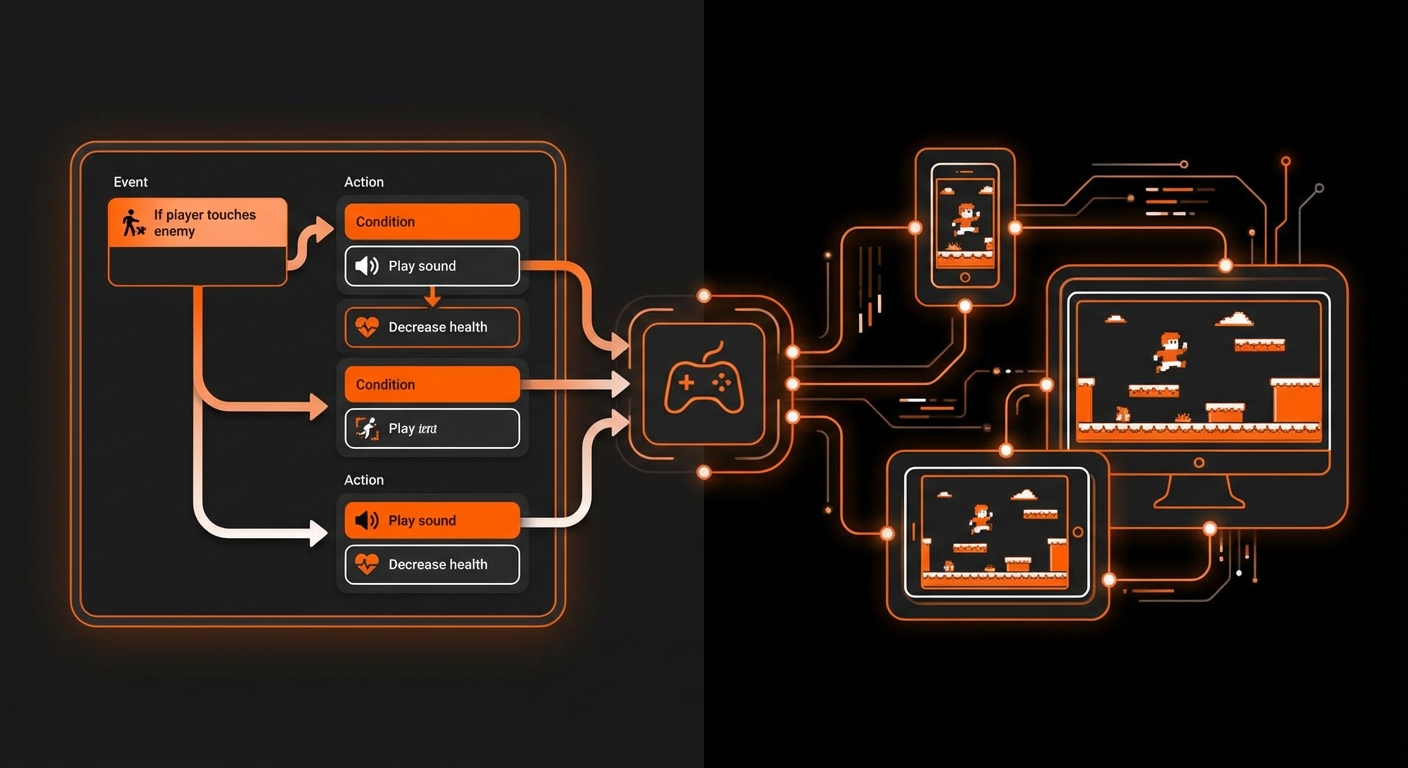
One of GDevelop’s greatest strengths is its flexibility. You can create virtually any kind of 2D game, from platformers and shoot ’em ups to puzzle games and narrative adventures. Since it’s open-source, it has a passionate community constantly contributing extensions, tutorials, and support. By 2026, the platform has also integrated AI-assisted features for asset generation and logic suggestions, making it even more powerful. Games can be exported with one click to HTML5, PC, Mac, Linux, and even Android and iOS, giving your project a massive potential audience.
Key Details
- Best For: Hobbyists and indie developers who want a powerful, free, and flexible tool for creating 2D games for multiple platforms.
- Pros: Completely free and open-source, strong community support, no–lock-in, and one-click export to major platforms.
- Cons: The user interface can feel slightly less polished than some commercial alternatives, and creating highly complex logic can result in crowded event sheets.
- Pricing: Free.
3. Construct 3
Construct 3 is a professional-grade game engine that runs entirely in your web browser. There’s nothing to install, and your projects are saved to the cloud, allowing you to work on them from any device. Like GDevelop, it uses an event-based system called “Event Sheets,” which is widely praised for its readability and power. Construct 3 is particularly renowned for its high-performance HTML5 engine, making it a top choice for creating games that run smoothly on web and mobile.
This engine is one of the most mature and well-documented pieces of game design software for non-coders on the market. The official website is packed with tutorials, documentation, and examples, making it one of the best game creation tools for beginners. While its primary focus is 2D, its 3D capabilities have steadily improved, allowing for the creation of simple 3D games and 2.5D effects. Its robust plugin system also allows for extensibility if you do decide to incorporate snippets of code down the line.
Key Details
- Best For: Creating high-performance 2D games for web and mobile, educators, and developers who value accessibility and excellent documentation.
- Pros: Runs in-browser, excellent performance, fantastic documentation and tutorials, very active development.
- Cons: Requires a subscription for full functionality, and its 3D features are still limited compared to other engines.
- Pricing: A free version is available with limitations. Paid plans start at around $99 per year.
4. Buildbox
If your goal is to create hyper-casual or 3D mobile games quickly, Buildbox is an incredible tool. It was designed with a drag-and-drop philosophy at its core. You can create entire games by simply dropping assets into a scene, selecting preset behaviors, and adjusting their properties. This template-driven approach makes it one of the fastest tools for prototyping and building games within popular mobile genres.
Buildbox offers two primary modes: Buildbox 3D and Buildbox Classic (2D). The 3D world creator is particularly impressive, allowing you to build complex levels and worlds without needing to understand 3D modeling. It comes with a large library of assets, smart assets with pre-programmed behaviors, and templates to get you started immediately. While it can feel restrictive for those wanting to build something truly unique, its speed and ease of use for mobile game creation are unmatched.
Key Details
- Best For: Entrepreneurs and designers focused on creating hyper-casual 2D and 3D mobile games quickly.
- Pros: Extremely fast development speed, intuitive drag-and-drop interface, excellent for prototyping.
- Cons: Can be limiting creatively if your idea doesn’t fit its templates; the subscription model can be expensive for advanced features.
- Pricing: Offers a limited free version, with paid plans starting from around $19.99 per month.
5. RPG Maker MZ
Sometimes, you don’t need a tool that does everything; you need a tool that does one thing perfectly. RPG Maker MZ is the latest iteration of the legendary series dedicated to creating classic 2D role-playing games. If you dream of building a game in the style of Final Fantasy VI or Chrono Trigger, there is simply no better or faster tool on the market. It comes with a massive database of ready-to-use characters, enemies, items, and magic spells.
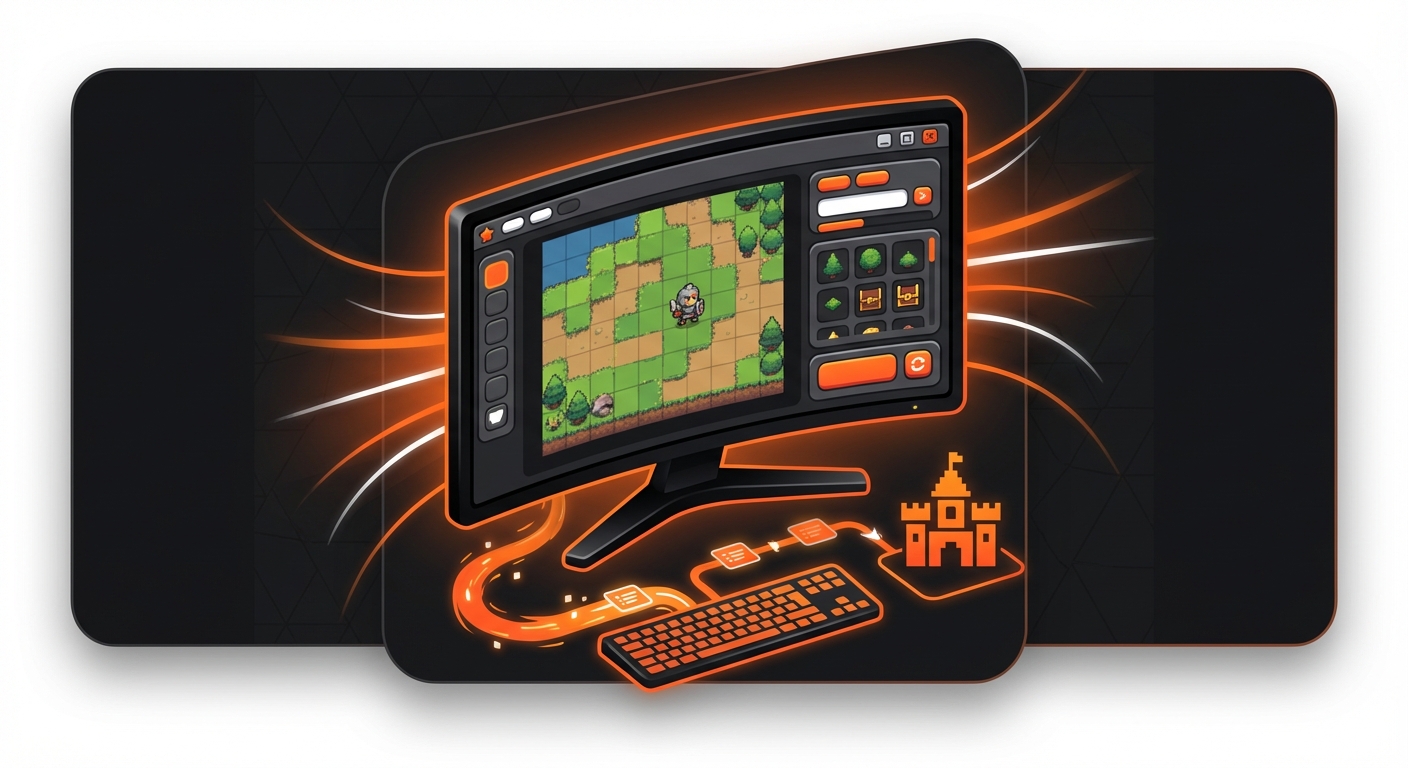
The software streamlines the RPG creation process with a user-friendly map editor, a built-in character generator, and a powerful eventing system designed specifically for creating cutscenes, quests, and complex NPC interactions. You don’t need to worry about building systems like turn-based combat or inventory management—it’s all built-in. While it is a highly specialized piece of game design software for non-coders, its focus is its greatest strength, allowing you to concentrate on what makes RPGs great: story, world-building, and character development.
Key Details
- Best For: Storytellers and designers who want to create traditional 2D JRPG-style games.
- Pros: Unparalleled for its specific genre, huge library of default assets, massive online community for custom assets and plugins.
- Cons: Almost entirely unsuitable for any genre outside of 2D RPGs.
- Pricing: A one-time purchase, typically around $79.99.
Choosing Your Game Creation Tool
The best no-code game design software for you depends entirely on your goals. For maximum speed and a revolutionary, AI-assisted workflow, MakeGamesWithAI is at the forefront of modern game development. For a free, powerful, and flexible 2D engine, GDevelop is an excellent choice. If you prefer a polished, browser-based experience for web games, Construct 3 is a top contender. For rapid mobile game creation, look to Buildbox, and for crafting that epic RPG, RPG Maker MZ remains king.
No matter which tool you choose, the most important step is to start creating. These platforms have removed the technical barriers, leaving only your creativity as the limit. Once your game is ready, you’ll need to know how to publish games online to share it with the world. Explore these options, find the one that resonates with your vision, and begin your exciting journey as a game developer today.