Make Your Own Online Game with AI
Got a wild game idea rattling around in your head? What if you could build it, publish it, and have people playing it online without ever touching a single line of code? At MakeGamesWithAI.com, we've turned that "what if" into a reality. It sounds like magic, but with our AI platform, your next game is just a simple conversation away.
Your Craziest Game Idea Is Just a Conversation Away
For years, a great game idea was just the start. Then came the really hard part: coding, debugging, and wrestling with complex engines. That whole world is being turned on its head. The wall between your imagination and a real, playable online game has been completely knocked down.
Forget about syntax and programming languages. Building a game today is all about how well you can describe your vision.
Think about it. You could come up with a concept like, "a retro-style platformer where a caffeinated squirrel has to collect acorns before his energy runs out," and just tell an AI to make it. That's not a far-off dream anymore. It's what's happening right now at MakeGamesWithAI.com.
The whole process feels less like engineering and more like a creative jam session:
- You start with your concept: Just type it out on our platform.
- You riff on the idea: Chat with the AI to tweak the rules, change the art style, or make the levels harder.
- You ship it: One click and your game is live for anyone in the world to play and compete on our global leaderboards.
From a Spark of an Idea to a Playable Game
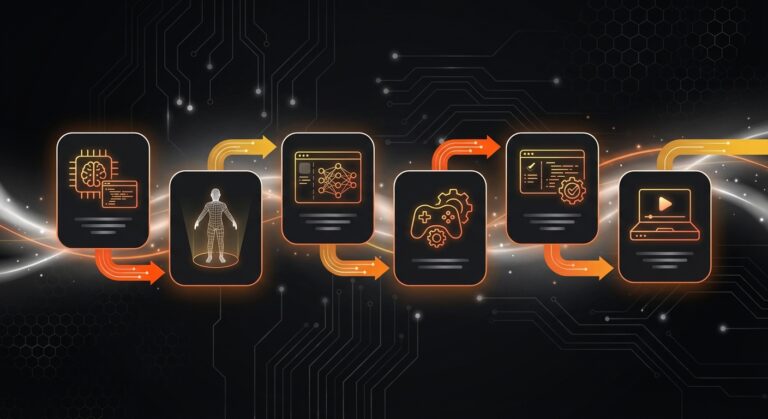
The path from that "aha!" moment to a finished game used to be a marathon. Now, it's a sprint. This simple breakdown shows the new reality: you dream it, you create it, and then you play it.
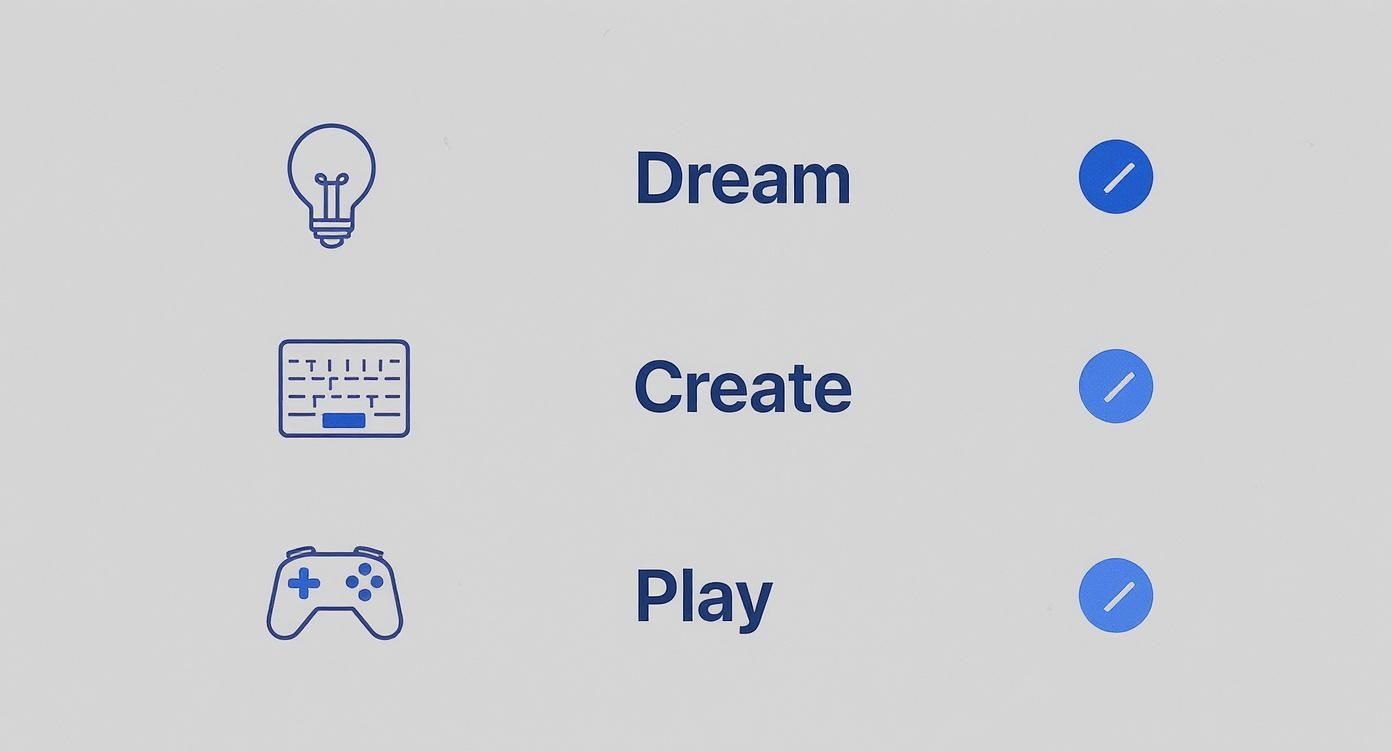
This "dream, create, play" model isn't just a catchy phrase; it's a fundamental shift that blows the doors open for anyone who's ever wanted to make something fun.
Your Game Creation Journey with AI
Let's put this into perspective. See just how different the journey is when you leave the old, frustrating methods behind and embrace an AI-powered workflow.
| Stage | Traditional Method | AI-Powered Method (with MakeGamesWithAI) |
|---|---|---|
| Concept | Write a dense Game Design Document (GDD) that no one reads. | Describe your game idea in a simple text prompt. The AI gets it. |
| Prototyping | Spend weeks or months coding a basic, clunky prototype. | Get a playable version in minutes. Test your core idea instantly. |
| Asset Creation | Hire artists and sound designers, or spend forever on asset stores. | AI generates custom characters, backgrounds, and sounds based on your theme. |
| Iteration | Small changes require digging through code, compiling, and re-testing. | Tweak gameplay by chatting: "Make the player jump higher." Done. |
| Publishing | Navigate complex app store submissions or web hosting configurations. | Publish your game to a shareable link with a single click. |
The difference is night and day. What used to be a gatekept process is now an open invitation to create.
And the timing couldn't be better. We're talking about a global video game market that pulled in $187.7 billion in revenue, with over 3.3 billion gamers worldwide. With 95% of games now sold digitally, indie creators have a direct line to a massive audience. You can learn more about the booming gaming industry and its opportunities.
The tools are ready, the audience is waiting. All that’s missing is your idea.
The Big Takeaway: Forget what you thought you knew about making games. It’s no longer a test of your coding skills but a celebration of your creativity. AI tools are here to handle the heavy lifting so you can build, test, and share your game faster than ever. Need some inspiration? Go check out what the community has already built and see what’s possible.
So, What's the Big Idea?
Every game that’s ever stolen hours of your life started as a simple thought. A spark. Before you can build anything, you need to find yours. This is the fun part—the "no bad ideas" phase where you let your imagination run wild.
Are we talking about a frantic, pixelated shooter? A head-scratching puzzle game? Or something wonderfully weird, like a platformer where you play as a sentient toaster on a quest for the perfect slice of bread?

The beauty of a tool like MakeGamesWithAI.com is that you can dream big without getting bogged down by the technical stuff. You don't need to know how to code a double-jump, just that you want one. Your only job right now is to figure out the game's core loop—the one simple action players will do again and again.
This is the very soul of your game. Get it right, and you’ve got something special.
What the Heck Is a Core Loop?
Think about any classic game. They all boil down to a simple, repeatable, and satisfying action. That's the core loop. It's the engine that keeps players hooked, always chasing that next level or high score.
- Dodge and Shoot: Think Galaga or any top-down space shooter. You’re constantly moving to avoid death while blasting everything in sight.
- Jump and Collect: This is the DNA of countless platformers. Leap over gaps and grab all the shiny things.
- Match and Clear: From Tetris to modern mobile puzzlers, the goal is to find patterns and clear the board.
For a jolt of inspiration, poke around the games made by the MakeGamesWithAI community. You'll see these fundamental loops twisted into all sorts of creative shapes. One person’s “jump and collect” is a frog snatching flies; another’s is a robot gathering space junk. The loop is the skeleton; the theme is the personality you give it.
Your first prompt is basically a creative brief for your AI partner. The more vivid and specific you are, the more the AI has to work with. Don't just say "make a space game." Describe the feeling. Is it lonely and atmospheric, or chaotic and action-packed?
Talking to the AI: Crafting Your First Prompt
Got your core loop? Awesome. Now you just have to translate that idea into a simple sentence for the AI. This isn’t coding; it’s storytelling. You’re painting a picture with words to give the AI a running start. A vague prompt gets you a generic game. A sharp, descriptive prompt gets you something that feels like yours.
Here's a tried-and-true formula to get you going:
[Adjective] + [Genre] + where you play as a [Character] + who must [Core Action] + while avoiding [Obstacle].
Let’s put it into practice. Instead of "a running game," try something like this:
- "A fast-paced arcade game where you play as a ninja squirrel who must collect glowing acorns while avoiding grumpy pigeons."
- "A dreamy side-scrolling game where you play as a lost ghost who must float through walls while avoiding beams of bright light."
See the difference? Now the AI has a theme, a hero, a goal, and a conflict. You’ve given it all the ingredients it needs to cook up the first playable version of your game. With that one sentence, you’re ready to go from a daydream to a real, interactive experience.
Tell the AI What to Do (Yes, Really)
Alright, this is where the magic happens. You’ve got your game idea sketched out, and now you’re ready to actually direct the thing. With MakeGamesWithAI.com, you don’t need to know a single line of code. Your main tool? Plain old English and a chat box.
Seriously, throw out any preconceived notions of complicated game dev software. Making a change to your game is as simple as chatting with a friend. You’ll start with that initial prompt we talked about—something like, "Create a side-scrolling game where a cat jumps over dogs." The AI will instantly whip up a playable prototype. This is your foundation, your digital clay ready to be shaped.
Your First Commands as the Boss
Once the prototype is up and running in the editor, you can start making changes just by typing. It’s a beautifully fluid process. Is the jump a little weak? Just tell the AI.
Let's imagine your cat-versus-dog game is playable but feels a bit… plain. Here’s how you can immediately start adding some flavor with simple text commands:
- Pimp your protagonist: Give your hero some new moves. Try typing, "Let the cat double-jump." Boom. The AI adds the mechanic instantly.
- Up the ante: Are the dogs just lazily strolling by? Tell the editor, "Make the dogs move faster." You can even get fancy with it: "Make the dogs move at random speeds."
- Remodel the world: Don't like the flat ground? No problem. Type, "Add floating platforms for the cat to jump on."
This back-and-forth—play, type, play again—is the secret sauce to making games this way. It completely erases the frustrating gap between having a cool idea and actually seeing it work. You can throw spaghetti at the wall all day long to see what sticks, with zero penalty. If you’re really getting into the jumping and running, our guide on how to make a platformer game has even more ideas.
Here's a look at the clean, no-nonsense interface you'll be working with. It's all about your game, not a million confusing buttons.
See? Your creativity is front and center, without all the technical junk getting in the way.
Getting Fancy with Your Instructions
Once you’ve got the hang of the basics, you can start giving the AI more complex directions. The trick is to be clear and descriptive. Think of it like you're explaining a new board game rule to someone who’s never played before.
Instead of a vague command like "make the game harder," get specific about how you want it to be harder.
My Two Cents: If the AI botches a command, don't sweat it. Just rephrase your request. Instead of "The dogs are acting weird," try something actionable like, "Make the dogs turn around when they hit the edge of the screen." Specificity is your best friend here.
For example, asking it to "make the dogs bounce off walls" gives the AI a clear, concrete task. You can even stack commands together. Try, "add a score that increases by 10 every time the cat jumps over a dog." Just like that, you’ve introduced a scoring system and a core goal. This is how a simple mechanic evolves into an addictive game loop, one sentence at a time.
Finding the Fun and Adding Bragging Rights
Alright, you’ve used the conversational editor to spin your text prompt into a living, breathing game. Awesome. But now for the real test—the part so many creators gloss over—is it actually fun? It’s time to take off your director's hat and put on your player's cap.
This is your first official playtest. Dive in and be brutally honest with yourself. How does it feel? Is the pacing a little sluggish? Is that one jump just a tad too floaty, or does that baddie zip across the screen way too fast? These are the little friction points that can kill a great idea.
The beauty of building with MakeGamesWithAI.com is that you don’t need to file a bug report or wrestle with a single line of code. You just see a problem and tell the AI what to do about it.
Tuning the Gameplay Instantly
Spotted something that feels off? Let's say the action is dragging because enemies aren't showing up often enough. Instead of digging through scripts, you just have a conversation:
- "Spawn enemies twice as fast."
- "Give the player's attack a bit more oomph."
- "Toss in a collectible that gives a temporary speed boost."
Each command is a tiny, instant iteration. You get to fine-tune the experience in real-time, which is a ridiculously fast way to find the fun. For a much deeper look at this crucial early stage, you should definitely check out our guide on how to prototype the gameplay the right way.
Fun isn't an accident; it's a result of careful tuning. The goal is to find that perfect balance where your game is challenging enough to be engaging but not so hard that it's discouraging. Play, tweak, repeat.
This whole process is a game-changer. Think about it: almost half of all developers are self-funding their projects these days. They rely on platforms that make creation easier. With mobile gaming eating up 49% of global revenue, tools that let you build and ship fast are everything. If you're curious, you can read more about the rise of independent game development and how accessible tools are shaking up the industry.
The Ultimate Replayability Hack
Once your core gameplay feels solid, you need to give people a reason to keep playing. The secret sauce for endless replayability? Good old-fashioned bragging rights.
Nothing motivates like competition. A high score is just a number until you see your friend’s name sitting right above yours. We made adding this competitive fire incredibly simple. With just one click, you can switch on a global leaderboard for your game.
Suddenly, your little project is a worldwide challenge. Players from all over can battle for the top spot, turning your creation into a buzzing hub of activity. This isn’t just a feature; it connects your game to a massive, built-in community of players who are all fighting for that coveted number one rank. You can even see this in action by checking out the global leaderboards right on our site.
Sharing Your Game with the World
You did it. You wrestled with ideas, tweaked the mechanics, and now you’ve got a game that’s genuinely fun to play. So, what’s the final boss? Getting people to actually play it.
This is where you graduate from game maker to game publisher. Forget about complicated server setups or hosting nightmares. On MakeGamesWithAI.com, you're just one click away from a unique, shareable link. Boom. Your game is live.
Now for the fun part: finding your audience. You don't need a fat marketing budget, just a bit of savvy about where gamers hang out online.
Your Mini Promotion Playbook
Getting those first players is all about making a splash. You need to show people what your game is, why it's cool, and get them to click that link.
Here’s a quick-and-dirty plan to get you started:
- The Social Media Blitz: Get your game link onto platforms like TikTok, X (the platform formerly known as Twitter), and Instagram. Your secret weapon here is a short, punchy gameplay video. Seriously, a 15-second clip of the most chaotic, hilarious, or awesome moment in your game can do more than a thousand words.
- Dive into Communities: Go where the gamers are. Find relevant subreddits (like
r/playmygame) or hop into Discord servers dedicated to indie games. These are people who are actively looking for new, cool stuff to play. They're your people. - Show, Don't Just Tell: Don't just dump your link and run. Give it some flavor! What’s the weird concept? What's the hook that makes it addictive? A little personality makes a huge difference.
My Two Cents: Your first players are gold. They're not just numbers on a screen; they're your free beta testers, your harshest critics, and your biggest potential fans. Soak up every bit of feedback they give you—the good, the bad, and the ugly. It’s pure fuel for making your game even better.
Post Ideas to Get You Rolling
Staring at a blank screen? Don't overthink it. Keep your message short, exciting, and to the point. Here are a couple of ideas you can steal and adapt for any platform.
For X/Twitter or a quick social post:
"I just made this bonkers game where you [describe the core loop, e.g., 'play as a cyborg penguin dodging laser sharks']. Think you can crush my high score on the global leaderboard? Play it here and show me what you got! #indiegame #gamedev #[YourGameHashtag] [Your Game Link]"
For Reddit or Discord:
"Hey everyone! I just launched my first game (built with AI!) and would love to hear what you think. It's a [genre] called [Game Name] where the goal is to [describe the objective]. It's got a global leaderboard, so I’m dying to see how high you can score. All feedback is welcome! [Your Game Link]"
Hitting "share" is just the start. The real magic begins when you see names you don't recognize popping up on that global leaderboard. That’s when you know people from all over are playing something you brought to life.
Want some inspiration? Check out all the awesome games our community at MakeGamesWithAI has created. You can see how others got the word out and started building their own player base.
Thinking Bigger and What Comes Next
You did it. You shipped a game. Pop the champagne (or your beverage of choice), because that's a huge accomplishment! But don't get too comfortable. This is where the real fun begins. You've got the fundamentals down; now it’s time to see what this AI can really do when you push it.
Let's start layering in some real complexity. You can move beyond the basics by giving the AI more advanced, multi-part prompts to cook up some truly unique mechanics. Think bigger than a simple score-and-survive loop.
- How about some power-ups? Try something like, "Create a collectible that gives the player a 5-second speed boost and makes them invincible."
- Ready for more levels? "Once the player’s score hits 1000, I want to switch to a new 'ice' level where the player slides more."
- Time for a boss battle! "After three minutes of gameplay, spawn a giant boss enemy that shoots projectiles and takes ten hits to defeat."
This is how you go from a fun little arcade game to a genuinely memorable experience. You're directing the show, one conversational command at a time.
From Hobby to Portfolio Piece
Look, while you might not be adding a "buy now" button directly on the platform just yet, don't underestimate what you've just created. That link to your game? That's a powerful asset. It's a living, breathing part of your creative portfolio.
It proves you can not only come up with a cool idea but also see it through to a playable, finished product. For anyone looking to break into game design, development, or any creative tech field, a finished game speaks way louder than a resume. You can dig deeper into how AI is shaping the future of game development to see just how valuable this skill is becoming.
Beyond just a portfolio piece, your game is a magnet for building a community. Share it on social media. Maybe start a Patreon or Ko-fi where you give supporters a peek behind the curtain of your creative process. You could even run little competitions using the leaderboard, offering small prizes or bragging rights to the top players. Suddenly, your project isn't just a game; it's a clubhouse.
Your first game is more than just a game; it's a launchpad. It’s a way to prove your creative vision, build a community, and open doors you may not have even known were there.
The entire industry is moving in this direction. The old model of "buy a game once and you're done" is fading. We're living in the "Games as a Service" era, where ongoing content and community engagement are king. In fact, projections show in-game purchases are on track to generate a staggering $74.4 billion globally by 2025. You can check out more emerging video game monetization trends to see how indie creators are carving out their own successful niches.
Your next great idea is just a conversation away. Get back in there and start creating with Make Games With AI. Let's turn that vision into a playable reality today at https://makegameswithai.com.