Your Guide to a Simple Game Maker
Ever scribbled a game idea on a napkin during lunch? Or maybe you've got a whole world living in your head that you'd love to explore? What if I told you that you could turn that idea into a real, playable game right now—without touching a single line of code? It’s not science fiction; it’s the magic of a simple game maker built on AI, and at https://makegameswithai.com/, you can build and publish a game in minutes and see how you stack up on our global leaderboards.
Turn Your Game Idea Into Reality Without Code
Let's be real: traditional game development is hard. It involves steep learning curves and ridiculously complex software. But that's the old way. Today, tools like the AI-powered platform we've built at MakeGamesWithAI.com are flipping the script. This guide is your backstage pass, showing you exactly how to build a complete game from the ground up and join a community of creators on our games portal.
I'm talking about taking a simple concept—even just a one-sentence idea—and watching it blossom into a genuine game with characters, goals, and rules. We're not just going to talk about it; we're going to dive in and get our hands dirty. You'll be building and sharing your own game in minutes.
The New Era of Game Making for Everyone
The hunger for easy-to-use creative tools is massive. The market for game engines was valued at around USD 3.2 billion in 2024 and is expected to explode to nearly USD 13.8 billion by 2034. And guess what? Mobile games, the perfect playground for simple, fun ideas, make up the biggest slice of that pie at 47%. That's a huge audience just waiting for your game. If you're a numbers person, you can dig into the full game engines market report for more.
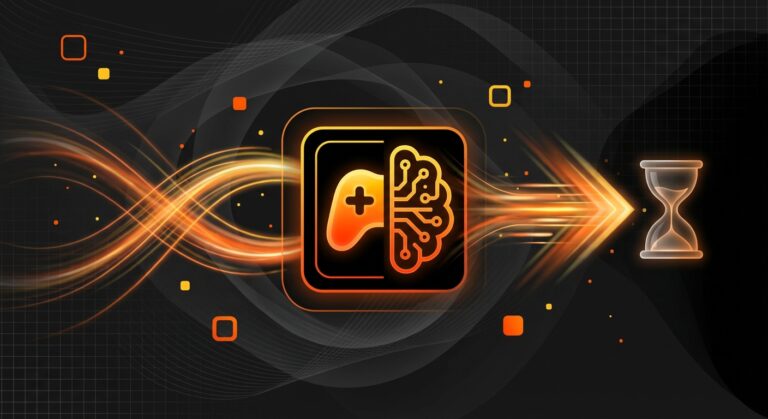
So, how does this all work? This diagram lays it out perfectly. It shows how AI takes the long, winding road of game development and turns it into a super-fast highway from your brain to a playable game.
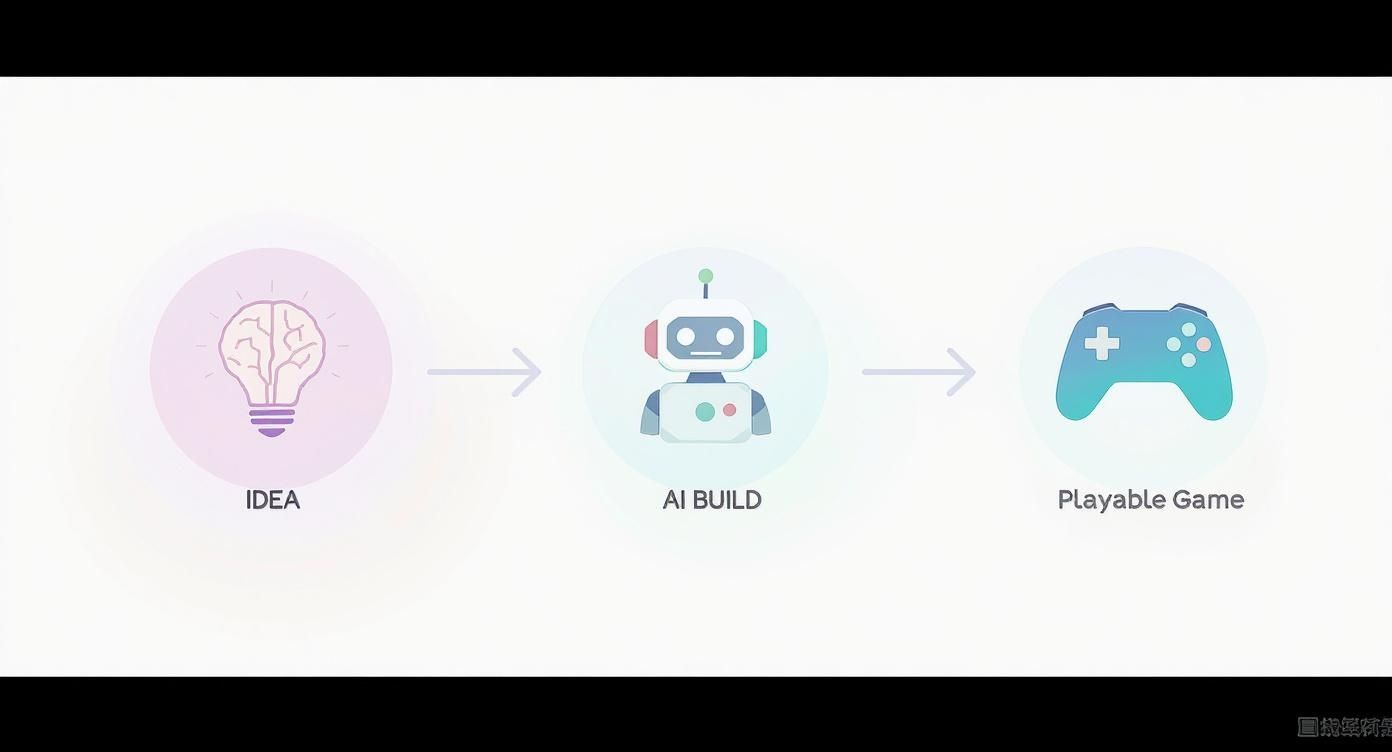
The big idea here is that the technical roadblocks are gone. Your creativity is now in the driver's seat.
From Idea to Playable Game: The AI Workflow
Here's a quick overview of how you'll turn a simple idea into a fully functional game using AI.
| Phase | Your Action | What the AI Does |
|---|---|---|
| 1. The Spark | You write a simple prompt describing your game idea. | Analyzes your text to understand the core concept, genre, and characters. |
| 2. The Build | You watch! (And maybe grab a coffee). | Generates all the necessary game assets—characters, environments, items—and writes the underlying game logic. |
| 3. The Polish | You tweak gameplay using plain English conversation. | Interprets your feedback and instantly modifies game rules, speeds, or visuals. |
| 4. The Launch | You hit the publish button. | Packages your game, hosts it, and gives you a shareable link. |
It really is that straightforward. The AI handles the heavy lifting, so you can focus on what makes the game fun.
Your Creative Journey Starts Here
The only thing holding you back now is your own imagination. Everything you need is right there at your fingertips, ready to go. If you want to dive deeper into the nuts and bolts of it, our guide on how to create a game app is a great next step.
This whole adventure kicks off with a simple text box. No complicated menus, no confusing jargon. Just you and your idea.
It's clean, it's simple, and it all starts with your words. Your journey as a game developer officially begins now. Let's do this.
So, What Kind of Universe Are We Building Today?
When you’re working with an AI game creator, that first prompt you type is everything. It’s not just a suggestion; it's the DNA for your entire game. Think of it as the ultimate cheat code, the one that sets the stage for everything that comes next. A great prompt is what separates a forgettable, cookie-cutter game from something that feels special and, more importantly, yours.
Over at tools like MakeGamesWithAI.com, this is where the real fun begins. You don't need to write a massive game design doc. You just need one solid, punchy sentence to kick things off. The AI is your 24/7 dev team, just waiting for you to tell it what to build.
The Four Ingredients for a Killer Prompt
To get something truly cool out of any simple game maker, you need to give the AI a clear blueprint. I've found that the best prompts always nail four key ingredients. Get these right, and you're already halfway to a game you’ll be excited to play.
Here's the secret sauce:
- Genre: What kind of game is it? A classic side-scrolling platformer? A frantic top-down shooter? An arcade-style dodger? This sets the basic rules of engagement and how the player sees the world.
- Character: Who's the star of the show? A cybernetically enhanced squirrel? A hard-boiled detective who happens to be a cat? A marshmallow who has seen too much? Your hero needs a little personality.
- Objective: What's the point? Is the player grabbing cosmic acorns, cracking the case of the missing yarn, or just trying to stay alive for as long as possible? The objective is the engine of your game.
- Setting: Where is all this happening? A sprawling steampunk forest? A rain-slicked, neon city? A kingdom made entirely of candy? The setting wraps your game in a distinct vibe and visual flair.
When you mash these four things together, you’re giving the AI a rich, detailed picture to work with. It prevents the AI from just shrugging its digital shoulders and spitting out something generic.
Turning a Fuzzy Idea into a Solid Prompt
Let's see this in action. A wishy-washy prompt like "make a fun platformer" is a recipe for boredom. The AI has almost nothing to go on, so it'll probably give you the most basic, uninspired game you can imagine.
Now, let’s spice it up with our four ingredients.
Here's a much better prompt: "A fast-paced platformer where a ninja frog has to collect glowing fireflies in a mystical bamboo forest at night, all while avoiding shadowy monsters."
Night and day, right? The AI now knows the genre (platformer), the character (ninja frog), the goal (collect fireflies), the setting (mystical bamboo forest), and even a built-in enemy (shadow monsters). This is the kind of detail a simple game maker loves. It can instantly spin up a world that feels coherent and exciting from the jump.
Pro-Tips for Prompting Like a Pro
Once you get the hang of the basics, you can start playing with the formula. It's like being an artist mixing paints on a palette. Try tossing in more evocative words to really nail the mood and art style.
Here are a few tricks I like to use:
- Adjectives Are Your Friend: Don't just say "forest." How about an "enchanted, bioluminescent forest"? Or a "creepy, forgotten forest"?
- Set the Mood: Words like "eerie," "whimsical," "cyberpunk," or "chaotic" can totally change the game's art style, sound effects, and music.
- Add a Twist: Throw a curveball. "A cooking game… but it's set in space and you serve aliens." The more unique the combo, the more interesting the result.
Your prompt is your direct line to the AI's imagination. The more vivid and specific you are, the more awesome your game will be. It’s a fun little puzzle, and you’ll be surprised at how a slightly different prompt can lead to a completely new and amazing experience.
Bringing Your Game to Life With AI-Generated Assets
Alright, you've got your game concept nailed down and the core idea prompted. Now for the magic: making it look amazing. A killer simple game maker, like the one we've built at MakeGamesWithAI.com, completely demolishes the old artistic barriers. Forget spending years learning to draw; you can now generate incredible visuals with just a handful of words.
This isn’t about struggling with pixel art or getting lost in 3D modeling software for weeks on end. It's about describing the world in your head and watching the AI paint the picture for you. This is how you transform a simple text prompt into a living, breathing visual experience that immediately grabs a player's attention.

From Sprites to Backgrounds in a Flash
Picture every visual piece of your game—the hero, the bad guys, the shiny collectibles, the background—as an individual asset. With a good AI tool, you can conjure these up on the fly.
Let's stick with our "ninja frog" platformer idea. You could tell the AI:
- For the hero: "Generate a 2D sprite of a small, agile ninja frog with a red scarf."
- For the enemies: "Create a shadowy monster sprite with glowing red eyes."
- For collectibles: "Make a vibrant, glowing firefly icon."
- For the environment: "Design a set of bamboo forest platform tiles with a nighttime feel."
Each one of these prompts spits out a visual component you can drag and drop right into your game world. You can also browse a massive library to find the perfect assets, making sure your game feels cohesive and looks professionally polished. For more on this, check out our guide to finding great free 2D game assets to get you started.
Nailing a Cohesive Art Style
One of the sneakiest challenges for new game makers is keeping the art style consistent. It’s so easy to end up with a mishmash of clashing visuals. An AI-powered simple game maker helps you sidestep this problem by letting you steer the overall aesthetic with descriptive words.
Want a classic, retro feel? Just add "pixel art" or "8-bit" to your prompts. Leaning towards something more modern and clean? Try "vector art" or "cartoon style." The trick is to use the same style keywords across all your asset prompts. Do this, and your character will look like they actually belong in the world you've built for them.
A consistent art style is more than just eye candy—it's about clarity. When players can instantly distinguish a friend from a foe or an item from the background, the game just feels better and is way more intuitive to play.
This is the real power of accessible tools. While big engines like Unity get all the headlines, simpler makers are quietly making a huge impact, accounting for over 10% of new titles on Steam in 2024. They’re empowering a new wave of creators to build and launch games without needing a giant team or a Hollywood budget. You can dig into some fascinating insights about the rise of accessible game engines and their growing influence. By being smart about your asset choices, you can make a game that truly stands out.
Refining Gameplay Through Simple Conversation
Alright, you’ve brought your game to life. The art is in place, the core concept is chugging along, but now for the real test: is it actually fun? This is where you put on your game designer hat. With a simple game maker like the one at MakeGamesWithAI.com, you don't need to get bogged down in a complex editor—you just need to talk.
Forget about digging through obscure menus to tweak a physics variable or trying to make sense of code just to adjust the difficulty. You can literally have a conversation with your game. This is where you get to experience the magic of instant iteration, turning a good idea into great gameplay in real time.
Speaking Your Game into Awesomeness
Think of the conversational editor as your personal game-tuning genie. It gets what you mean, not just what you type. Let's say your platformer hero feels a bit heavy, and their jump has all the oomph of a wet firecracker.
Instead of wrestling with gravity settings, you just tell the AI what you want.
- "Make the player jump 30% higher."
- "You know what? Give the player a double-jump."
- "Bump up the player's movement speed a little bit."
The AI takes those requests and—poof!—the changes are live. You can hop right back into the game and feel the difference immediately. That instant feedback is everything when you're trying to nail the "game feel," something that can take traditional developers ages to get right.
This back-and-forth process is the absolute heart of game design. It’s never about getting it perfect on the first shot; it's all about making tiny, constant improvements. I remember one developer talking about how "breaking the game was the best part of the game," which pushed them to lean into whatever players found most entertaining.
Balancing the Challenge in Real Time
Is your game a brutal, controller-throwing nightmare? Or is it a total cakewalk? Finding that perfect difficulty balance is one of the toughest nuts to crack in game design, but a conversational editor makes it shockingly easy.
You can adjust the challenge with plain, direct instructions. For instance, if your enemies are a bit of a joke, you could try:
- "Increase enemy speed by 25%."
- "Make the enemies shoot way more often."
- "Shorten the time between enemy waves."
On the flip side, if players are hitting a wall, you can dial it back just as easily. A simple "Cut the boss's health in half" or "Sprinkle more health packs in the level" can do wonders.
This ability to rapidly prototype the gameplay lets you fine-tune the experience until it hits that perfect sweet spot between challenging and fair. The whole thing becomes less about technical fiddling and more about shaping the emotional ride for the player. It’s this quick-change power that makes a conversational simple game maker such a game-changer for creators at any skill level.
Time to Unleash Your Game and Rule the Leaderboards
Alright, you've done the hard work. You've brought a crazy idea to life, built a playable world, and tweaked the mechanics until they felt just right. Now for the best part: getting it into the hands of actual players.
Forget what you’ve heard about complicated launch processes. With a simple game maker like the one we're using at MakeGamesWithAI.com, this isn't a stressful technical nightmare. It's the victory lap.
You’re literally one click away from going live. Your masterpiece gets published to our community hub, the MakeGamesWithAI.com/games portal, where anyone in the world can jump in and play. No servers, no code deployment, just pure, instant gratification.
Let the Games (and Bragging Rights) Begin
So, what makes a player stick around? The thrill of the chase. That "just one more round" obsession is fueled by competition, and that's where leaderboards are pure magic.
Every single game you build on our platform automatically comes with a scoring system tied directly into our global leaderboards page. Boom. Instant replayability.

This isn’t just a nice-to-have feature; it’s your secret weapon. It immediately gives players a reason to master your game and fight for that coveted top spot.
In a sea of indie games, this matters. A lot. Big engines like Unity might have powered 51% of all games on Steam in 2024, but market share doesn't always equal success for the little guy. The real magic happens on community platforms where discoverability and engagement are everything. For a deeper dive, check out this great analysis of how different game engines perform in the market.
How to Not Get Lost in the Crowd
Okay, your game is live and the leaderboard is ticking. Now you need to hook people. Your game's thumbnail and description are your digital storefront window, so don’t be boring.
Here are a few tricks I've learned for making a game pop:
- Design a Killer Thumbnail: Don't just show the title screen. Grab a screenshot of the most exciting moment in your game—a massive jump, a near-miss with an enemy, or your main character looking awesome. Action sells.
- Write a Description that Sizzles: Keep it short, punchy, and intriguing. Instead of a generic "This is a fun platformer," try something like, "You're a rogue toaster on the run. Can you escape the chaotic kitchen before you get unplugged for good?"
- Listen, Tweak, Repeat: The community is your new best friend. Pay attention to comments. See what players love and where they get frustrated. Then, jump back into the conversational editor and make those quick fixes. A developer who listens is one who wins.
Got Questions About AI Game Makers? We’ve Got Answers.
Diving into AI game creation for the first time feels a bit surreal, I get it. When you're staring at a tool like the one we've built at MakeGamesWithAI.com, it's only natural for your brain to start firing off questions. So, let's just get right to it and tackle the big ones I hear all the time from new creators.
This stuff is designed to be ridiculously easy, but a little inside knowledge goes a long way. Here are the straight-up, no-fluff answers to help you start building with confidence.
Do I Really Need to Know Zero Code?
Yep. 100%. I can't stress this enough: platforms like ours are built for designers, storytellers, and anyone with a cool idea—not programmers. The entire process, from dreaming up your concept to tweaking the game's physics in the conversational editor, is done with plain English.
You just type what you want, and the AI does all the heavy lifting in the background. It completely demolishes the old-school barriers of learning programming languages, memorizing functions, and wrestling with complicated game engines. You get to skip all that and focus on the fun part: making your game.
What Kinds of Games Can I Actually Make?
Right now, AI game makers absolutely crush it when it comes to 2D games. We're talking about all the classics you grew up loving:
- Fast-paced side-scrolling platformers
- Intense top-down adventure games
- Old-school arcade shooters
- Tricky puzzle games that make you think
The magic is all in your prompt. You tell the AI you want a "top-down zombie shooter where you collect tacos," and that's what it builds. While you probably won't be building a massive open-world 3D epic just yet, the sky's the limit for creating seriously fun and unique 2D games—all of which can plug right into our global leaderboards.
The real beauty of a simple game maker is its focus. It lets you nail what makes 2D games so addictive—responsive controls, clear goals, and that "one more try" feeling—without getting bogged down in a million confusing options.
How Long Does It Actually Take to Make a Game?
Okay, this is where things get wild. You can go from a single sentence to a playable game in just a few minutes. I'm not kidding. A fully fleshed-out mini-game with your own art, balanced gameplay, and a live leaderboard can easily be whipped up in an afternoon.
This ridiculously fast turnaround means you can try out a dozen different ideas in the time it would traditionally take just to install a game engine. Don't believe me? Check out what people are creating right now over on the community games portal.
Can I Make Money From This?
At the moment, the main goal for most AI game makers is to get more people creating and sharing their ideas, not necessarily direct monetization. But think of it this way: building games on these platforms is a killer way to prototype ideas and build a portfolio at lightning speed.
Getting noticed in the community and having a hit game can be a massive stepping stone for bigger opportunities in the gaming world down the road.
Ready to stop asking questions and start making something? Make Games With AI can take that awesome idea rattling around in your head and turn it into a real, playable game in minutes. It's free to get started. Go on, see for yourself.