From Prompts to Prototypes: A Modern AI Game Tutorial for Non-Coders
The landscape of game development is undergoing a seismic shift. For decades, creating a video game was an exclusive craft reserved for those who spent years mastering C++, C#, or complex engines like Unity and Unreal. If you had a brilliant idea but lacked the technical prowess to implement it, your concept likely remained just that—a concept.
Today, that barrier to entry is crumbling. The rise of generative AI has ushered in a new era where natural language becomes the primary coding syntax. Learning the basics of AI in game development is no longer about understanding neural network architectures; it is about mastering the art of communication with intelligent systems.
In this article, we will explore how prompt engineering is replacing traditional scripting and provide a comprehensive ai game tutorial for creators ready to build their first game without writing a single line of code.
The Paradigm Shift: Logic vs. Language
To understand how to build games with AI, one must first understand the fundamental change in workflow. Traditional development follows a strict logic path: defines variables, write functions, debug syntax errors, and compile. It is a rigid process where a missing semicolon can break an entire project.
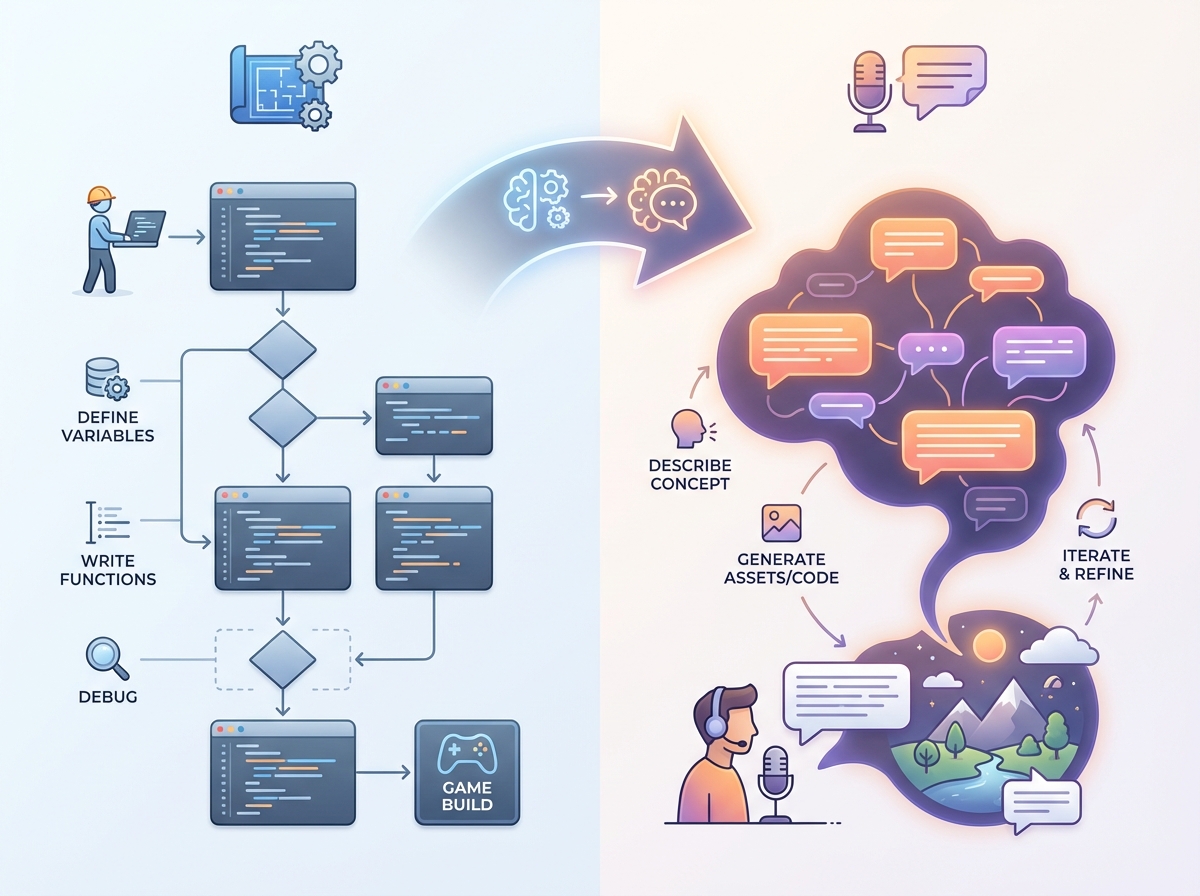
AI-assisted development flattens this curve. Instead of defining how the computer should do something, you define what the outcome should be. This approach shifts the creator’s role from a “builder” to a “director.”
The Rise of No-Code Platforms
While learning traditional engines is still valuable for AAA development, the democratization of gaming lies in no-code platforms. Tools like MakeGamesWithAI have emerged as powerful facilitators in this space. They interpret human intent and translate it into playable mechanics, assets, and rules systems instantly. This allows solo creators to bypass the months of prototyping usually required to test a game loop.
AI Game Tutorial: Your Step-by-Step Guide
If you are ready to transform your vision into a playable reality, follow this modern workflow designed for AI-native game creation.
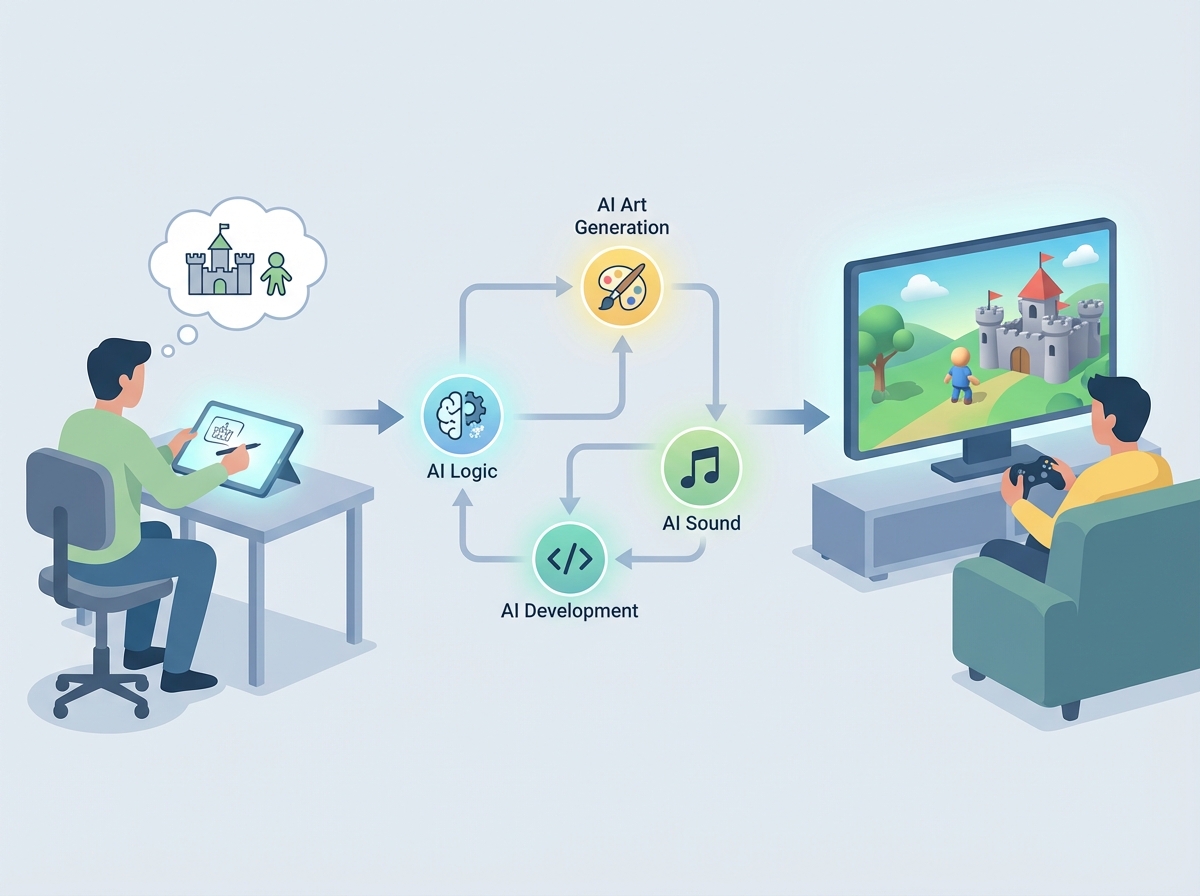
1. Conceptualization and the “Master Prompt”
Every great game starts with a hook. In the AI era, this hook must be articulated clearly. Your “Master Prompt” is the initial instruction you give the AI.
When using a platform like MakeGamesWithAI, vague requests yield vague results. Instead of typing “Make a fun platformer,” apply the following structure to your prompt:
- Genre & Perspective: (e.g., “A 2D side-scrolling platformer…”)
- Theme & Setting: (e.g., “…set in a neon-lit cyberpunk city…”)
- Core Mechanic: (e.g., “…where the player must avoid robotic guards and collect data chips.”)
- Atmosphere: (e.g., “…with a fast-paced, synth-wave aesthetic.”)
The AI interprets this vision to set up the physics, the environment, and the win conditions automatically.
2. Asset Selection and Visual Identity
Once the logic is generated, the game needs a visual identity. In traditional workflows, this would require hiring a 2D artist or scouring asset stores.
Modern AI tools streamline this by offering integrated libraries. For instance, MakeGamesWithAI provides over 100 included characters, environments, and effects that can be injected into the game via simple selection or description. The key here is consistency; ensure the assets you select match the descriptive prompts you provided in step one to maintain immersion.
3. Iteration via Chat-Based Editing
This is the most revolutionary aspect of the new workflow. In the past, changing a game mechanic meant rewriting code. Now, it involves a conversation.
If you generate a game and find the movement speed is too slow, or the enemies are too easy, you simply tell the AI.
“Make the enemies 20% faster.”*
“Add a double-jump ability to the main character.”*
“Change the background to a sunset forest.”*
This features allows for rapid prototyping. You can see your changes in a live preview immediately, allowing you to polish the “game feel” in minutes rather than days. This conversational iteration is central to the ai game tutorial philosophy: build, play, chat, repeat.
Beyond the Basics: Features That Drive Engagement
Creating a game is one thing; creating a community around it is another. One of the hurdles of traditional development is integrating backend services like leaderboards or multiplayer servers.
Competitive Scoring
Players love competition. Implementing a global leaderboard typically requires knowledge of databases and server-side scripting. However, modern AI game platforms handle this natively. MakeGamesWithAI, for example, includes global leaderboards as a standard feature. By simply requesting “add a scoring system based on survival time,” the platform handles the backend infrastructure, allowing you to focus on game balance.
Instant Distribution
The final step in any game development tutorial is deployment. The friction of exporting an .exe file, zipping it, and uploading it to a hosting site can deter many hobbyists. Cloud-based AI platforms solve this with instant publishing.
With a single click, your project is live. You receive a public link that can be shared on social media, allowing anyone with a browser to play your game instantly. There is no installation required for the player, and no server hosting costs for the developer.
The Commercial Viability of AI Games
A common question regarding AI-generated content is ownership. Can you sell what you create?
As the industry matures, platforms are clarifying these rights. The Creator Plan from MakeGamesWithAI ($19.99/month), for example, explicitly includes commercial use rights. This opens the door for creators to not just experiment, but to build portfolios and products. Whether you are an educator making games for students, a marketer creating interactive ads, or an indie dev testing concepts, the rights to your creation remain yours.
Conclusion: The Future is Conversational
We are witnessing the end of the “technical gap” in game design. The ability to code is being replaced by the ability to imagine and articulate.
Mastering the basics of AI game development does not mean memorizing syntax; it means learning how to guide an intelligent assistant to build the world you see in your mind. With tools like MakeGamesWithAI offering unlimited projects and chat-based modifications, the only limit is your creativity.
The best way to learn is to do. Open a prompt window, describe a world, and hit generate. Your first game is just a sentence away.