AI Game Creation for Hobbyists: A 2025 Guide
Have you ever dreamed of building your own video game, only to be stopped by the seemingly insurmountable wall of coding and complex software? In 2025, that barrier is officially a thing of the past. The rise of powerful, intuitive artificial intelligence has democratized game development, putting creative tools directly into the hands of visionaries like you. This guide provides a clear, step-by-step roadmap for AI game creation for hobbyists, empowering you to turn a simple idea into a playable, shareable game.
Why AI is a Game-Changer for Hobbyist Developers
Traditionally, solo game development required a rare combination of skills: programming, art design, sound engineering, and project management. This steep learning curve meant countless brilliant game ideas never saw the light of day. Today, AI acts as your multi-talented co-developer, handling the most technically demanding tasks.
AI platforms can:
- Generate Code Instantly: Describe your game’s mechanics in plain English, and the AI writes the underlying code.
- Create and Suggest Assets: Access vast libraries of characters, environments, and effects, or even generate new ones based on your descriptions.
- Accelerate Prototyping: Test a core gameplay loop within minutes, not weeks, allowing for rapid iteration and creative exploration.
This shift allows you to focus on what truly matters: the story, the gameplay, and the fun. By removing technical roadblocks, AI lets you create games faster and smarter. To learn more about this revolutionary shift, explore the fundamentals of AI for Game Development: Create Games Faster & Smarter.
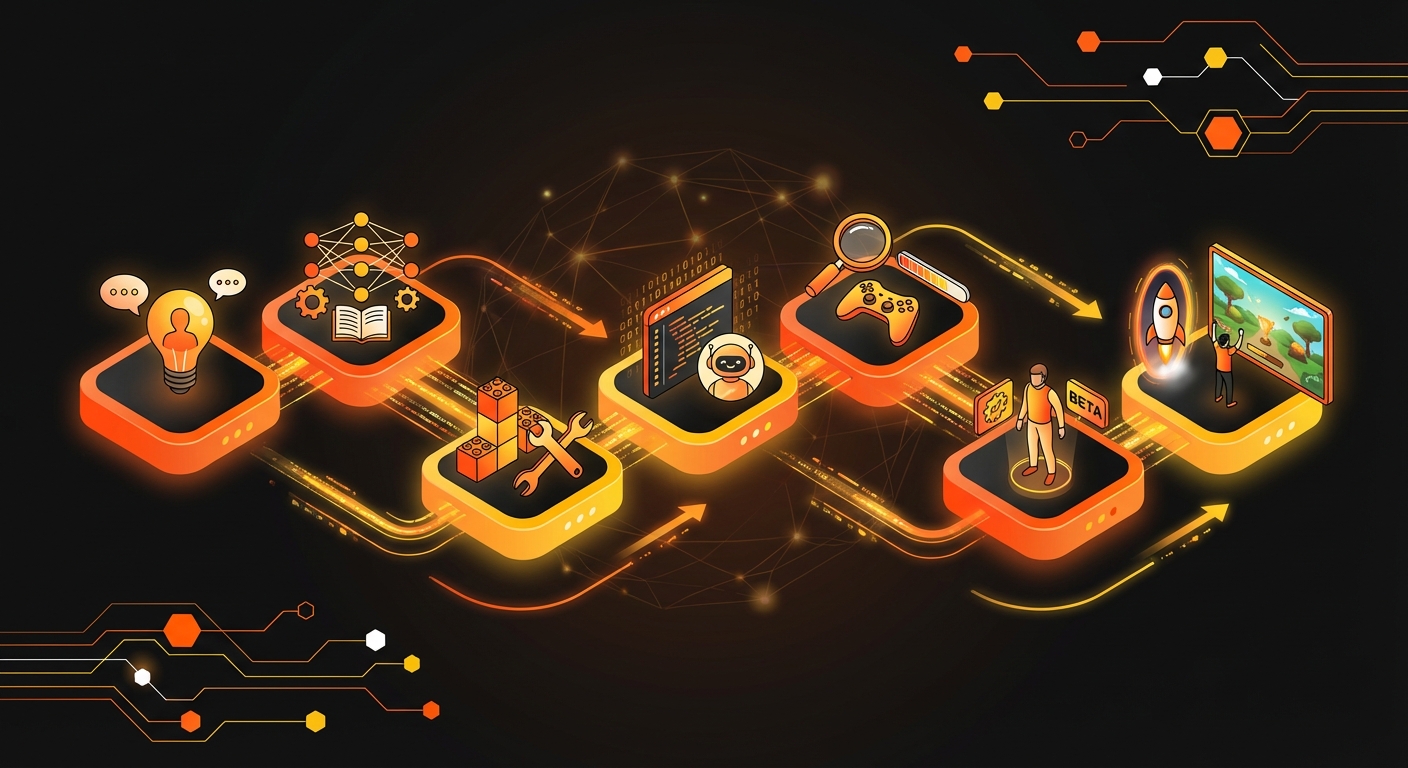
Step-by-Step Guide to AI Game Creation
Ready to bring your vision to life? Follow these seven steps to build your first game using the power of AI.
Step 1: Brainstorm and Refine Your Game Concept
Every great game starts with a solid idea. Before you touch any tools, take time to define what you want to create. A clear concept is the most important instruction you can give an AI.
Consider these key elements:
- Genre: Is it a puzzle game, a side-scrolling platformer, a top-down shooter, or a racing game?
- Core Mechanic: What is the main action the player will perform? (e.g., jumping, collecting, shooting, matching).
- Objective: What is the goal? (e.g., reach the end of the level, get the highest score, defeat the boss).
- Theme/Setting: What is the visual and narrative style? (e.g., futuristic space, enchanted forest, post-apocalyptic city).
Tip: Use a generative AI like ChatGPT or Claude to help you brainstorm. Try a prompt like, “Give me five unique game ideas that combine the ‘endless runner’ genre with a ‘steampunk’ theme.”
Step 2: Choose the Right AI Game Creation Platform
With the boom in AI development, numerous tools are now available, each with its own strengths. For a hobbyist, the ideal platform should prioritize ease of use, a rich feature set, and a supportive community. When evaluating your options, look for a no-code interface, a generous asset library, and transparent pricing.
Platforms like MakeGamesWithAI are designed specifically for this purpose. They offer a text-to-game engine that requires zero programming knowledge, allowing you to describe your game and see it come to life instantly. For a detailed comparison of the top tools available this year, check out this list of the 11 Best AI Game Generators (December 2025).
Step 3: Generate Your First Playable Prototype
This is where the magic happens. Once you’ve chosen your platform, you’ll typically start with a text prompt. This is your initial instruction to the AI, and it should be as descriptive as possible based on the concept you defined in Step 1.
For example, a strong prompt would be:
*”Create a 2D side-scrolling platformer. The player is a brave squirrel who must collect 10 magic acorns in a forest level filled with bouncy mushrooms and grumpy badger enemies. The squirrel can jump and throw nuts.”
Within seconds, the AI will interpret these instructions and generate a playable prototype. This initial phase of AI game creation for hobbyists is incredibly rewarding, as you can immediately see your idea in action, similar to how you would build arcade games with AI instantly.
Step 4: Iterate and Customize with AI-Powered Editing
Your first prototype is a starting point, not the final product. The real power of modern AI tools lies in their iterative capabilities. Using a chat-based editor, you can refine every aspect of your game with simple commands.
On a platform like MakeGamesWithAI, you can simply type your changes:
- “Make the player’s jump height 20% higher.”
- “Change the background to a nighttime forest.”
- “Add a double-jump ability for the squirrel.”
- “Increase the speed of the badger enemies.”
You can also swap out characters, props, and environmental assets from the platform’s library to perfect the visual style of your game.
Step 5: Add Gameplay-Enhancing Features
Once your core gameplay feels right, it’s time to add features that increase engagement and replayability. Many AI platforms offer built-in modules for these elements, saving you from complex setup.
Consider adding:
- Scoring Systems: Track points for collecting items or defeating enemies.
- Leaderboards: Introduce a competitive edge. Tools like MakeGamesWithAI can integrate global leaderboards automatically.
- Sound and Music: Use AI-powered sound generators or browse a built-in library to add sound effects and a background track.
- Multiple Levels: Duplicate and modify your first level to create a longer, more varied experience.
Step 6: Test, Get Feedback, and Refine
No game is complete without playtesting. Because AI platforms allow for instant deployment, sharing your creation is as simple as sending a link. Get your friends, family, or members of an online community to play your game.
Ask for specific feedback: Was it fun? Were the controls intuitive? Was any part too difficult or too easy? Use this valuable input to make further refinements in the AI editor. This feedback loop is crucial for polishing your game.
Step 7: Publish and Share Your Game
Congratulations! You’ve created a complete game. The final step is to share it with the world. Modern AI platforms handle the complexities of hosting and deployment. With a single click, you can publish your game, making it accessible to anyone with a web browser. Share your link on social media, with gaming communities, and be proud of what you’ve built.
Common Mistakes to Avoid in AI Game Development
As you begin your journey, steer clear of these common pitfalls:

- Vague Prompts: The AI is powerful, but it’s not a mind reader. Be specific and detailed in your initial description to get the best results.
- Accepting the First Draft: Don’t stop at the first prototype. The true creative process lies in iterating, tweaking, and refining the game based on your vision and player feedback.
- Over-Scoping: It’s tempting to create a massive open-world RPG as your first project, but start small. A polished, simple game is far more impressive than an ambitious but broken one. For more guidance, our guide to Game Development for Beginners: Create Your First Game Without Coding is a great resource.
- Forgetting the Fun: AI can build the mechanics, but you are the director of fun. Play your game constantly and ask yourself, “Is this enjoyable?” If not, use the AI editor to make changes until it is.
What to Expect: Your First AI-Generated Game
By following this guide, you can expect to have a fully functional, playable game in a fraction of the time it would take with traditional methods. You’ll have gone from a simple idea to an interactive experience you can share with anyone. This process is not just about the final product; it’s an incredible, hands-on way to learn the core principles of game design, player engagement, and creative iteration without getting bogged down by technical hurdles.
Conclusion: Start Your Game Creation Journey Today
The era of game development being reserved for expert coders is over. In 2025, AI has leveled the playing field, making it possible for anyone with a creative spark to build and share their own games. By following a structured process—brainstorming your concept, choosing the right tool, generating a prototype, and iterating based on feedback—you can successfully navigate the world of AI game creation for hobbyists.
For those ready to dive in, platforms like MakeGamesWithAI provide an all-in-one solution designed to get you from idea to finished game as smoothly as possible. With its intuitive chat-based editor and powerful features, it’s the perfect launchpad for your new favorite hobby.