Best Video Game Creation Software for New Developers
So, what's the "best" software to make a video game? Honestly, it depends entirely on what you're trying to achieve. But if your goal is to have a finished, playable game today without touching a line of code, then AI-powered platforms are in a league of their own. Tools like MakeGamesWithAI let you use simple text to spin up a game in minutes, complete with features like a global leaderboard for instant competition. It's a completely different universe from traditional engines that can take months just to learn the basics.
Choosing Your Game Creation Software
Diving into game development feels a bit like staring at a giant, confusing skill tree. There are a million tools out there, and they all claim to be the one you need. For years, the path was pretty clear: learn a complex programming language like C++ or C# and buckle up for a long, difficult journey. That high barrier to entry kept a lot of creative people on the sidelines.
But the game has changed. A new breed of software is rewriting the rules, and frankly, it's about time. Platforms like MakeGamesWithAI.com let you skip the technical grind altogether. You just describe your game idea in plain English, and the AI handles the heavy lifting—building the mechanics, generating assets, and making it playable. This flips the script, making raw creativity, not coding ability, the most important skill.
Mapping Your Development Journey
The tool you pick really defines your whole experience. Are you ready to sink months into a powerful engine to get every pixel just right? Or would you rather have a working prototype before your coffee gets cold? It’s a classic speed vs. control trade-off.
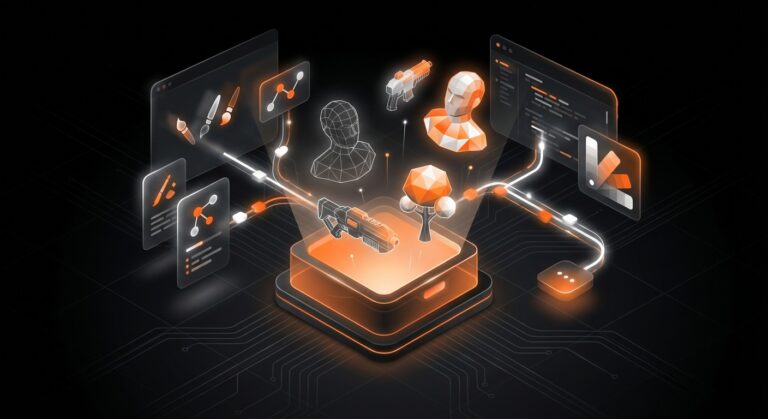
This image breaks down the three main roads you can take as a game maker today.
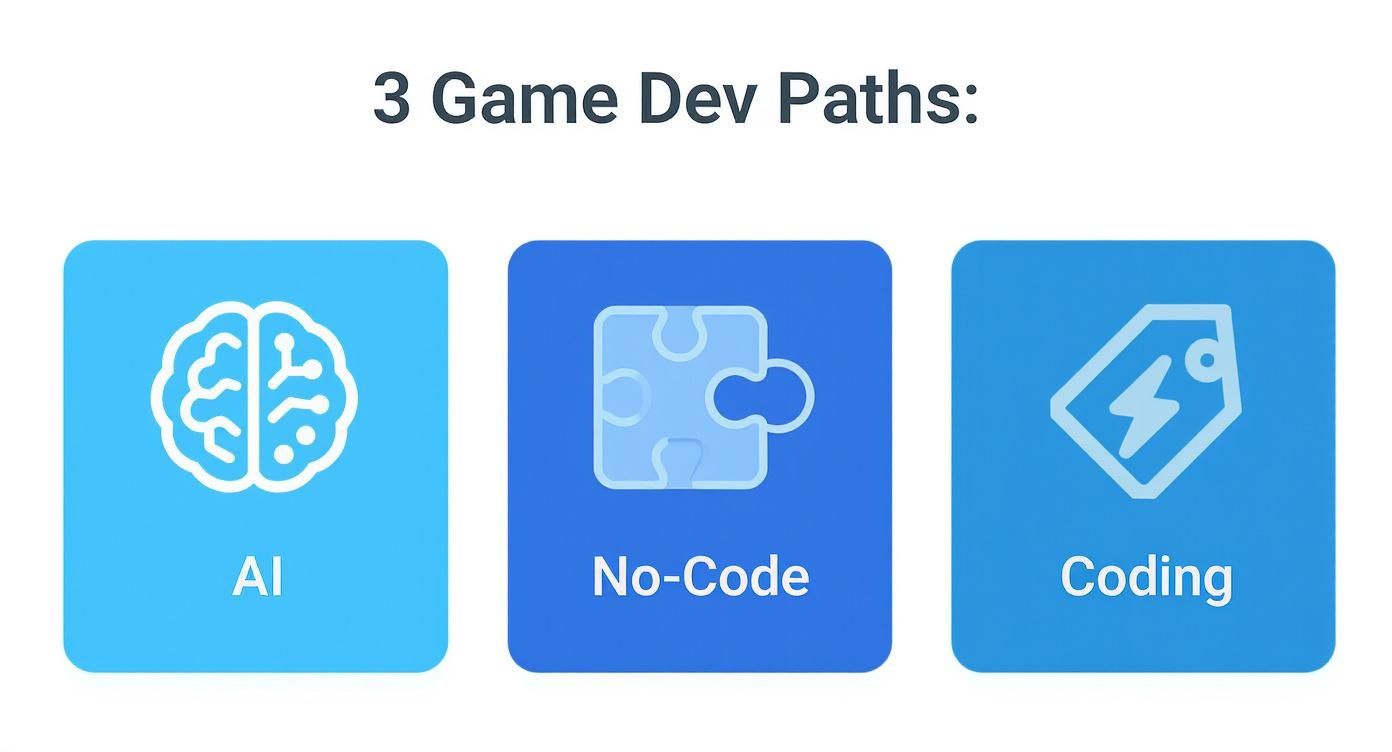
Each path is built for a different kind of creator with different goals, timelines, and technical chops. There's no single "right" way—just the right way for you.
This entire shift is being fueled by the explosion of AI in the gaming world. The market for AI in gaming was already valued at around USD 1.5 billion, and experts predict it will surge to an incredible USD 9.8 billion by 2034. That's not just hype; it shows how deeply AI is being integrated into modern tools to make game creation faster and more accessible. If you want to dig into the numbers, this detailed market analysis is a fascinating read.
Your choice of game creation software boils down to a simple trade-off: speed versus control. AI gives you unbelievable speed and lets anyone build a game, while traditional engines offer absolute control but demand a massive investment of your time.
Comparing Top Game Creation Platforms
To make things a little clearer, let's look at the main options side-by-side. This table gives you a quick snapshot of who each type of tool is really for and what its biggest strength is.
| Software Type | Primary Focus | Ideal Creator | Key Advantage |
|---|---|---|---|
| AI-Powered | Instant game generation from text prompts | Beginners, hobbyists, fast prototypers | Speed: Go from idea to playable game in minutes. |
| No-Code Visual | Drag-and-drop logic and event systems | Visual thinkers, artists, designers | Accessibility: Build complex logic without writing code. |
| Code-Intensive | Full control over every game element | Professional developers, large studios | Control: Complete freedom to build anything imaginable. |
Ultimately, the best tool is the one that gets your game out of your head and onto the screen. Whether that's through a simple conversation with an AI or by meticulously crafting every line of code is up to you.
The New Frontier of AI-Powered Game Creation
Picture this: you have a wild idea for a game. You type out a single sentence describing it, and poof—it appears on your screen, fully playable. This isn't some far-off fantasy from a sci-fi movie; it's what's happening right now with AI-powered game creation. The whole game development playbook is being rewritten, and the biggest barrier to entry—coding—is being kicked to the curb.
Leading this charge are platforms like MakeGamesWithAI.com. Forget wrestling with intimidating game engines or learning a new programming language. Here, you just have a conversation with an AI. You describe what you want, and it handles all the heavy lifting—the code, the assets, the game mechanics—translating your vision directly into something you can actually play.

From Idea to Playable Game in Minutes
The biggest win here is sheer, unadulterated speed. Traditional game development can drag on for months, even for a simple prototype. With AI, you can go from a thought bubble to a fully functional game—with graphics, sound, and a scoring system—in under a minute.
This acceleration is a massive deal for a few reasons:
- Instant Prototyping: Got a crazy idea for a game? You can build it instantly and see if it's actually fun. No more sinking weeks into a concept just to find out it doesn't work.
- Effortless Iteration: Don't like how a jump feels? Want to add a new enemy? Just tell the AI. The conversational editor lets you tweak, adjust, and add features on the fly.
- Total Accessibility: Suddenly, anyone with an idea can be a game developer. You could be a storyteller, an artist, or just someone with a cool concept. You no longer need a technical background to bring it to life.
This whole approach is sometimes called "vibe coding." You're not programming every little detail; you're describing the outcome, the feel, the vibe you're going for, and letting the AI handle the technical nitty-gritty.
The core promise of AI game creation is simple: if you can describe it, you can build it. This flips the script, making creative vision—not technical skill—the only prerequisite for making a game.
Eliminating Common Development Hurdles
Beyond just spitting out a game, these AI platforms solve so many of the logistical nightmares that trip up new developers. Features that would normally require extra coding, third-party plugins, or a server-side headache are just… there. Built-in from the start.
For instance, what’s a game without a little friendly competition? With a tool like MakeGamesWithAI, a global leaderboard is automatically wired into every single game you create. Players from all over the world can instantly compete for the high score, all visible on the main global leaderboards page, and you didn't have to write a single line of backend code.
Sharing your masterpiece is just as easy. One click, and your game is published and live on a public link. Gone are the days of worrying about hosting or complicated deployment pipelines. You can see the amazing variety of projects people are building on the community games page—all made and shared in just a few moments. The implications of this are huge. To get a better sense of the tech making this possible, check out our deep dive on the role of AI in game development.
By taking care of all the tedious but critical stuff, AI lets you focus on the only thing that really matters: making your game fun.
Traditional Game Engines for When You Need Ultimate Control
Sure, AI-powered platforms like MakeGamesWithAI.com are throwing the doors wide open for new creators, but that's not the whole picture. For the perfectionists out there—the developers who want to control every single pixel, every physics quirk, and every line of code—the traditional game engines are still the undisputed kings of the ring.
These are the power tools behind the blockbuster AAA titles and the indie darlings that steal our hearts. We're talking about titans like Unity and Unreal Engine. They aren't just software; they're massive ecosystems packed with asset stores, rendering pipelines, and huge communities of fellow developers. Diving in means tackling a steep learning curve, but the payoff is immense: the power to build literally anything you can dream up, exactly the way you see it in your head.
This hunger for control is why the professional game development software market is booming, currently valued at around USD 1.36 billion and projected to climb to nearly USD 1.887 billion by 2035. It's a clear sign that serious developers aren't backing away from complexity. You can dig into more of the numbers on this growth in this market research report.

Unreal Engine: The Cinematic Powerhouse
When a game’s graphics make your jaw hit the floor, there's a good chance it was built with Unreal Engine. Developed by the folks at Epic Games, Unreal has cemented its reputation as the go-to engine for ambitious 3D projects that want to look incredible. It’s packed with high-end rendering features like the Lumen global illumination system and Nanite virtualized geometry, letting developers craft photorealistic worlds without melting your GPU.
But don't assume it's only for hardcore coders. One of Unreal's killer features is Blueprint, its visual scripting system. This lets you build out complex game logic, character AI, and interactive events by connecting nodes on a graph instead of writing lines of code. It’s an amazing bridge that empowers artists and designers to jump in and implement their own ideas, making it a dream for teams chasing that blockbuster, cinematic feel.
Unreal Engine is built from the ground up to deliver best-in-class tools for high-fidelity 3D. If your game lives or dies on its stunning visuals, Unreal is almost always the right call.
Unity: The Versatile All-Rounder
While Unreal is busy owning the high-end 3D space, Unity has quietly become the darling of indie developers and mobile game creators everywhere. Why? Because it’s an absolute chameleon. Built on the popular C# programming language, Unity offers a much friendlier on-ramp for new programmers.
Its real magic, though, is its sheer flexibility. Unity is just as happy building a slick 2D platformer as it is a complex 3D RPG or a chart-topping mobile puzzle game. This adaptability gets a massive boost from the Unity Asset Store, a gigantic marketplace overflowing with ready-to-use models, scripts, sound effects, and editor tools. This lets solo devs and small teams create games that look and feel far more polished than their budget would suggest.
And if you’re focused on 2D, Unity has a fantastic set of tools for sprite management and animation. For a deeper dive into that world, check out our guide to the best 2D game engines.
Choosing Your Engine: A Clash of Philosophies
At the end of the day, picking between Unity and Unreal is less about which one is “better” and more about which one fits your project and your team. It’s a choice of philosophy.
Here’s a quick way to break it down:
- What's Your Main Goal? Is your number one priority creating a visually stunning 3D world that pushes graphical boundaries? Unreal Engine is your workhorse. Need a flexible tool that can handle both 2D and 3D and deploy to a dozen different platforms? Unity is the pragmatic choice.
- What Skills Does Your Team Have? Got artists and designers who want to build gameplay without becoming programmers? Unreal's Blueprint system will feel like a superpower. Is your team more comfortable with classic object-oriented programming? Unity's C# foundation will be a perfect fit.
- How Do You Feel About Their Business Models? This is a big one. Unreal generally takes a cut of your revenue after you earn a certain amount, while Unity relies on subscriptions paired with a… let's just say controversial… per-install fee.
Committing to a traditional engine is a big deal. You're not just picking software; you're buying into an entire ecosystem and a way of thinking. They demand more from you upfront, but the fine-grained control they offer is still the undisputed gold standard for professional game development.
Finding the Perfect Software for Your Project
So, you've seen the raw power of traditional engines and the mind-bending speed of AI. Now for the million-dollar question: which one is right for your project? Let’s be real—the idea of a single “best video game creation software” is a complete myth. The right software is the one that clicks with your specific goals, skills, and timeline.
Are you a hobbyist looking to crank out your first game over a weekend? An indie team with dreams of a commercial launch on Steam? Or a designer who needs to visualize a gameplay idea before lunch is over? Each of these scenarios screams for a totally different tool. Let's dig into some common situations to find your perfect match.

Scenario 1: Prototyping an Idea in an Hour
A lightning bolt of inspiration strikes—a wild game mechanic that just might work. But is it actually fun? The last thing you want is to spend weeks wrestling with an engine just to test a gut feeling. You need answers, and you need them now.
- Best Tool: MakeGamesWithAI.com was practically born for this moment.
- Why it Works: The whole process feels more like a conversation than development. You can simply describe your concept—"a top-down shooter where a wizard fights off waves of goblins"—and have a playable build in under a minute. It’s all about testing the core fun, not getting lost in the technical weeds. You can instantly shoot a link to your friends for feedback and see how everyone stacks up on the automatically generated global leaderboards page.
For raw, unfiltered prototyping, nothing touches the velocity of AI. It collapses the gap between idea and validation from weeks down to minutes. You get to fail faster and find the fun sooner.
Scenario 2: Building Your First-Ever Game
You’re a complete rookie. You adore games, your head is swimming with ideas, but the very thought of coding sends a shiver down your spine. Your goal is simple: finish and share a real game you can be proud of, minus the brutal learning curve.
- Best Tool: MakeGamesWithAI.com or a visual scripting tool like GDevelop.
- Why it Works: An AI platform like MakeGamesWithAI just vaporizes the technical barriers. No programming, no asset pipelines, no deployment headaches. You get to focus entirely on the creative part—describing the game you want to bring to life. This is incredibly empowering and keeps you motivated because you see real, playable progress almost instantly. Check out the MakeGamesWithAI's games page to see what other first-timers have cooked up.
Scenario 3: Creating a Commercial Indie Title for PC or Console
Okay, it’s serious business now. You’ve got a small team, a killer artistic vision, and you’re aiming for the big leagues: Steam, Nintendo Switch, or PlayStation. You need a powerful, flexible, and well-supported engine that can go the distance for a multi-year development cycle.
- Best Tools: Unity or Godot Engine.
- Why they Work:
- Unity: Its cross-platform support is legendary, making the often-painful process of porting your game to different consoles and storefronts much smoother. For a small team, the massive Asset Store is a godsend, offering ready-made art, sound, and code that can save you hundreds of hours.
- Godot: As an open-source engine, it’s 100% free. No revenue sharing, no subscriptions—a massive win for indie teams on a shoestring budget. Its lightweight feel and slick, scene-based structure make it a joy to use for both 2D and 3D projects.
The decision here really boils down to your team’s comfort level with programming (C# for Unity vs. the Python-like GDScript for Godot) and your philosophy on licensing models. In the end, it’s not about chasing the most powerful software; it’s about choosing the one that actually empowers you to finish your game.
Let's Talk About the Money
Alright, let's get down to brass tacks: the money. Even if you're building a game purely for the love of it, the financial side of things can sneak up on you. The world of game development is littered with confusing subscription tiers, hidden fees, and revenue-sharing deals that can feel like a pop quiz in calculus. Picking the right tool isn't just about cool features; it's about finding a financial model that doesn't torpedo your budget before you've even shipped your first title.
The pricing landscape is all over the place. At one end, you have the absolute heroes of the indie scene, like Godot, which is 100% free forever. Seriously. That means every single penny you earn from your game is yours to keep, which is a massive win for anyone starting out on a shoestring budget.
The Big Engine Dilemma
Then you have the titans of the industry, Unreal Engine and Unity, and this is where things get… complicated. For years, Unreal's deal was pretty sweet and simple: you paid them nothing until your game made a cool $1 million in gross revenue. After that, they took a 5% royalty. That's a fantastic deal if you're making a small game, but if you score a massive hit, that 5% suddenly becomes a very big number.
Unity has always been more of a subscription-based service, with different plans for different needs. But they threw a huge wrench in the works recently with a controversial runtime fee, charging developers for each time their game is installed past certain milestones. The backlash was immediate and intense, and it served as a stark reminder that when you build on someone else's platform, they can change the rules of the game at any time.
The real cost of a game engine isn’t what you pay today. It’s the financial contract you're signing for the future. A "free" start can get incredibly expensive when success finally comes knocking.
A Simpler Way with AI and No-Code
This is where a whole new breed of tools, like MakeGamesWithAI.com, is rewriting the script. They sidestep the convoluted revenue shares and surprise install fees entirely. Instead, you get pricing that's actually predictable. MakeGamesWithAI, for instance, lets you build your first game on a free trial, and after that, it’s just a straightforward monthly subscription for unlimited game creation.
This kind of model is a breath of fresh air, especially for beginners and rapid prototypers. Here's why:
- No More Guessing Games: You know your exact monthly cost. No need to stress about a surprise bill if your game unexpectedly blows up on TikTok.
- Your Success is Yours: You keep 100% of the money your game earns. It’s that simple.
- Keep Your Head in the Game: Forget wasting brainpower trying to forecast royalty payments or track install counts. You can pour all that energy back into what really matters: making something fun.
This approach just removes all the financial anxiety that can paralyze new developers, letting you focus purely on the creative side. Getting a handle on these different models is a big deal, as the financial stability of the game dev market can have a real impact on your project's viability. Choosing software with a clear and fair price tag is one of the best ways to set yourself up for a less stressful and ultimately more successful journey.
Why AI Is Kicking Open the Doors to Game Development
For the longest time, making a video game felt like trying to join a secret society. You had to know the secret handshake—in this case, complex programming languages—or you weren't getting in. Artists, storytellers, and designers with amazing ideas were left on the outside looking in. But that's all changing, and AI is the one swinging the sledgehammer that’s bringing down those walls.
Think of AI as the ultimate translator. It takes your raw, creative ideas and turns them directly into something people can actually play. This is exactly what we're doing with our platform, MakeGamesWithAI.com. We let you build a game just by talking to it, using plain English. Suddenly, the biggest hurdle—the coding—is gone. A whole new wave of creators can now jump into the fray.
The Technical Hurdle Just Got a Lot Lower
Let's be real: the dream of making a game used to die on the hill of learning C#, C++, or Python. AI-powered tools just walk right around that hill. Instead of burying yourself in syntax and logic for months on end, you get to focus on what actually matters: your game idea. This completely changes the game, turning a months-long slog into a minutes-long creative sprint.
This kind of speed creates a playground for experimentation. When you can throw an idea at the wall and see if it sticks in a matter of minutes, you’re not afraid to try weird things. That’s where the real magic happens. You can fail fast, learn faster, and double down on the ideas that truly have potential.
The real win with AI in game development is that it puts imagination back in the driver's seat. It's less about how you build it and all about what you build. The focus shifts back to designing something genuinely fun.
It's Not Just About Building—It's About Community
AI isn't just changing how games get made; it's turbocharging how they're shared and played. Features that used to be a massive headache to implement, like online leaderboards, are now just built right in. For instance, every single game created on our platform automatically gets its own global leaderboard. It’s an instant shot of competition and community. You can see it live on our global leaderboards page, where people are duking it out in games that were created just moments ago.
This new accessibility is pouring fuel on an already-hot market. The game development software industry is projected to grow by an insane USD 70.7 billion between 2024 and 2029. Nearly 44% of that explosion is expected to come from the Asia-Pacific region alone. What’s driving this? More people than ever are getting their hands on tools that let them bring their ideas to life. You can dive deeper into the market trends here.
Look, the big, traditional game engines will always have their place for building massive, AAA blockbusters. But for the solo creator, the hobbyist, or the designer with a cool idea, AI offers something far more powerful: speed, simplicity, and an immediate connection to players. This isn't about replacing the old guard. It's about flinging the gates open for everyone else.
Got Questions? We've Got Answers
Stepping into game development can feel a bit like drinking from a firehose. There's so much to learn, so let's tackle some of the most common questions that pop up when you're trying to pick the right game-making software.
Can I Actually Sell a Game I Make with AI Software?
You bet. Tools like MakeGamesWithAI.com are absolutely built for creating commercial games. Always double-check the fine print in the terms of service, of course, but for whipping up hyper-casual mobile hits, quirky indie titles, or slick prototypes, these platforms are a game-changer.
The real magic is how they demolish the old barriers. You can get an idea out of your head and onto the market in a fraction of the time, often without needing to assemble a team of coding wizards.
Do I Have to Learn to Code to Make Games?
Nope, not anymore. That old gatekeeper has been kicked to the curb. While knowing how to code gives you ultimate control and is still a huge asset for massive, complex projects, it's no longer the only way in. The rules have changed.
AI-powered platforms like MakeGamesWithAI.com let you build games just by describing what you want in plain English. Even the big traditional engines have visual scripting systems that let you drag and drop logic blocks instead of writing code. It really just comes down to what you want to achieve.
The right tool depends entirely on your mission. If your goal is to bring ideas to life fast and focus on pure design, AI is your best friend. If you dream of engineering complex game systems for a major studio, learning to code is still a fantastic investment.
How Long Does It Take to Make a Simple Game?
This is where you see the starkest difference between the old way and the new way. Firing up a traditional engine like Unity for the first time? A beginner could easily spend weeks, if not months, just wrestling with the interface and coding basics before they have anything playable.
With an AI tool, that timeline gets crushed. On MakeGamesWithAI.com, you can literally go from a single sentence to a playable game in a few minutes flat. The work shifts from technical grunt work to creative iteration. You can have a fun, shareable game—complete with features like global leaderboards—ready to go almost instantly.
Ready to stop thinking about it and start doing it? With Make Games With AI, your first game is about 60 seconds away.