how to make a game without coding: Build with AI Tools in Minutes
So, you want to make a game but don't know how to code? Good news: that doesn't matter anymore. Seriously. You can now build a complete, playable game just by telling an AI what you want. This completely flips the script, letting anyone with a spark of an idea jump right into creating. With our platform at MakeGamesWithAI.com, you can go from idea to playable prototype in minutes and even compete on our global leaderboards.
Turn Your Game Idea Into Reality Without Writing Code
Ever get hit with a genius game idea, then immediately deflate thinking about learning C++ or some other coding beast? That massive learning curve has stopped countless would-be creators dead in their tracks. But here’s the thing: that wall has been completely smashed. Making a game without code isn't some far-off fantasy; it’s here, right now, and it's powered by AI.
You can take a simple thought and spin it into a real, working game using tools that feel more like a conversation than a programming session. Our platform, MakeGamesWithAI.com, was built for exactly this. It hands you the megaphone, letting you direct an AI to build, tweak, and perfect your game using plain English. Forget syntax errors, bug-squashing nightmares, and watching hours of tutorials. Your imagination is the only skill you need.

The No-Code Revolution Is Here
This isn't just about games; it's a huge shift in how everything is being made. Market research predicts that by 2025, a whopping 70% of new applications will be built using low-code or no-code platforms. What’s wild is that nearly 24% of the people using these tools have zero coding background, and another 40% admit their skills are pretty limited. This isn't a niche trend—it's a tidal wave making it possible for anyone to build cool stuff. You can dig into more of these stats on no-code development trends.
People are starting to call this new method "vibe coding" because it's all about capturing the feel of the game, not getting bogged down in the nuts and bolts. You just say what you want: "make the hero jump higher," "add spiky obstacles," or "create a scoring system." The AI just gets it done, handling all the messy code in the background.
Key Takeaway: You don't need to be a programmer to be a game developer anymore. AI platforms act as your personal translator, turning your creative vision directly into a playable experience. This lets you focus on the fun part: making a great game.
Think of this guide as your treasure map. We're going to walk you through the entire journey, from that first "what if?" idea to hitting the "publish" button on a finished game. You’ll see how to create art, design levels, and define the rules of your world, all through a simple chat.
Traditional Coding vs AI No-Code Game Creation
To really get why this is such a big deal, let's look at the old way of doing things versus the new AI-powered approach. The difference is night and day, especially if you're just starting out and want to see your idea come alive fast.
| Aspect | Traditional Game Development | AI-Powered No-Code (MakeGamesWithAI.com) |
|---|---|---|
| Required Skills | Deep knowledge of programming languages like C++, C#, or Python. | Creative ideas and the ability to describe them in English. |
| Time to Prototype | Weeks or months to build a basic, playable version. | Minutes to generate a playable game from a single prompt. |
| Iteration Process | Manually rewriting, debugging, and compiling code for every change. | Instant modifications through conversational commands. |
| Accessibility | Limited to those with technical expertise or large budgets. | Open to anyone, including artists, writers, and students. |
| Community Features | Requires separate implementation for leaderboards or sharing. | Instantly includes access to global leaderboards and a community games page. |
Looking at that table, it’s pretty obvious why AI-driven development is a total game-changer. It obliterates the old barriers and puts the creative process on hyperdrive. Now, you can experiment, fail, and innovate at the speed of thought.
Alright, let's get our hands dirty and start building.
Turning Your Big Idea into a Playable Game
Every game you've ever loved started as a tiny spark of an idea. A little "what if?" moment. But getting from that spark to something you can actually play used to mean staring down a mountain of code. Not anymore. Now, you can jump that gap in minutes by treating AI as your creative co-pilot. This is where the magic happens—turning your raw ideas into real, playable fun.
When you use a platform like MakeGamesWithAI.com, you're not starting with a intimidating blank script. You're starting a conversation. Think of it like briefing an impossibly fast, endlessly creative dev team that’s hanging on your every word. This isn't just about speed; it's about keeping that creative fire lit without getting bogged down.
From a Simple Prompt to an Interactive World
It all kicks off with your prompt. This one sentence is the DNA of your entire game. The trick is to be descriptive enough to give the AI a clear direction, but not so long that you get lost in the weeds.
Let's walk through a real-world example. Say you've got an idea buzzing around for a retro-style game. You could just type in something like:
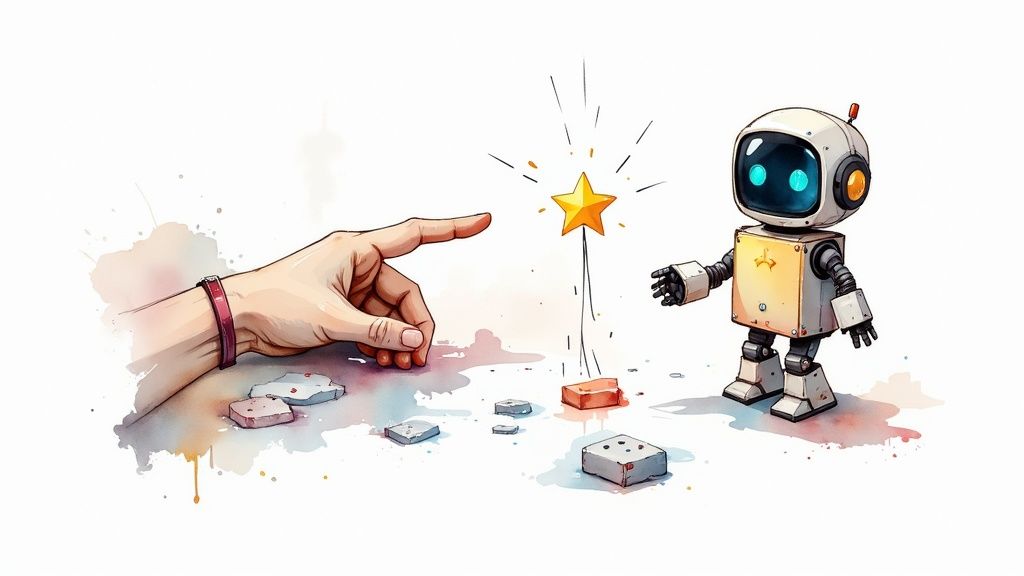
"Create a side-scrolling platformer where a tiny robot collects lost stars in a neon city. The robot can jump and the goal is to reach the portal at the end of the level. Add some simple floating enemies to avoid."
With just that one request, the AI on MakeGamesWithAI.com springs into action. In under a minute, it spits out a fully playable level, complete with:
- A little robot character you can actually control.
- A cool neon city backdrop and platforms to jump on.
- Shiny star collectibles scattered all over the place.
- Some pesky floating enemies to dodge.
- A working portal to finish the level.
Boom. You're not just staring at a drawing anymore—you're playing your game. That’s the power of turning simple words into a world.
Your AI Brainstorming Buddy
But what if your idea is still a little fuzzy? No problem. That's actually where AI shines. You can toss vague concepts at it and see what it tosses back.
- Need a theme? Just ask, "Generate five unique themes for a 2D puzzle game."
- Stuck on characters? Try, "Describe three hero characters for a fantasy brawler game."
- Want a cool mechanic? Prompt it with, "Suggest a unique gameplay mechanic for a top-down shooter."
The AI becomes your personal sounding board, spitting out ideas you can tweak, combine, or totally ignore. This creative back-and-forth is often where the most original games are born, long before you even have a "final" idea. For a deeper look at this crucial first stage, check out our guide on how to effectively prototype the gameplay.
Nailing Down Your Game's Vibe
Once you’ve got that first playable version up and running, the real fun starts. Now it’s time to dial in the look and feel of your game. This isn't about code; it's about pure creative choice.
You can dive into libraries packed with professional game assets—characters, backgrounds, items, you name it—and swap things in and out with a click. Don't like the starter robot? Drop in a sleek, chrome-plated hero instead. The neon city feel a bit too dark? Swap it for a brighter, more vibrant skyline.
This instant visual feedback is a game-changer. You're not just building mechanics in a vacuum; you're crafting an entire experience and seeing it come to life right before your eyes.
Pro Tip: Don't get hung up on perfection with your first prototype. Its only job is to answer one question: "Is this fun?" Get a basic version working, play it, and trust your gut. Iteration is everything.
This isn't just a niche trick, either. A recent Google Cloud study found that 90% of game developers are already using AI in their workflows. A massive 36% are using it for things like generating levels and dialogue on the fly. This is the new normal, and it’s making it easier than ever to build something amazing without a single line of code.
By following this flow, you can take a fleeting thought and turn it into a working prototype ridiculously fast. You're not just an ideas person anymore—you're a game maker. Now, let's get refining.
Directing Your Game with Simple Conversation
Alright, your prototype is live. Now you get to slide into the director's chair, and trust me, this is where the real fun starts. It's a universe away from the old-school way of making games.
Forget digging through scary-looking code files or trying to remember what a semicolon does. Your most powerful tool now is plain English. The entire creative process happens in a simple chat with an AI on MakeGamesWithAI.com. Some people call this "vibe coding," and it’s all about shaping your game’s feel and function with straightforward instructions.
Instead of typing something like player.jump_force = 15;, you just say what's on your mind. This direct line from your brain to the game lets you make changes incredibly fast. You stay in that creative zone without getting stuck on technical hurdles.
The Power of Conversational Editing
Think of the AI as your personal game dev, always on standby, ready to make any change you can describe. And I'm not just talking about tiny tweaks—you can reshape entire gameplay loops with just a few sentences. It feels less like programming and more like a creative jam session.
Let's go back to that little robot platformer we talked about. After playing the first version, you've probably got a notebook full of ideas. Here’s how you could bring them to life by just talking to the AI:
- Tuning the Physics: "The robot's jump feels a bit floaty. Can you increase its gravity by 20% and give the jump a little more oomph?"
- Smarter Enemies: "Make the red enemies actually patrol back and forth on their platforms. They look kind of silly just floating there."
- Adding Danger: "Let's put some spikes on the floor in the middle of the level. If the player touches them, send 'em back to the start."
- Changing the Vibe: "Change the background to a spooky forest and add some fog effects to make it moodier."
Each command gets processed instantly, and your game updates right before your eyes. You can immediately jump in, playtest the change, and decide what to do next. This super-tight iteration loop is the secret to polishing a rough idea into something that’s genuinely fun to play.
You can start building some seriously vibrant worlds with just a few prompts, creating games that look and feel incredibly professional.

Seriously, you can achieve results like this without ever having to look at a single line of code.
Fine-Tuning the Details
The conversational editor isn't just for big, sweeping changes. It’s fantastic for drilling down into the tiny details that give a game its soul. These are the little things that often get skipped in traditional development because they’re just too tedious to implement. With an AI, they’re just another quick request.
Think about these kinds of nuanced adjustments:
- Juicy Audio: "Can we make the coin pickup sound a bit more sparkly and satisfying? Like a classic arcade game."
- Visual Polish: "When the player jumps, add a small dust cloud effect right where they take off from."
- Slicker UI: "Display the player's score in the top-right corner, and let's use a cool, futuristic font."
- Living Worlds: "Create a character who stands near the portal. When the player gets close, have them say, 'Be careful! The next world is full of danger!'"
Pro Tip: Talk to the AI like you'd talk to a person. Instead of a vague "make it harder," try something specific like, "double the boss's health and make its attack pattern faster." The clearer you are, the closer the AI will get to your vision on the first go.
This level of control lets you inject your unique personality into every pixel of the game. If you're serious about building a game from the ground up, learning to communicate your vision clearly is a massive advantage. We've got even more tips in our guide on how to make your own online game.
Real-World Scenario: A Quick Level Redesign
Let’s walk through a more complex example. Imagine your first level is a bit… well, boring. It’s just a straight line of platforms. Yawn. You can completely redesign it on the fly, all from the chatbox.
Here’s how that conversation might play out:
- You: "Okay, let's scrap this level design. I want more verticality. Add three tall towers made of platforms that the player has to climb."
- AI: Instantly, the level rebuilds with three platform towers.
- You: "Nice, that's a good start. Now, connect the second and third towers with a rickety-looking rope bridge."
- AI: A bridge asset appears, connecting the two towers.
- You: "Perfect. Let's make it tricky. Put a fast-moving enemy on that bridge. And as a reward, place a health pickup at the very top of the last tower."
- AI: The enemy and health pack pop into existence.
In just a couple of minutes, you've transformed a flat, uninspired level into a dynamic challenge with real risk and reward. This is how you make a game without coding—by directing, reacting, and refining in a fluid, creative conversation. It's an awesome process that puts the focus right back where it should be: on the design and the fun.
Getting the "Game Feel" Right and Sparking Competition
Alright, you've done it. You have a game! It’s got a theme, characters, and it actually works. Pat yourself on the back. But now comes the part that separates a quick prototype from something people genuinely can't stop playing. We need to polish this thing until it shines.
This is where you stop being a director and start being a player. The very first thing to do? Play your own game. A lot. I mean, really play it. Does the jump feel floaty or satisfyingly crisp? Are the enemies a pushover, or are they frustratingly unfair? Is it even obvious what you're supposed to be doing?
Grab a notebook (digital or otherwise) and jot down every little thing that feels off. This hands-on process is where the soul of a game is forged.
Tweaking and Tuning with Your AI Co-Pilot
Got your list of grievances? Normally, this would be the point where you’d crack open a code editor and brace for a long night. Not here. With a platform like MakeGamesWithAI.com, you can make these changes just by talking to the AI.
It’s less like coding and more like giving notes to a junior developer who works at the speed of light.
- "The player character feels a bit sluggish. Can we bump up their movement speed by 15%?"
- "You know what would be cool? A double-jump. Let's add that."
- "Whoa, that second bad guy is way too fast. Let's cut its speed in half."
This back-and-forth is your secret weapon. You can have an idea, test it, and refine it again in minutes. This is how indie developers punch above their weight—by using smart tools to get the game feel just right without getting bogged down in complex systems. It's a game-changer, especially when you realize that 56% of indie devs are self-funded and need every second to count. If you're curious about this shift, you should read more about modern indie development workflows and how AI is shaking things up.
Light That Competitive Fire with Leaderboards
A fun game is one thing. A fun game where you can crush your friend's high score? That's a whole other level of addictive. Bragging rights are one of the most powerful motivators in gaming.
The great news is that a global leaderboard isn't some complex feature you have to build from scratch. On MakeGamesWithAI.com, it's already built-in. Your only job is to decide how players earn their points.
Pro Tip: A simple scoring system and a leaderboard are probably the fastest ways to add a ton of replay value. It instantly turns a solo experience into a worldwide showdown.
Start by telling the AI how to keep score. It's as easy as:
- "Give the player 10 points every time they grab a coin."
- "Let's award 100 points for squashing an enemy."
- "How about a time bonus? Give them an extra 500 points if they finish the level fast."
Once you've set the rules, the platform takes over. Every time a player logs a new high score, it's automatically added to the global rankings. Bam. Instant competition.
Just imagine your game's title up here, with players from all over the world battling for the top spot.
This isn’t just a boring list; it's a living, breathing part of your game that gives people a reason to come back day after day.
Bring in Some Fresh Eyes
Finally, you have to accept a hard truth: you're too close to your own game now. You know how to beat it, you know its quirks, and you'll miss glaring issues that a new player will spot in seconds.
It's time to share your game link. Send it to friends, family, or drop it in a relevant social media group. Ask them a few simple questions:
- Did anything confuse you right away?
- What was the most fun part for you?
- Was there any point where you just wanted to quit?
- If you could change one thing, what would it be?
This feedback is pure gold. Take their notes, thank them profusely, and head straight back to your AI editor to make those final polishes. This loop—play, get feedback, tweak with AI—is how you turn your cool little idea into a game that people will truly love.
Publishing and Sharing Your Game with the World
Alright, this is it. The moment of truth. You’ve built your game, squashed the bugs, and polished it until it shines. Now it’s time for the best part: getting it into the hands of players.
This used to be the hard part, a tangled mess of dealing with web servers or navigating the labyrinth of app store submissions. Thankfully, those days are long gone. With a platform like MakeGamesWithAI.com, you're literally one click away from being a published game developer. You hit the "Publish" button, and bam—your game is live and ready to be played by anyone with the link. It’s that simple.

But hold on. Just because it’s easy doesn't mean you should mash that button without a little prep work. A few minutes of setup now can make a world of difference in how many people find and fall in love with your game.
Setting Your Game Up for Success
Before you unleash your game upon the world, you need to give it a proper introduction. Think of it like a book cover or a movie poster—it's your chance to grab someone's attention and convince them to give your game a shot.
On our platform, this means filling out a few key details. Don't just rush through these!
- Game Title: This needs to be memorable. "My First Game" is fine for a project file, but "Cosmic Slug Annihilation" is something people will actually remember.
- Thumbnail: This is probably the most important piece. You need a killer image that screams "play me!" A screenshot of the most exciting moment of gameplay is way better than your title screen.
- Description: Here's your elevator pitch. In just a couple of sentences, tell people what's cool about your game. Use exciting language like, "Blast through alien hordes!" or "Can you top the global leaderboard?"
Pro Tip: Your game description is your best sales tool. Briefly explain the core gameplay loop and hint at the challenge. A great description sets expectations and gets players excited to jump in.
Once you’ve nailed these, you’re ready for the big reveal.
Joining a Vibrant Community of Creators
Publishing on MakeGamesWithAI.com does more than just generate a link—it puts your game right in the middle of a bustling arcade filled with other creators and eager players. Your creation gets a spot on our community games page, where thousands of people browse for their next favorite game.
This is your instant audience, a built-in community you wouldn't get just by launching a game into the void.
This community is also your best source of early feedback. Players can leave comments, tell you what they love, and point out things you might have missed. Engaging with them is huge. Thank them for playing and listen to what they have to say. It’s how you get better and build a loyal following. The general strategies for launching and getting feedback are pretty universal, whether you're building for the web or thinking bigger; you can dive deeper by exploring our guide on making mobile games.
Spreading the Word Beyond the Platform
Now it’s time to put on your promoter hat. Be your game's biggest cheerleader and share that link far and wide!
- Social Media: Post about it on Twitter, TikTok, or whatever you use. A short, punchy video of gameplay works wonders.
- Online Communities: Find relevant groups on places like Reddit or Discord. Subreddits for indie games or game dev beginners are great places to share what you’ve built.
- Friends & Family: The old-school approach! Send the link directly to your friends and dare them to beat your high score. A little friendly competition goes a long way.
The feedback you'll get from this wider audience is pure gold. It might spark an idea for your next update or even inspire an entirely new game. Hitting "publish" isn't the end of your journey; it's the start of a whole new chapter.
Got Questions About Making Games With AI?
Diving into AI game creation is a trip, but let's be real—it's new territory. You've probably got some questions rattling around in your head. Is this for real? Can I actually make a decent game this way?
Let's clear the air and tackle the big ones. I want you to walk away from this feeling totally confident and ready to build something awesome.
The number one question I hear? It's always about the "catch." Can you really build something cool and complex without touching a single line of code?
Can I Make a Real Game This Way?
You absolutely can. Platforms like MakeGamesWithAI.com are built from the ground up for exactly this. Forget wrestling with syntax and semicolons. You just talk to the AI. You describe how your character should jump, what the bad guys do, or how a puzzle should work, and the AI handles all the messy stuff behind the scenes.
Now, are you going to build the next Elden Ring on your first go? Let's manage expectations—probably not. But you can create some surprisingly deep and seriously fun platformers, puzzle games, and arcade classics with your own unique twist. The trick is to start small. Nail down one core idea, then start layering on more cool features as you get the hang of bossing the AI around.
So, What Kinds of Games Can I Make?
Honestly, the list is getting longer by the day. Right now, the world of 2D games is your oyster. We're talking about genres like:
- Side-scrolling platformers: Your classic run, jump, and bonk-the-enemy adventures.
- Top-down shooters: Think pure, chaotic arcade fun.
- Puzzle games: Build clever, brain-bending challenges.
- Story-driven adventures: Craft little worlds with dialogue and choices.
The real magic here is the speed. You can spitball an idea for a platformer, play it in minutes, and decide it’s not clicking. No problem. You can pivot to a puzzle game just by changing your prompts. It’s wild. If you need a shot of inspiration, go check out the community games page on our site. You’ll be blown away by what people are cooking up.
Think of yourself as the director, not the coder. Your job is to focus on what makes a game great—the feeling, the story, the fun factor. Let the AI be your tireless technical crew. It's a total game-changer for how to make a game without coding.
Do I Own My Game? And Can I Make Money From It?
Yes and yes! You own the creative rights to the game you design. The platform is your tool, but the idea, the world, and the final experience are all yours.
When it comes to making money, the features are still evolving. But publishing your game is the perfect way to start building a portfolio and attracting a fanbase. Think of it as your proving ground. Share your game, get people playing, and then you can point that audience to your Patreon, a Ko-fi page, or your next big project.
As these AI tools get even better, you can bet direct monetization options will become standard. For now, the mission is simple: make cool stuff and get it into people's hands.
Ready to jump in? MakeGamesWithAI is basically your own personal game studio, waiting to bring your craziest ideas to life in a matter of minutes. Build your first game completely free and see just how far your imagination can take you. Start creating your game now!