Build a Hit Hyper Casual Game in Minutes
A hyper-casual game is the simplest, most instantly playable kind of mobile game you can imagine. Using a tool like MakeGamesWithAI.com, you can create your own chart-topping game idea in minutes without writing a single line of code. Think of it less like a traditional video game and more like a digital fidget spinner—you pick it up, you get it, and it's perfect for killing a few spare minutes.
Decoding the Hyper-Casual Game Craze
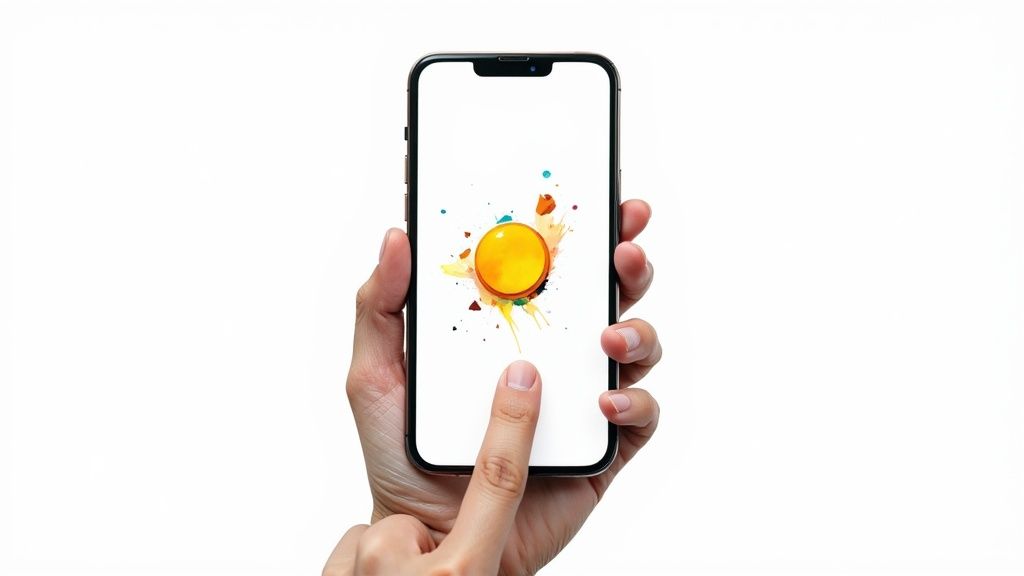
Picture this: you're waiting for the bus or standing in line for coffee. You pull out your phone, tap an icon, and you’re immediately playing. No confusing stories, no long-winded tutorials, just pure, simple fun. That’s the magic of hyper-casual. They’re the popcorn flicks of the gaming world—lightweight, easy to get into, and massively entertaining.
This dead-simple approach has lit a fire under the mobile market. The global hyper-casual scene recently hit an estimated value of USD 7.5 billion. Even wilder, projections show it rocketing to an incredible USD 21.30 billion as its universal appeal keeps pulling in players from every walk of life. You can dive into the data yourself to see just how explosive this growth is.
And all that growth? It's created a massive opportunity for new creators to jump in and make their mark.
The Rise of the New Developer
Not too long ago, making a game meant you needed serious coding skills and months, if not years, of development time. The hyper-casual boom completely flipped that script. The focus shifted from complex systems to addictive, dead-simple ideas, throwing the doors wide open for anyone with a creative spark.
This is where platforms like MakeGamesWithAI come in. They’re leading the charge to make game creation something anyone can do. Seriously. You can go from a vague idea to a playable game with leaderboards, like the ones on our global leaderboards page, in just a few minutes, all without touching a single line of code.
The core philosophy here is to focus on one simple, powerful concept that anyone can understand instantly. You're not aiming for perfection. The goal is to prototype, test, and find the fun as fast as humanly possible.
This new mindset means aspiring developers can actually compete in a huge market. It’s no longer about who has the biggest budget; it’s about who has the cleverest, most addictive idea that hooks players from the very first tap.
To really get what makes these games tick, it helps to break down their core components. This isn't just a random collection of features; it's a finely-tuned formula for creating addictive, snackable fun.
Core Pillars of a Hyper-Casual Game
| Characteristic | What It Means for Players | Why It Matters for Developers |
|---|---|---|
| One-Tap Mechanics | You can play with a single finger. No complex button combos or confusing controls. | Massively broadens your audience. Anyone, from a kid to a grandparent, can play instantly. |
| Instant Onboarding | The game starts immediately. There are no tutorials or long loading screens. | You have seconds to grab a player's attention. Getting them into the fun right away is critical. |
| Short, Snackable Sessions | A single round lasts 30-60 seconds. Perfect for playing in short bursts of free time. | High replayability. Players can squeeze in dozens of sessions a day, which means more ad views. |
| Minimalist Visuals | Clean, simple, and often colorful graphics that are easy to understand at a glance. | Faster to produce and keeps the focus entirely on the core gameplay loop without distractions. |
Ultimately, these pillars work together to create an experience that feels effortless for the player and is incredibly efficient to build and test for the developer.
Why This Genre Dominates the App Stores
So, what’s the secret sauce that makes these simple games so ridiculously successful? Their power comes down to a few key principles that create an addictive, shareable loop.
- Zero Barrier to Entry: They completely demolish the learning curve. No tutorials mean players are in the game and having fun from the first second.
- Simplicity is King: Clean visuals and one-touch controls make the games instantly understandable, regardless of someone’s gaming history.
- Built for Modern Life: The games are designed to be played in tiny, bite-sized chunks, making them the perfect companion for our on-the-go lives.
This formula has proven to be a chart-topping machine, consistently launching hyper-casual titles to the top of the app stores and opening up a whole new frontier for game makers.
Unlocking the Secrets of Addictive Game Design

So, what’s the secret sauce that makes a hyper-casual game so ridiculously addictive? It’s not some dark magic. It’s actually a brilliant, finely-tuned design philosophy built on three core pillars. Get these right, and you're on your way to a chart-topping hit.
And here’s the cool part: you can build and test these ideas in minutes using a platform like MakeGamesWithAI.com. Our conversational editor lets you slap together these core mechanics and tweak them on the fly, no code required. See what others have built on our community games page for inspiration.
These games are built for the real world—for playing with a single thumb while you’re holding onto a subway pole with your other hand. That extreme simplicity is the bedrock of their massive appeal. Let's break down the three pillars that make this whole thing work.
Embrace Simplicity with One-Tap Mechanics
Here's the golden rule for any hyper-casual game: if it takes more than one finger to play, it’s probably too complicated. One-tap mechanics are the heart and soul of the genre. They ensure that literally anyone, from your tech-savvy niece to your grandma, can pick up the game and instantly know what to do.
This design choice obliterates every possible barrier between the player and the fun. No confusing button combos, no virtual joysticks to master. The player’s only job is to tap, hold, or swipe at just the right moment. This makes the game feel incredibly intuitive and immediately rewarding, which is exactly what you need to stand out in a jam-packed app store.
Get Players Hooked with Instant Onboarding
Picture this: you download a new game, and it immediately throws you into a five-minute, unskippable tutorial. You’d delete it before the narrator finished their first sentence, right? Hyper-casual developers know this. That’s why they are masters of instant onboarding.
The moment a player opens the game, they are in the game. The core action itself is the tutorial. In a stacking game, your first tap stacks a block. Boom. You just learned the entire game by doing, not by reading a wall of text. This completely friction-free start is absolutely critical for keeping players around past the first few seconds.
The core philosophy is what some developers call "one concept impact." The goal isn't perfection; it's about creating a single, powerful idea that’s easy to grasp and instantly fun. You can explore how to rapidly bring these ideas to life in our guide to prototyping your gameplay.
Create Satisfying Gameplay Loops
Alright, this is the big one. The most powerful secret behind hyper-casual addiction is the satisfying gameplay loop. A single round is ridiculously short, often lasting just 30 to 60 seconds. This brevity is what fuels that powerful "just one more round" feeling.
Each tiny session follows a simple, hypnotic pattern:
- Action: The player performs the simple core mechanic (like tapping to jump).
- Result: They either succeed and push forward or fail spectacularly.
- Reward/Restart: They get points and a slightly harder challenge, or they can instantly restart with a single tap.
This loop delivers a constant stream of tiny dopamine hits. The quick failures aren't frustrating; they’re just invitations to try again immediately. This is the addictive cycle that keeps players coming back dozens of times a day, turning a simple little game into a full-blown obsession.
So, you’ve built a super fun, hopelessly addictive hyper-casual game. That’s awesome! But how do you actually turn all those frantic screen taps into real money? The great thing about this genre is that its money-making strategy is just as simple as its gameplay, built around methods that won't make players want to throw their phones.
The money involved here isn't pocket change, either. The top 100 hyper-casual games pulled in a staggering 2.4 billion downloads in just the first half of a recent year. In that same timeframe, they raked in $345 million from in-app purchases. It’s solid proof that simple games can be serious business when you get the monetization right. You can dig into more of these wild industry numbers in this hyper-casual gaming report.
This massive scale works because of a smart, ad-focused approach.
The Magic of Rewarded Video Ads
Let's be clear: the undisputed champion of hyper-casual monetization is the rewarded video ad. These aren't your typical, annoying pop-ups that ruin the fun. Instead, they're a simple, voluntary trade. Players choose to watch a short video, and in return, they get something cool—an extra life, a fancy power-up, or a pile of in-game coins.
This opt-in system is a total win-win:
- Players feel like they're in charge. They aren't being force-fed ads; they're making a strategic decision to get ahead.
- Developers see sky-high engagement. Because players are actively choosing to watch, they almost always finish the video, which means much better revenue for you.
Think of it like a friendly deal. The game offers a helpful boost, and the player "pays" for it with 30 seconds of their time. It's a positive exchange that keeps them playing longer and feeling good about it.
The secret is finding the right balance. You need to offer rewards that feel genuinely valuable, but you can't make the game unplayable for people who decide not to watch. The goal is to sweeten the deal, not put up a paywall.
Other Ways to Get Paid
While rewarded ads do the heavy lifting, a truly smart strategy mixes in a few other methods to bring in more revenue without annoying your players.
Interstitial Ads
These are the full-screen ads that pop up between game sessions—like after you fail a level and before you hit "retry." As long as you don't overdo it, they're a solid way to make money during the natural pauses in the game.
Banner Ads
You know these—the small, static ads that just hang out at the top or bottom of the screen. They don't make much money on their own, but their constant presence adds up, providing a small but steady trickle of income that complements the bigger ad formats.
Lite In-App Purchases (IAP)
Finally, you have what I call "IAP lite." Hyper-casual games don't have complicated virtual stores. Instead, they offer one or two simple, high-impact purchases. The absolute classic is a one-time payment to remove all ads forever. For more on where the industry is heading, check out our guide to the game dev market. This single offer is a huge win for dedicated players who hate ads, and it’s a fantastic revenue spike for you.
Build Your First Game with AI in Under 5 Minutes
Alright, enough theory. Let's get our hands dirty and actually build something. I’m serious—you can go from a spark of an idea to a playable game in less time than it takes to get a pizza delivered. The old-school way of wrestling with code for months is officially dead.
Your new home base is MakeGamesWithAI.com. This isn't one of those intimidating game engines with a million buttons. You start with a simple text box. That’s it. Just tell the AI what you want. "A corgi on a skateboard dodging fire hydrants." "A UFO abducting cows." Type it out, and watch the AI spit out a working game with all the basic art and mechanics ready to go.
Fine-Tune Your Fun with Conversational Editing
Now for the fun part. Your first draft is ready, but you want to put your own spin on it. Forget digging through confusing menus or learning a scripting language. You just… talk to the AI.
It’s like having a programmer sitting next to you. Type, “Make the corgi jump a little higher,” and it happens. Say, “Change the background to a sunny beach,” and boom, you’re at the coast. This back-and-forth turns game design into a creative jam session, letting you test ideas as fast as you can think of them.
This is a massive leg up in the hyper-casual world. Speed is everything. You can bash out a dozen prototypes in an afternoon, quickly figuring out which ideas have that magic spark and which ones are duds.
We’re trying to tear down the wall between your imagination and a finished game. You're not a coder here; you're the director. You guide the AI, and it handles the grunt work, freeing you up to focus on what actually matters: making something fun.
Add Competition and Share Your Creation
What’s a game without a little friendly rivalry? With a single click, you can plug in a global leaderboard, pulling right from our global leaderboards page. Suddenly, players from all over the world are battling for the high score in your game. Talk about an instant engagement boost.
Once you’ve polished your little gem, publishing is just as painless. One click, and your game is live on the web with a link you can share anywhere. Text it to your friends, blast it out on social media, and start getting real feedback in minutes. That immediate reaction is pure gold for figuring out what to tweak next.
Need a shot of inspiration? Go check out the wild stuff our community has already cooked up on the community games page. You’ll see just how far you can push a simple idea. For a full-blown walkthrough of the entire process, our guide on how to create a game app has you covered. It's never too early to start thinking about making a little cash, either.
This flowchart breaks down the typical monetization path for a hyper-casual hit, from rewarded ads to those small, optional purchases.
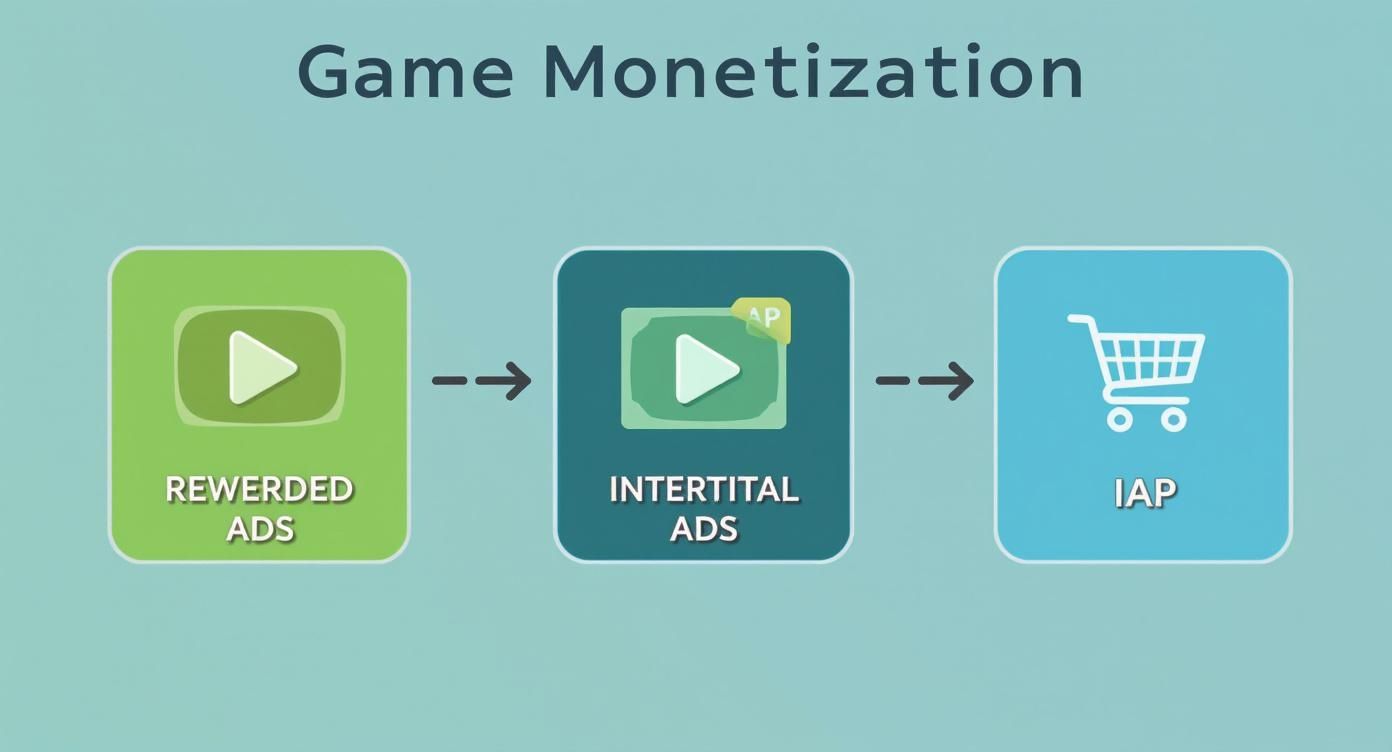
As you can see, the goal is to ease players in with ads that feel like a fair trade for a reward, with the option for your biggest fans to buy small perks directly.
Making Sense of the Numbers: Key Metrics and Classic Mistakes
So, you’ve shipped your game using MakeGamesWithAI.com, and people are actually playing it. Awesome! But now for the million-dollar question: is your game a hidden gem or just a fun little experiment? The answer lies in the data. You can easily add a leaderboard to your game and watch players compete globally by checking our global leaderboards page.
Don’t let the term "Key Performance Indicators" (KPIs) intimidate you. It’s just a fancy way of saying you need to watch a few key numbers to see if players are truly hooked. The hyper-casual market is a whirlwind; one week you're up, the next you're down. Just look at a titan like Block Blast! — its weekly downloads once rocketed from 631,000 to a staggering 870,000, with a weekly active user base hovering around a massive 8.7 million. As you can see in this deeper dive into hyper-casual trends, things change in the blink of an eye. You've got to keep your finger on the pulse.
The Numbers That Actually Matter
Forget about getting lost in a sea of spreadsheets. For a hyper-casual game, you really only need to watch a few vital signs to know if you've got a hit on your hands. These are the metrics that give you a clear, no-nonsense picture of what’s working and what’s not.
-
Day 1 Retention: This is the big one. It's the percentage of players who come back for more the day after they first install. If you're hitting around 35% or higher, that's a fantastic sign that your core loop is genuinely addictive. It’s your game’s first and most important handshake with the player.
-
Session Length: How long are people sticking around in one go? We’re not aiming for epic gaming marathons here. A healthy session in the hyper-casual world is just a few minutes—long enough for a player to get in, have a few satisfying rounds, and get out.
-
Ad Click-Through Rate (CTR): This is how you'll keep the lights on. It measures how many players are willing to tap that "Watch Ad for a Reward" button. A high CTR tells you that your in-game rewards are compelling enough to make watching an ad feel like a fair trade, which is the heart and soul of hyper-casual monetization.
Rookie Mistakes That Will Sink Your Game
Knowing your numbers is only half the story. You also have to steer clear of the classic traps that snare so many new developers. Countless promising games have fizzled out not because the idea was bad, but because of a few simple, avoidable stumbles that drain all the fun out of the experience.
The moment you catch yourself thinking, "You know what this needs? A skill tree," you've completely lost the plot. Simplicity isn't just a design choice in hyper-casual; it's the entire product.
Watch out for these game-killers:
-
Overcomplicating the Core: The magic of hyper-casual is its one-tap, instant-gratification mechanic. The second you add another button, a confusing rule, or a clunky objective, you’re creating friction. Players came for simplicity, so stick to one deeply satisfying action.
-
Aggressive Ads: Nothing makes a player hit the uninstall button faster than being bombarded with ads. Shoving a full-screen, unskippable video in their face after every single attempt isn't monetization—it's just plain annoying. Be respectful. Space out your ads and lean heavily on rewarded videos that players choose to watch.
-
Ignoring Player Feedback: Once your game is out in the wild, your players become your most valuable consultants. If they're all saying a level is frustratingly hard or a feature makes no sense, listen up! A failure to iterate based on what real people are saying is a one-way ticket to a dead game.
Hyper Casual KPI Benchmarks vs. Common Pitfalls
To make it even clearer, here’s a quick-glance table comparing the goals you should be aiming for with the common mistakes that will hold you back.
| Metric (KPI) | Good Target | Common Pitfall That Hurts This Metric |
|---|---|---|
| Day 1 Retention | 35%+ | Confusing Onboarding. If players don't "get it" in 3 seconds, they won't come back tomorrow. |
| Session Length | 2-5 Minutes | Lack of a "Just One More Try" Loop. If losing feels punishing instead of motivating, sessions get cut short. |
| Ad CTR | 15-25% | Worthless Rewards. Offering a lame reward (like 10 extra coins) for a 30-second ad is a bad deal. Players will ignore it. |
| DAU/MAU Ratio | >0.15 | Boring Progression. If the game feels the same on day 10 as it did on day 1, there's no reason for players to stick around. |
Think of this table as your cheat sheet. If you can stay on the "Good Target" side of things, you’re well on your way to building a game that people not only play but also love coming back to.
Got Questions About Making a Hyper-Casual Game? Let's Talk.
So, your head is buzzing with game ideas, but a few nagging questions are holding you back. Good. That's the perfect place to start. Let's tackle the common hurdles that trip up new creators and see how tools like MakeGamesWithAI.com are built to tear them down. You can check out our community games page to see what's possible.
Think of this as your cheat sheet for getting started with confidence.
What’s This Going to Cost Me?
This is usually the first question on everyone's mind, and the answer has changed dramatically. A few years ago, you'd be looking at a serious budget for developers, artists, and software—easily running into thousands of dollars just to get a simple game off the ground.
Today? That cost has basically evaporated.
Using a platform like MakeGamesWithAI, you can build and launch your first game for free. No credit card, no hidden fees. You get to test your ideas, prototype concepts, and share your creation without spending a single cent. If you fall in love with the process and want to build a whole library of games, you can jump on a simple monthly subscription. The days of needing a fat wallet to be a game developer are officially over.
Okay, But I Can't Code. Is That a Dealbreaker?
Not anymore. This is probably the single biggest myth that scares people away from making games. Traditional game development is absolutely steeped in code, but the new AI-powered tools have flipped the script entirely.
The whole philosophy behind a platform like ours is to let you create through conversation. You’re not wrestling with syntax or debugging code; you’re just telling the AI what you want in plain English. This frees you up to focus 100% on what makes a game fun, not the technical grunt work.
It’s like this: you don’t need to be an electrical engineer to use a microwave. You just need to know what you want to make. In the same way, you don't need to be a programmer to tell an AI what kind of game to build.
How Long Does It Really Take to Make One of These?
Forget everything you've heard about giant studios spending years on a single title. The hyper-casual world moves at lightning speed. With an AI generator, you can go from a simple idea to a playable prototype in under five minutes. Yes, you read that right.
From that initial spark, you might spend a couple of hours (or a fun weekend) fine-tuning the gameplay in the conversational editor, adding a competitive leaderboard, and polishing the look and feel. The magic of this approach is pure velocity—you can experiment with a dozen different ideas in the time it used to take just to get a character to jump correctly.
What Happens If My First Game Flops?
Welcome to the club! Seriously, this is part of the process. The most successful hyper-casual creators don’t sit around waiting for a single stroke of genius. They embrace a rapid-fire "test and trash" mindset. They build something small, get it in front of people, and look at the numbers. If it’s not grabbing players, they drop it and immediately move on to the next concept.
- Failure is Fast: The goal isn't to avoid failure; it's to fail as quickly and cheaply as possible.
- Data Over Drama: Let the metrics tell you if an idea has legs. Don't get emotionally attached to a game that players aren't enjoying.
- Volume is Your Friend: Your first nine ideas might go nowhere. Your tenth could be the one that explodes.
This is where building with AI gives you an almost unfair advantage. It lets you churn through concepts and find that one golden idea without sinking months of your life into a project that was doomed from the start.
Ready to stop thinking and start making? With MakeGamesWithAI, you can turn your idea into a real, playable game in minutes. Go from a simple text prompt to a finished game with global leaderboards, ready to share with the world in just one click. Start creating your first hyper-casual game now.