Making Mobile Games Without Any Code
Making mobile games used to be a serious grind. I'm talking months, even years, spent buried in coding books and wrestling with complicated software. But things have changed. Drastically. Now, the quickest way to get that awesome idea out of your head and onto a screen is by letting AI do the heavy lifting. With a platform like https://makegameswithai.com/, you can literally talk your game into existence, share it with a single click, and watch players compete on the built-in global leaderboard page.
Your No-Code Shortcut to Building Mobile Games
Let's be real: the dream of making a hit mobile game often dies a quiet death when faced with the harsh reality of coding. Traditional game development is a beast. It demands you learn programming languages, get your head around clunky game engines, and pour endless hours into tasks that feel more like homework than creating something fun. It's a massive barrier that has kept countless brilliant game ideas from ever seeing the light of day.
But what if you could just… skip all of that? Imagine describing your game in plain English and watching it build itself. That's not science fiction anymore; it's the new way of making games, and it's all thanks to conversational AI. Think of https://makegameswithai.com/ as your personal, on-demand development team, ready to turn your vision into a real, playable game without you writing a single line of code.
An Idea is All You Need
Forget everything you've heard about needing to be a coding genius to make games. The most critical piece of the puzzle has always been, and will always be, a great idea. This new AI-first approach puts your idea in the driver's seat by kicking all those technical hurdles to the curb.
You're no longer stuck choosing between a multi-year coding bootcamp or giving up on your dream. The tools we have now let you:
- Build in Minutes: Go from a wild concept like "a pirate squirrel collecting golden acorns" to a working prototype faster than you can brew a cup of coffee.
- Change Anything, Anytime: Don't like how something works? Just tell the AI. You can tweak gameplay, add features, and experiment on a whim.
- Stay Creative: Spend your energy where it matters most—designing awesome levels, dreaming up cool characters, and making your game fun—instead of hunting down that one misplaced semicolon that's crashing everything.
This isn't just a convenience; it's a game-changer. The mobile gaming world is absolutely booming. We're talking a market projected to rocket past $125 billion by 2025, with an estimated 49 billion game downloads happening in 2024 alone. That's a massive audience starving for fresh, unique games. Your game.
So, How Does This Magic Work?
The whole process is incredibly simple. Instead of being slapped in the face with a terrifyingly blank coding screen, you get a clean, friendly chat window. You just start typing, describing the game you want to make.
It really is that easy. Here's the starting screen on https://makegameswithai.com/. No clutter, no confusing menus—just a clear path to start creating.
This conversational editor is your command center. You can type things like, "make the player a knight who can double jump" or "add an enemy goblin that throws rocks," and the AI just… does it. Instantly. This back-and-forth—describing, testing, refining—is the heart of no-code game development.
It's a world away from the old method of fighting with complex tools. If you're curious about how the old school compares, you might want to check out our guide on the best 2-D game engines to see just how much easier this new AI-first approach is. You get to focus on the fun, playtesting and perfecting your game in real-time.
To really drive the point home, let's look at how the old way of making games stacks up against this new AI-powered method.
Traditional Game Development vs The AI Approach
See how the old way of making games stacks up against the new AI-powered method you'll use on MakeGamesWithAI.
| Milestone | Traditional Path | The MakeGamesWithAI Way |
|---|---|---|
| Concept | Whiteboards, design docs, flowcharts. Days or weeks of planning before any action. | Type your idea into a chat box. |
| Prototype | Weeks of coding to build a basic, often clunky, version. Requires engine expertise. | Get a playable prototype in minutes, just by describing it. |
| Adding a Feature | Write new code, debug, integrate with existing code, recompile. Can take hours or days. | "Add a power-up that makes the player invincible for 5 seconds." Done. |
| Fixing a Bug | Hunt through hundreds of lines of code to find the problem. Frustrating and time-consuming. | "The player is falling through the floor." The AI fixes it. |
| Iteration | A slow, painful cycle. Small changes require significant technical effort. | A fast, fun conversation. Tweak and test ideas on the fly. |
| Publishing | A complex process involving build configurations, app store submissions, and waiting. | Click a button. Your game is live and shareable instantly. |
As you can see, it's not even a fair fight. The AI approach removes virtually all of the friction, letting you jump straight to the creative, fun part of bringing a game to life.
Bringing Your First Game to Life with AI
Alright, this is where the fun really begins. We’re done with the theory and ready to get our hands dirty. It’s time to actually start making a game by just talking to the AI over at https://makegameswithai.com/. We’re about to go from a vague idea—like "a sci-fi adventure platformer"—to actually steering the ship, giving direct commands, and watching them pop up on screen in seconds.
Forget learning a new programming language. This is all about having a conversation. Think of the AI as your creative sidekick, ready to build whatever you can dream up, piece by piece. You're the director, and it's your entire production crew.
It's a complete flip of the old-school game-making process.

This image nails it. The AI path just erases all the usual friction, letting you leap straight from a cool idea into pure creation.
Speaking Your Game into Existence
Let's cook up something simple, like a classic platformer. Instead of busting out the graph paper or writing a long design doc, your first move is just a simple text prompt.
You can start super broad:
"Create a 2D platformer game set in a spooky forest."
Poof. The AI throws a basic level on the screen with a placeholder character. Now the real magic starts. You get to refine it with specific commands, each one layering on top of the last.
- Who’s the star? "Change the player character to a cat with a jetpack."
- What’s the point? "Add glowing mushrooms for the cat to collect. The goal is to collect 10 mushrooms."
- What’s the catch? "Add floating platforms that disappear a second after the cat touches them."
With every sentence you type, the game morphs right in front of you. There’s no waiting for code to compile or assets to load. You're just in the flow, iterating in real-time. That instant feedback is what makes this so addictive—and powerful.
Choosing Your Style and Nailing the Vibe
A game is so much more than its rules; it's about the whole vibe. The AI gives you access to a library of professional game assets, but picking the right ones is where your creativity shines. You can swap out characters, backgrounds, and items just by asking.
For instance, you could tell it:
"Change the disappearing platforms to look like old wooden planks."
"Make the forest background darker and add some fog."
And it’s not just about looks. You can fine-tune the physics with plain English. If your jetpack cat feels a little too floaty, just say, "Make the player's gravity stronger." If the jumps aren't quite high enough, tell the AI, "Increase the player's jump height." It’s an incredibly intuitive way to dial in the exact gameplay feel you're going for without touching a single slider or number.
My two cents: When you're just starting, go wild! The beauty of this conversational editor is that nothing is set in stone. Try out a bunch of different characters, mess with the rules, and just see what feels fun. You might accidentally discover an awesome game mechanic you never would have planned.
If you want to find some killer art for your game, our guide on where to find free 2D game assets is packed with resources to get you started.
Building Out the Gameplay Loop
Okay, you’ve got your basic movement and a cool environment. Now it’s time to add the juicy stuff like enemies and scoring. This is where your creation starts to feel like a real, complete game.
Here’s how you could build out the action, step-by-step, just by talking:
- Introduce a baddie: "Create an enemy that looks like a ghost. It should patrol back and forth on its platform."
- Set the rules of engagement: "If the player jumps on the ghost's head, the ghost disappears and the player gets 10 points. If the player touches the ghost from the side, the player loses a life."
- Bring in the big boss: "At the end of the level, create a large ghost boss that shoots projectiles at the player."
This conversational approach turns what would normally be hours of tedious coding—figuring out collision detection, enemy patrol paths, and projectile logic—into a few simple sentences. It almost feels like cheating.
Alright, you’ve got a game. It’s fun, the gameplay is tight, and you're pretty proud of it. But let's be honest, what turns a simple game into a full-blown obsession? Bragging rights.
Nothing hooks a player like the primal urge to be the best. To see their name at the top of a list, just one spot higher than their friends… or some random person halfway across the world. This is where we inject that addictive, competitive magic into your creation.
Sparking Competition with Global Leaderboards
A scoring system is a good start, but it's only half the battle. The real magic happens when players can see exactly how their skills stack up against everyone else who has ever played.
With MakeGamesWithAI.com, adding a leaderboard isn't some soul-crushing, week-long coding nightmare. It’s already done for you. Seriously. Every single game made on the platform automatically gets its own global leaderboard from the get-go.
Tap into the Power of Being #1
The psychology behind it is dead simple, but man, is it effective. Leaderboards give people a goal that goes way beyond just "beating the game." It creates a powerful feedback loop that keeps them coming back for more.
- A Real Sense of Achievement: Seeing your name—even if it's "FluffyBunny123"—climbing the ranks feels good. It's a tangible reward.
- Infinite Replayability: A leaderboard gives players a concrete reason to play the same level over and over, trying to perfect a run to shave off a few seconds or squeeze out a few more points.
- Building a Community (of Rivals): Suddenly, your game isn't a solo experience. It’s a worldwide tournament.
This one feature instantly plugs your game into a wider ecosystem. It’s not just floating in the digital void; it’s part of the action you can see on the global leaderboard page, putting your creation right alongside other popular games.
Here’s a peek at what that looks like in the wild.
It’s clean, simple, and laser-focused on what players care about: rank, name, and the score they need to crush. It turns a casual playthrough into a determined mission.
Designing a Score That Actually Matters
Since the tech side of the leaderboard is handled, your job is to make the score itself mean something. A great scoring system is easy to understand on the surface but has hidden depths for dedicated players to master. It should always reward skill, not just mindless grinding.
Think about adding a few layers to your scoring logic:
- Reward Speed: Got a time-based level? Add a massive point bonus for finishing fast.
- Encourage Flair: Award extra points for sick combos, finding all the secrets, or taking out enemies in a particularly cool way.
- Introduce High-Stakes Risks: Place a collectible worth a boatload of points in a ridiculously dangerous spot. This gives the pros something to shoot for and a reason to risk it all.
For instance, in a platformer, you could just tell the AI, "Give the player 500 bonus points for finishing the level without taking damage." Boom. You've just created a "perfect run" challenge. For a shooter, try, "Add a score multiplier that increases by 1x for every 5 enemies defeated in a row without missing a shot." These simple commands add a ton of depth to the chase for that high score.
My Two Cents: Go big with the numbers. Getting 10 points feels fine, I guess. But earning 10,000 points? That feels epic. Don't be shy about inflating your scores to make achievements feel more momentous. It’s a simple psychological trick that flat-out works.
When you nail the scoring and tie it into the automatic global leaderboard, you’re not just making a game anymore. You're building a competitive arena. You're giving players a reason to care, to practice, and to come back tomorrow to reclaim their spot on top. That’s how a little project can blow up into something huge.
Publishing Your Game to the World, Instantly
Alright, let's get to the part that usually gives developers a nervous twitch: publishing. In the old world, this is where your creative momentum would slam into a brick wall of technical checklists, app store guidelines, and a waiting game that could test the patience of a saint.
What if you could just… sidestep all of that nonsense? With https://makegameswithai.com/, the whole concept of a stressful, drawn-out launch is officially a thing of the past. Forget wrestling with developer portals. The second you feel your game is ready for fresh eyes, you should be able to share it. Here, publishing isn't a two-week ordeal; it's a single click.
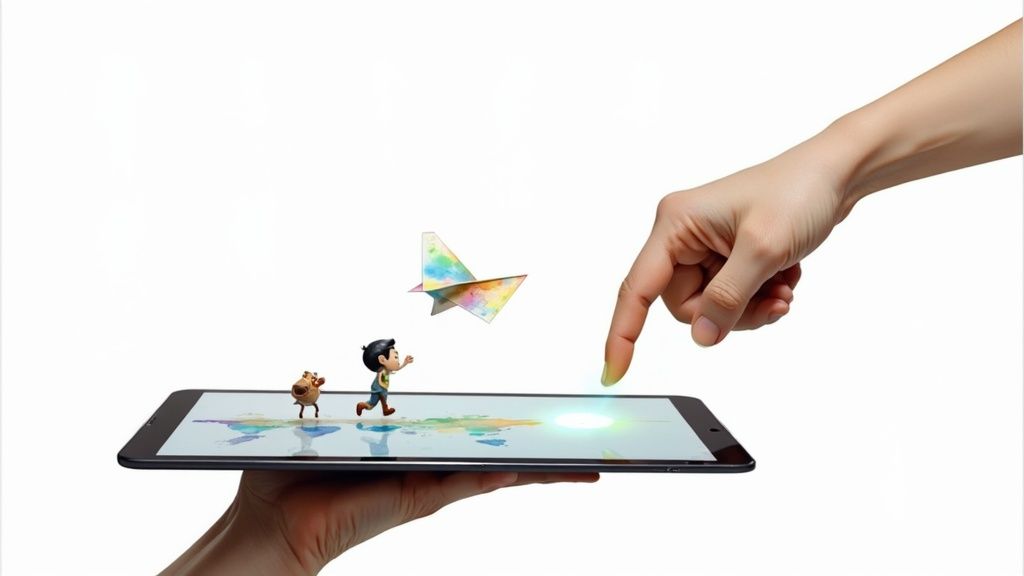
This completely flips the script on making mobile games. "Publishing" stops being this big, scary final exam and becomes just another tool in your creative toolbox.
From Editor to Live in Seconds
The process is so simple it's almost funny. Once you're happy with how your game is running in the conversational editor, you just hit the publish button. Seriously, that’s it. No compiling code, no uploading builds, no waiting for a review board to pass judgment on your creation.
The AI immediately spits out a unique, shareable web link. This link is your golden ticket. You can text it to your friends, slap it on your social media, or drop it in a Discord server. Anyone who clicks can instantly play your game on their phone or computer—no downloads or installations needed.
This instant deployment lets you create at the speed of your imagination.
- Have a wild idea for a new level at 2 AM? Build it, publish it, and get your friend's opinion before you even have your morning coffee.
- Someone spots a bug? Fix it with a quick prompt and republish the corrected version on the spot.
- Not sure if a boss is too hard or too easy? Publish two different versions and let your players decide.
This tight loop of rapid-fire creation and immediate feedback is what truly separates this modern approach from the slow, plodding methods of yesterday.
The Power of the First Wave
That initial feedback you get is pure gold. It’s the raw, unfiltered reaction from the very first people to touch your game, and it’s priceless. Sharing that fresh game link is the fastest way on Earth to find out what’s clicking with players and what’s falling flat.
You’ll learn things you could never figure out on your own. Maybe a jump feels just a little too floaty, a puzzle is more confusing than clever, or an enemy has a glaringly obvious weak spot you never saw. These first players become your unofficial QA team.
Don't chase perfection before you hit that first publish button. The goal is to get something "good enough" into people's hands. Think of it less as a grand premiere and more as an open house party where you’re asking for help arranging the furniture.
This is a fundamental truth for new game makers. It’s a million times better to release a fun but slightly flawed game and polish it with real-world feedback than to spend six months perfecting a game in a vacuum, only to find out the core idea isn't fun. For a deeper look at nailing that core experience, check out our guide on how to make a platformer game for some solid advice.
Joining a Community of Creators
When you publish on MakeGamesWithAI, your game doesn’t just get tossed into the void. It immediately becomes part of a living, breathing ecosystem of other games made by people just like you. Your project gets featured on the public community games page, where players are actively hunting for their next favorite thing.
This gives you a built-in source of players without having to spend a dime on marketing.
Benefits of Instant Community Access
- Discovery: Players can discover your game simply by browsing the collection.
- Inspiration: Seeing what other people are building is an incredible way to spark new ideas for your own projects.
- Competition: Because your game’s leaderboard is live from day one, you’re instantly part of a global contest, pushing players to fight for that top spot.
This seamless pipeline from idea to publication to community is what makes this so powerful. It vaporizes the technical roadblocks, letting you focus entirely on the fun part: designing the game. You get to make your game better, not fight with submission forms. The platform handles the boring stuff so you can get your game out into the world faster than ever.
Getting Your Game in Front of Actual People
Alright, you did it. You pushed the button, and your game is officially live on https://makegameswithai.com/. Take a second to celebrate that win! But don't rest for too long, because now the real adventure starts. Building the game is one thing; getting people to actually play it is a whole different beast.
Forget about spending a dime on marketing. As a new creator, your most powerful tools are your own enthusiasm and the people you know.
That instant publish link you got? It's now your golden ticket. The first move isn't some big, flashy launch. Think of it more like a "friends and family" soft-launch. Blast that link out to everyone—your friends, your parents, your coworkers, even that one cousin who's glued to their phone playing games. Their initial reactions are pure gold.
This inner circle will give you the raw, honest feedback you desperately need to find those weird bugs and polish the rough spots. Plus, they’ll be the first ones to post scores on the global leaderboard, which is a huge deal. Nothing kills a new game faster than an empty leaderboard; you need it to feel alive and competitive from the get-go.
A Killer Gameplay Clip is Your Secret Weapon
Let's be real: we all live in a world of endless scrolling. A fantastic gameplay clip is how you stop the scroll. People are way more likely to tap a link if they see a glimpse of the action first. You don't need a Hollywood production budget, either. Just screen-record a genuinely exciting moment from your game.
Need some ideas? Try capturing clips of:
- The "No Way!" Moment: Record your character pulling off a ridiculously difficult jump or maneuver.
- The Final Showdown: Show those last few chaotic seconds of a tough boss fight.
- The Perfect Run: Nothing beats a fast-paced montage of a player racking up a massive combo or an insane high score.
- The Hilarious Fail: Don't underestimate the power of a funny bug or a spectacular, unexpected death. These are often the most shareable clips!
Keep your clips short and sweet—think 15-30 seconds, max. Then, unleash them everywhere you can: TikTok, Instagram Reels, X (what we all still call Twitter), and Reddit. And here’s the most important part: always, always put the direct link to your game right there in the post or in your bio. You have to make it brain-dead simple for someone to go from watching your clip to playing your game.
Pro Tip: Don't just post a video and walk away. Ask a question! Something as simple as, "Think you can top this score? Game link in my bio!" can make a massive difference in how many people actually click through.
Jump Into the Indie Dev Scene
You're not doing this alone. Seriously, one of the best no-budget marketing tactics is to connect with communities of players and other developers who are already hungry for new games. This is where being on a platform like ours really helps.
Your first stop should be the MakeGamesWithAI community games page. This is your home turf, filled with a built-in audience of fellow makers and curious players. Share your game, tell the story behind it, and chat with other people on the exact same journey.
From there, branch out to other indie hotspots online:
- Reddit: Places like r/IndieGaming, r/gamedev, and r/playmygame are full of people actively looking to try new stuff.
- Discord: Hunt down servers dedicated to indie games or even a specific genre that fits your game.
- itch.io: Even though your game is hosted here, you can set up a project page on itch.io and link back to it. It’s a great way to tap into their super passionate community.
When you post in these places, don't just be a link-spammer. Introduce yourself, talk about what makes your game fun or weird or special, and then—this is key—ask for feedback. People are so much more willing to check something out when they see a real person behind it who actually cares. This grassroots approach doesn't just get you your first players; it starts building your reputation, which is the first step to creating some real buzz.
Got Questions? We've Got Answers.
Jumping into AI game development is exciting, but it's natural to have a few questions swirling around. Let's tackle some of the most common things we hear from new creators firing up https://makegameswithai.com/ for the first time. This is your cheat sheet for getting started with total confidence.
Seriously, Zero Coding? You Mean It?
Yes, we absolutely mean it. The entire platform is built around a conversational AI editor. You just… talk to it.
You describe your game, the rules, the characters, and what you want to happen, all in plain English. The AI does all the heavy lifting, translating your ideas into clean, functional code behind the scenes. Forget syntax errors and debugging nightmares. If you can explain your idea to a friend, you have all the skill you need to build a game right now.
Okay, But What Kind of Games Can I Actually Make?
You'd be surprised at the sheer variety you can pump out. The AI excels at crafting all sorts of awesome 2D games that people can't put down. Think of things like:
- Classic Platformers: We're talking epic side-scrolling adventures full of collectibles and death-defying jumps.
- Top-Down Shooters: Pure, fast-paced chaos. You, your ship, and waves of enemies. Simple, addictive fun.
- Arcade High-Score Chasers: The kind of games that are easy to learn but impossible to master, perfect for climbing those global leaderboards.
- Puzzle and RPG Hybrids: Why stick to one genre? Mix in some puzzle mechanics or light RPG elements to create something totally unique.
The system is incredibly flexible. Don't just take our word for it—head over to the community games page and see the wild stuff other creators are building. It’s a goldmine of inspiration.
Can I Get Rich From These Games?
Let's be real: our main goal is to get you from a spark of an idea to a playable game that people love, instantly. It’s about creation and sharing, first and foremost.
That said, many creators use the platform as a rapid-prototyping tool. They build a quick version, test the core concept, and see if it gets traction. Building a fun game and finding an audience is always the first, most crucial step before you can even think about monetization. Nail that, and you've built the foundation for whatever comes next.
Alright, enough talk. It's time to build. MakeGamesWithAI gives you everything you need to turn that game idea in your head into a reality in minutes, not months. Go ahead, start building your first game for free!