What is AI in Gaming? A 2026 Explainer
From the ghosts in Pac-Man to the hyper-realistic adversaries in today’s AAA titles, artificial intelligence has always been the invisible force powering our favorite video games. But in 2026, the answer to the question “what is AI in gaming” has evolved dramatically. It’s no longer just about creating a challenging opponent; it’s about building living, breathing worlds, personalizing player experiences, and even revolutionizing how games are made.
AI is the engine of immersion. It dictates how a stealthy enemy patrols its route, how a friendly companion reacts to your choices, and how an entire galaxy can be generated from a single line of code. This guide will break down what AI in gaming truly means today, why it’s more important than ever, and how it’s shaping the future for both players and creators.
Why AI in Gaming is a Game-Changer in 2026
Artificial intelligence has moved from a background feature to a headline innovation. Its growing importance stems from its ability to enhance games on multiple levels, making them more engaging, dynamic, and accessible than ever before.
- Enhanced Player Experience: Modern AI creates more believable and unpredictable non-player characters (NPCs). Instead of following rigid, pre-programmed paths, they can now learn from player behavior, coordinate in complex groups, and display emergent behaviors that make the game world feel truly alive.
- Unprecedented Scale and Replayability: AI-driven procedural content generation (PCG) allows developers to create vast, unique worlds without having to manually design every single asset. This results in games with near-infinite replayability, where every playthrough offers a new map, new quests, or new challenges.
- Democratized Game Development: Perhaps the most significant shift in 2026 is how AI is empowering creators. New tools are automating complex tasks like coding, asset creation, and level design, opening the doors for anyone with a creative vision to build and publish their own games.
The Core Components of AI in Games
To truly understand AI’s role, it’s helpful to break it down into its primary functions within a game. Think of these as the different jobs AI performs to create a cohesive and interactive experience.
Non-Player Characters (NPCs): The Brains of the Operation
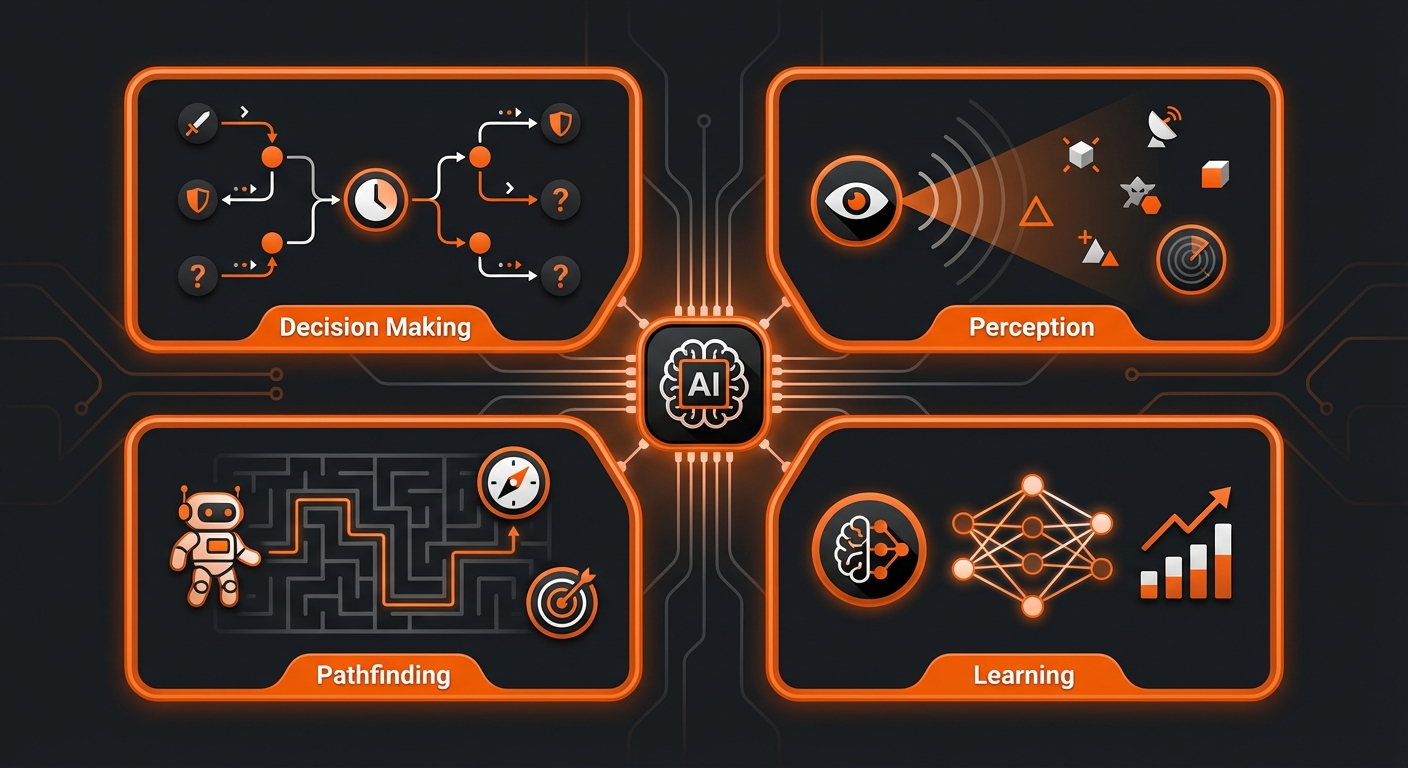
When most people think of AI in games, they think of NPCs. These are the characters you aren’t controlling, from the shopkeeper in a village to the final boss in a dungeon. For decades, their behavior was governed by simple logic systems like Finite State Machines (FSMs), where a character is always in a specific state (e.g., patrolling, chasing, or attacking).
Today, things are far more sophisticated. Developers now use advanced techniques like Behavior Trees and, increasingly, machine learning models. A modern AI-driven NPC can:
- Learn from the Player: An enemy might notice you always use a specific corner for cover and adapt by flushing you out with a grenade.
- Communicate and Strategize: A squad of enemies can coordinate their attack, with one providing suppressing fire while others flank your position.
- Exhibit Realistic Emotions: Companion characters can react dynamically to the story and your actions, forming a more believable bond with the player.
Creating compelling characters is a cornerstone of good game design. AI provides the logic that makes them feel intelligent and real, a crucial step in learning how to create characters in games: a 2026 guide.
Procedural Content Generation (PCG): Building Infinite Worlds
Procedural Content Generation is a technique where AI algorithms, rather than human designers, create game content. This can range from generating the terrain of an entire planet to placing trees, enemies, and treasure chests in a dungeon.
Think of it like giving the AI a set of rules and a box of LEGOs. The AI follows the rules—for instance, “dungeon rooms must be connected by hallways” and “boss rooms must appear at the end”—but uses the LEGOs to build a unique structure every time. This is the magic behind games like No Man’s Sky, with its quintillions of unique planets, and roguelikes like Hades, where the layout of the underworld changes with each escape attempt.
PCG provides massive benefits:
- Vast Content on a Small Budget: Small teams or solo developers can create games with a scope that would have previously required a massive studio.
- High Replay Value: Since the game world is different each time, players are encouraged to come back for new experiences.
- Surprise and Discovery: Players can never be sure what’s around the next corner, fostering a genuine sense of exploration.
Dynamic Difficulty Adjustment: A Personalized Challenge
One of the toughest challenges in game design is balancing difficulty. Make a game too hard, and players get frustrated; make it too easy, and they get bored. Dynamic Difficulty Adjustment (DDA) is the AI-powered solution.
An AI with DDA monitors your performance in real-time. If you’re struggling to defeat a certain type of enemy, the game might subtly reduce their health or accuracy. Conversely, if you’re dominating every encounter, the AI might introduce more formidable foes or more complex attack patterns. The goal is to keep the player in a state of “flow”—perfectly balanced between their skill level and the game’s challenge.
The New Frontier: Generative AI in Game Development
The most transformative aspect of what is AI in gaming in 2026 isn’t just how it powers the games we play, but how it helps us create them. Generative AI models can now produce code, art, music, dialogue, and even entire game mechanics from simple text prompts.
This paradigm shift is breaking down the technical barriers that once kept aspiring creators on the sidelines. You no longer need to be a programmer or a 3D artist to bring a game idea to life. This is the core philosophy behind platforms like MakeGamesWithAI, which leverage AI to turn your ideas into playable games in seconds. By describing what you want, the AI can generate the necessary code and assets, allowing you to focus purely on the creative aspects of design and storytelling.
If you’re curious about the specifics of this revolution, exploring how to use AI in game creation: a 2026 guide will give you a deeper understanding of the tools and techniques available today.
Key Takeaways: Understanding AI in Gaming
To summarize, here are the essential points to remember about the role of AI in the modern gaming landscape:
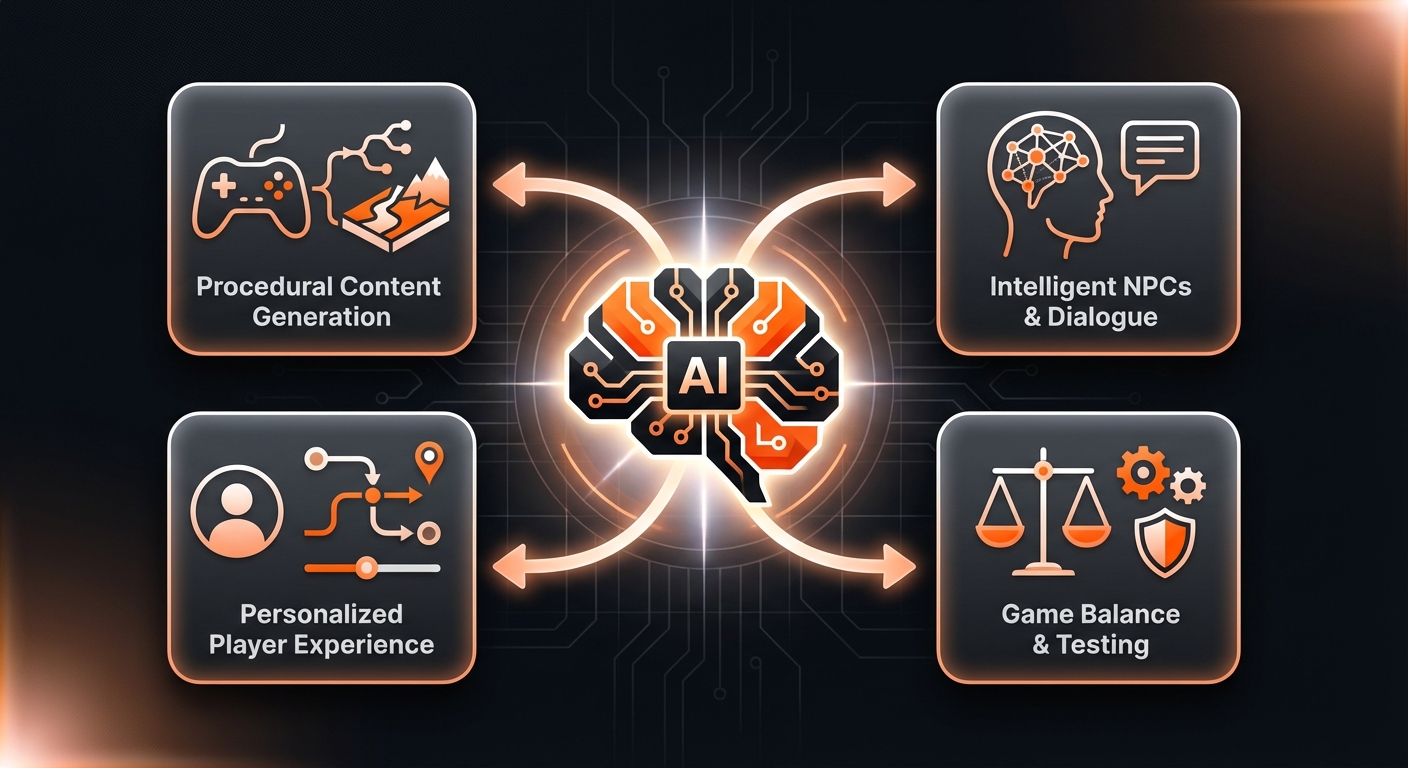
- AI is Multi-Faceted: It’s not just about smart enemies. It encompasses everything from intelligent NPCs and procedurally generated worlds to personalized difficulty and player analytics.
- It Creates Deeper Immersion: By making game worlds more responsive, unpredictable, and believable, AI is the key to creating truly immersive player experiences.
- Machine Learning is the Future: Modern AI, powered by machine learning, allows for characters and systems that can adapt and evolve, providing challenges that feel organic rather than scripted.
- Generative AI is a Revolution for Creators: The biggest leap forward is in development. AI tools are making game creation more accessible than ever, empowering a new generation of designers and storytellers.
The Future is Interactive and AI-Driven
Artificial intelligence has fundamentally reshaped the gaming industry. For players, it promises richer, more personalized, and endlessly replayable experiences. For developers, it offers powerful tools that streamline production and unlock new creative possibilities.
The power of AI is no longer limited to major studios with massive budgets. The line between player and creator is blurring, and the tools to build the next great interactive experience are at your fingertips. If you’re inspired to bring your own game world to life by applying solid 7 game design principles for beginners in 2026, platforms like MakeGamesWithAI provide everything you need to start creating today.