ai game generator free: Your Quick Guide to Building Games
Absolutely. You can find a top-tier AI game generator free of charge, and it's a total game-changer for bringing your wildest ideas to life. At MakeGamesWithAI.com, you can take a simple text description and spin it into a real, playable game—we're talking characters, goals, and even competitive leaderboards, all without touching a single line of code. You can see what others have made on our global games page and even climb the global leaderboards yourself.
Unleash Your Inner Game Designer for Free
Ever had that killer game idea pop into your head, only to be shut down by the thought of coding, expensive software, or not being able to draw a stick figure? That wall just came tumbling down. We're living in a time where your imagination is the only real skill you need to build and share entire worlds.

With a free AI game generator, one good sentence can literally blossom into a complete gaming experience. At MakeGamesWithAI.com, we've built the tools to make that happen. This isn't about making a clunky little demo; it’s about crafting a polished, shareable game you can text to your friends or show off in our community library. From that first spark of an idea to seeing your creation on the global community games page, this guide is your first step. Let's get started.
How AI is Fueling This Creative Explosion
The tech behind this shift is moving at a breakneck speed. The global AI game generator market is on a rocket ship, projected to blast off from USD 1.64 billion in 2024 to an eye-watering USD 21.26 billion by 2034. That explosive growth isn't just a number; it shows how everyone, from solo indie devs to massive studios, is jumping on board to build games faster and more creatively. You can get more details on the growth of the AI game generator market if you're curious.
This isn't just a trend for the pros. It's about giving everyone a seat at the creator's table. You don't need a fat wallet or a team of developers anymore. Your vision is the most important part of the equation.
The big idea here is simple: if you can describe it, you can create it. AI does the heavy lifting on the technical side, freeing you up to be the creative genius behind the game.
Your Journey from Idea to Published Game
We've laid out a path that’s designed to be as fun as the games you're about to make. The whole process is intuitive, so you can stay focused on the good stuff—your game. For a deeper look at the whole development process, check out our guide on how to create a game app from scratch.
To give you a bird's-eye view, here's a look at the creative adventure you're about to jump into.
This table outlines the key stages of creating your first game on our free platform, from initial idea to final publication.
| Your Creative Journey with MakeGamesWithAI.com |
| :— | :— | :— |
| Stage | What You Will Do | Key Feature Highlight |
| 1. Ideation & Prompting | Dream up a concept and describe it in a text prompt. | The AI interprets your natural language to build a game foundation in seconds. |
| 2. Generation | Watch the AI build the basic game with characters and goals. | Instantaneous generation means you go from idea to playable prototype in under a minute. |
| 3. Customization | Create your own unique art and assets with our built-in AI tools. | Generate custom sprites and backgrounds that perfectly match your vision. |
| 4. Refinement | Tweak gameplay mechanics and difficulty using our conversational editor. | Simply "talk" to the AI to make changes—no complex menus or code. |
| 5. Publication | Share your game with the world with one-click publishing. | Your game gets an instant shareable link and a spot on the global leaderboard. |
It's a straightforward process that puts all the creative power right where it belongs: with you. Now, let's dive into how to actually do it.
How to Craft the Perfect Game Prompt
Alright, this is where the magic really happens. The heart and soul of your AI-generated game is the prompt. Think of yourself as the director and the AI on MakeGamesWithAI.com as your infinitely creative, slightly quirky development team. If you mumble "make a space game," you'll get a space game. But if you give it a detailed, passionate pitch? That’s how you bring your actual vision to life.
Prompting isn't some dry, technical exercise. It’s storytelling. You’re telling a story to an AI that's just itching to build a world around it. The better your story, the better your game. Simple as that.
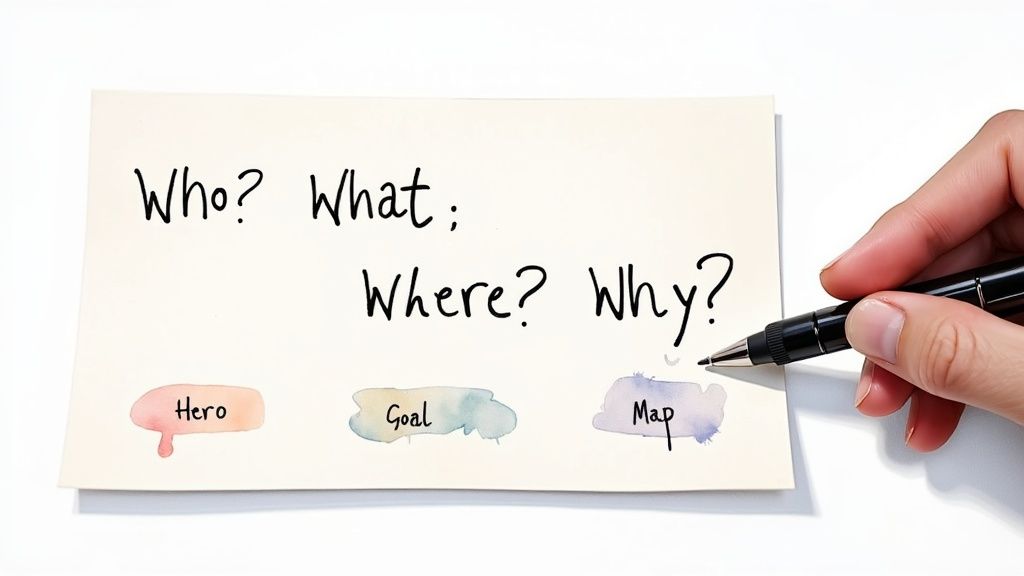
The Anatomy of a Killer Prompt
To get the AI on your wavelength, your prompt needs to answer a few basic questions. It’s like setting the stage for your game’s grand opening. The AI needs the rundown—the who, what, where, and how of your idea.
Here's a simple framework I always start with:
- Who is the player? Give your hero some life! Are they a nimble ninja? A ridiculously clumsy robot? A magical, acorn-hoarding squirrel?
- What's the goal? Be specific about what winning looks like. Do they need to collect 10 glowing orbs, scramble to the top of a crumbling tower, or defeat a giant, grumpy space slug?
- Where does it all go down? Paint a picture of the world. Is it a lush, overgrown jungle? A neon-drenched futuristic city? A spooky, cobweb-filled mansion?
- How does it play? This is all about the core mechanics. Is it a classic side-scrolling platformer with a slick double jump? Or maybe a top-down shooter where you're frantically dodging asteroids?
When you layer these details together, you hand the AI a rich blueprint. It’s the difference between a vague sketch and a detailed architectural plan.
Weak Prompt vs. Strong Prompt
Let's break it down with a real-world example. Say you've got an idea for a fun, bouncy platformer.
A weak, low-effort prompt would be something like:"Make a platformer game with a character that jumps on platforms."
I mean, technically, it'll work. But it’s like walking into a restaurant and just saying, "I'm hungry." You'll get food, but you’re leaving everything up to the chef. The AI is going to have to make a ton of guesses for you.
Now, let's inject some personality and detail. This is a strong prompt:"Create a 2D side-scrolling platformer with a bouncy slime character. The goal is to collect 15 shimmering water droplets to win. The setting is a magical forest with mushroom platforms. The slime can stick to walls for a second. Avoid the spiky caterpillars that patrol the ground."
See the massive difference? We’ve got a clear hero (bouncy slime), a specific goal (collect 15 droplets), a vivid setting (magical mushroom forest), and even some unique gameplay flavor (wall-sticking and enemies). The AI now has a crystal-clear picture of the game bouncing around in your head.
The secret is specificity. The more specific you are about characters, goals, and rules, the less the AI has to guess, and the closer the final product will be to what you actually wanted.
Defining the Rules and Vibe
Don't stop at the basics! You can—and should—get granular with the game's aesthetic and its fundamental rules. The AI is surprisingly good at picking up on these nuances, so don't be shy.
Toss in some extra instructions for things like:
- Art Style:
"...in a vibrant, 8-bit pixel art style"or"...with a dark, cartoonish, spooky theme like a Tim Burton movie." - Win/Loss Conditions:
"...the player loses if they touch one of the red ghosts"or"...reach the golden treasure chest at the very end of the level to win." - Unique Mechanics:
"...the player has a grappling hook they can use to swing from any wooden platform"or"...collecting a coffee cup gives you a 5-second speed boost."
The more of these flavorful details you feed the AI, the more unique and compelling your game will be right out of the gate. Think of this initial prompt as your foundation—a strong one makes everything that comes next way more fun.
Bringing Your World to Life with AI Assets
Okay, the basic framework of your game is there. The prompt did its job. But let's be honest, a game is more than just code and rules—it’s a vibe, a visual story. This is where you get to stop being a programmer and start being an artist, a world-builder. It’s time to give your game some personality.

With the built-in asset generator on MakeGamesWithAI.com, you can ditch all the placeholder art and start creating your own. That generic space hero the AI spat out? Let's make him a heroic cat astronaut in a comically small helmet. Those boring gray rocks? How about menacing, spiky purple asteroids? Go nuts. This is your chance to really make the game yours.
This kind of instant art generation is quickly becoming a huge deal in game development. Seriously, the market for these tools is projected to explode from USD 1.73 billion in 2025 to a whopping USD 8.92 billion by 2034. Why? Because AI-powered visuals have already boosted gaming realism by nearly 60%, and that's what keeps players glued to their screens. It’s a pretty clear sign that these tools are here to stay. If you're curious, you can dig deeper into the trends in the AI game assets generator market and see where this is all heading.
Crafting Cohesive Art
So, what’s the secret to a game that looks amazing instead of like a digital Frankenstein? A consistent art style. When everything looks like it belongs in the same universe, your game feels polished and professional. The great news is you can totally steer the AI to keep things consistent.
You just have to think like an art director when writing your prompts. Use keywords that tie everything together visually.
- Characters: Instead of "knight," try "A cute, chibi-style knight with oversized armor" or "A pixel art robot with glowing red eyes."
- Items: Don't just ask for a crystal. Ask for "A gleaming, collectible crystal in a low-poly style" or "A hand-drawn, cartoonish health potion."
- Backgrounds: Paint a picture. "A spooky, misty forest with tall, silhouetted trees" or "A vibrant, futuristic cityscape with neon signs."
See the pattern? By repeating style descriptors like "pixel art," "chibi-style," or "low-poly," you're basically teaching the AI your game's visual language. This little trick ensures your heroic cat astronaut doesn't look completely bizarre next to a hyper-realistic moon rock. And if you need more inspiration, we've got a whole guide on whipping up awesome 2D game assets for free.
Remember, every asset is another brushstroke in your masterpiece. You’re aiming for a collection of visuals that feel like they were made for each other, creating a world that just sucks the player right in.
Using this method, you can build up a whole library of custom art pretty quickly. This isn't just about making things look cool—it's about giving your game a soul.
Fine-Tuning Your Game with the Conversational Editor
Alright, so you’ve got a game. Your custom art is in, and it's starting to feel less like a template and more like your creation. But maybe the player character feels a bit floaty when they jump. Or perhaps those enemies are moving so fast they're just a blur on the screen. This is where the real fun begins—the part where a cool idea becomes an addictive game. And this is exactly where MakeGamesWithAI.com’s conversational editor comes in to save the day.
Forget about sifting through lines of code or getting lost in confusing menus. Polishing your game is now as simple as having a chat.
This back-and-forth—play, tweak, play again—is the absolute heart of game design. It’s what separates the good from the great. You get to be a designer, not a programmer, caught in a rapid-fire feedback loop that feels completely natural. If you want to dive deeper into this crucial stage, we've got a whole guide on how to properly prototype your gameplay ideas.
Making Changes on the Fly
The conversational editor is your direct line to the game's brain. You can make super-specific adjustments just by typing out what you want in plain English. See something you don't like? Type it. The AI makes it happen instantly.
Here are a few real-world examples of how this works:
- Nailing the Physics: Is your hero’s jump just not feeling punchy enough? Try typing:
"Make the player jump 25% higher"or"Decrease the gravity slightly."You can literally feel the difference in seconds. - Taming Your Enemies: Need to crank up the challenge (or tone it down)? Simple commands like
"Increase the red enemy's speed by 20%"or"Make the blue ghosts move in a random pattern"can completely change the game's difficulty. - Rewriting the Rules: Want to switch up the objective? Just tell the AI:
"Change the win condition to collecting 20 coins instead of 10."Done.
This direct interaction completely demolishes the technical walls that usually stand between an idea and a fun experience. You're not coding; you're directing.
More Than Just Tweaking Numbers
But it's not all about the numbers. The editor is just as good at handling the vibe and feel of your game. If a color palette is clashing or the silence is deafening, you can tell the AI to fix it on the spot.
The whole point is to keep you in that creative zone. By letting you make changes without ever leaving the game screen, the conversational editor lets you make tiny, real-time adjustments that snowball into a polished, professional-feeling final product.
This kind of immediate, intuitive editing is quickly becoming a huge deal in the game dev world. As of early 2025, around 36% of game developers worldwide are already using generative AI in their projects. This isn't just a fad; the demand for games that can adapt and be built faster is driving massive growth. The market is projected to jump from USD 1.47 billion in 2024 to an incredible USD 4.18 billion by 2029. You can read more about the growth of generative AI in gaming and see why this is such a big shift.
The conversational editor at MakeGamesWithAI.com puts this powerful tech right at your fingertips. It’s what makes our ai game generator free tool such a beast for rapid prototyping. You can change colors, add sound effects, or even rewrite how objects behave, all with simple text commands. Your creativity is the only limit—not your coding skills.
It’s Time to Unleash Your Game on the World
You’ve done it. The prompts have been written, the assets are perfect, and you’ve polished your creation into a real, playable game. So, what’s next? Making the game is one thing, but the real fun begins when you share it with everyone else. This is your big moment—the transition from creator to published game designer—and with MakeGamesWithAI.com, it’s ridiculously simple.
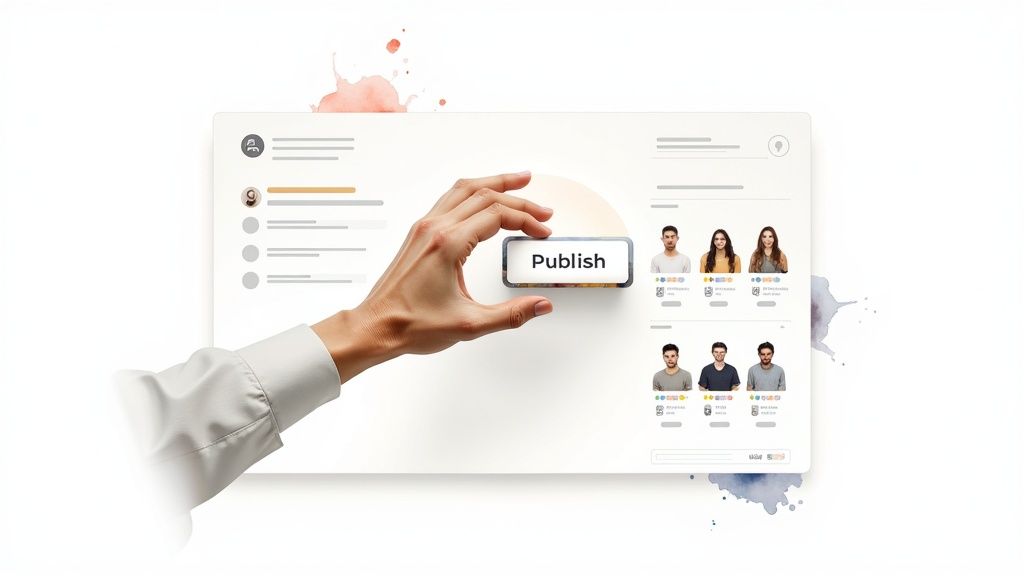
Don't even think about servers, hosting, or any of that technical deployment nonsense. We've stripped it all away. When your masterpiece is ready for its grand reveal, you just hit "Publish." That's it. Our ai game generator free platform instantly generates a unique link for your game. No downloads, no installs—just pure, immediate fun for anyone you share it with.
Go Live with a Single Click
The path from that final tweak to a live game is practically instant. The second you publish, your game doesn't just get its own URL; it also lands a spot in our community showcase. Suddenly, your creation is in front of a built-in audience of other players and makers just like you.
Your game will automatically appear on the global games page, which is a fantastic gallery of creativity. It's the perfect place to see what other people are building, get some inspiration, and see what players think of your own work.
Spark Some Friendly Competition
Let's be real—what’s a game without a little competition? The desire to hit the top of the leaderboard is what keeps players hooked. That’s why every single game made on MakeGamesWithAI.com gets a fully integrated, global leaderboard right out of the box. This isn't some add-on; it's a core part of the experience, designed to make your game more addictive from the get-go.
Think about it: players from across the globe could be fighting for the high score in your game. It’s an incredible way to build a community and keep people coming back for just one more try.
To get this working, you’ll want to have set up your scoring rules. As you were building and editing, you could have told the AI exactly how to award points.
- Define scoring events: Be specific with your prompts. Try things like,
"Award 10 points for every coin collected"or"Give the player 100 points for defeating an enemy." - Create time-based bonuses: Add a little pressure with commands like,
"Give the player a 500-point bonus for finishing the level in under 60 seconds."
These scores automatically get pushed to our system, populating the official global leaderboards. Players can see how they stack up not just in your game, but against everyone on the entire platform.
The real magic is seeing someone you've never met climb the ranks of a leaderboard for a game that, just a short while ago, was only an idea in your head. It’s the ultimate reward for your creativity.
Share Your Creation and Watch It Grow
Okay, your game is live and the leaderboards are buzzing. Time to get the word out! That unique link you got is your golden ticket. Blast it out on social media, text it to your friends, drop it in a Discord server—get it out there. The beauty of a web-based game is that there’s zero friction. Anyone with a browser can click and play instantly.
This immediate accessibility is crucial for getting your game in front of as many people as possible. So go on, show off what you made! Challenge your friends to beat your high score and watch as your simple idea turns into a worldwide competition.
Got Questions? We've Got Answers.
Jumping into any new creative tool can feel a bit like starting a new game—you're not quite sure where all the buttons are yet. So, let's clear up some of the most common questions people have about making games with a free AI generator like MakeGamesWithAI.com.
Is It Really Free to Make and Publish a Game?
Yep, 100% free. Seriously. At MakeGamesWithAI.com, we're all about knocking down the barriers that stop creative people from making cool stuff. From the moment you type your first idea to the second you hit "publish," you won't pay a single cent.
There are no sneaky subscriptions or hidden fees. Just pure, unadulterated game-making. You can build, tweak, and share your masterpiece with the world without ever reaching for your wallet.
Do I Need to Be a Coding Genius?
Absolutely not. In fact, that's the whole point. We built this platform specifically to obliterate the "you need to code" myth.
Our entire system runs on plain English. If you can tell a friend about your dream game, you have all the technical skill required. The conversational editor lets you make changes just by chatting with the AI, like you're giving directions to a creative partner. You focus on the vision; the AI handles the messy code behind the scenes. This is for the storytellers and the doodlers, not just the developers.
So, Can I Make Any Kind of Game?
The AI is a powerhouse for all sorts of classic 2D genres. Think side-scrolling adventures, top-down shooters that get your heart racing, and quirky arcade games. The better your prompt, the better your game will be.
Get specific. Tell it about the mechanics, the art style, the goal. The more detail you feed the AI, the closer it'll get to what you're picturing in your head. While you probably won't be building a sprawling 3D RPG on day one, the variety of polished, complete 2D games you can create is staggering. Need some ideas? Check out what other people have made on the community games page.
How Do I Show My Game Off to Friends?
Sharing is the best part, and we've made it ridiculously easy. As soon as you publish your game, you get a unique link to your creation.
That's it. Copy that link and blast it out to your friends on social media, in a text message, or over Discord. Anyone with the link can play your game instantly in their browser, on any device. No downloads, no installs, just instant fun.
Ready to stop daydreaming and start building? With Make Games With AI, your next awesome game is just a sentence away. Go create your first game for free and see where your imagination takes you.
https://makegameswithai.com/