AI Game Testing Automation: A Complete 2025 Guide
Imagine launching your game with near-perfect stability, confident that it has been played millions of times by a tireless expert who knows every possible exploit. This isn’t a fantasy—it’s the new reality made possible by AI game testing automation. This revolutionary approach uses intelligent, self-learning agents to test video games more thoroughly, efficiently, and deeply than ever before. As we move through 2025, it has become an indispensable tool for developers, transforming quality assurance from a manual chore into a strategic advantage.
This guide will explain what AI-powered game testing is, why it’s a critical component of modern development, and how it works under the hood.
What Exactly is AI Game Testing Automation?
At its core, AI game testing automation is the use of artificial intelligence, particularly machine learning models, to autonomously play a video game to find bugs, defects, and exploits. This goes far beyond traditional scripted automation, which simply follows a predefined set of commands and breaks the moment a button is moved.
Think of it like this: traditional automated testing is like a robot on a factory assembly line, performing the same task over and over. It’s efficient for that one task, but it has no awareness and can’t adapt if something changes.
AI game testing is like hiring an army of a million superhuman QA testers. These AI agents learn the game’s rules and objectives on their own. They don’t need sleep, they don’t get bored, and they can explore every corner of your game world with a curiosity and randomness that often surpasses human capability. They are designed to push boundaries and do the unexpected, which is precisely where the most elusive bugs hide.
Why AI-Powered Game Testing is a Game-Changer in 2025
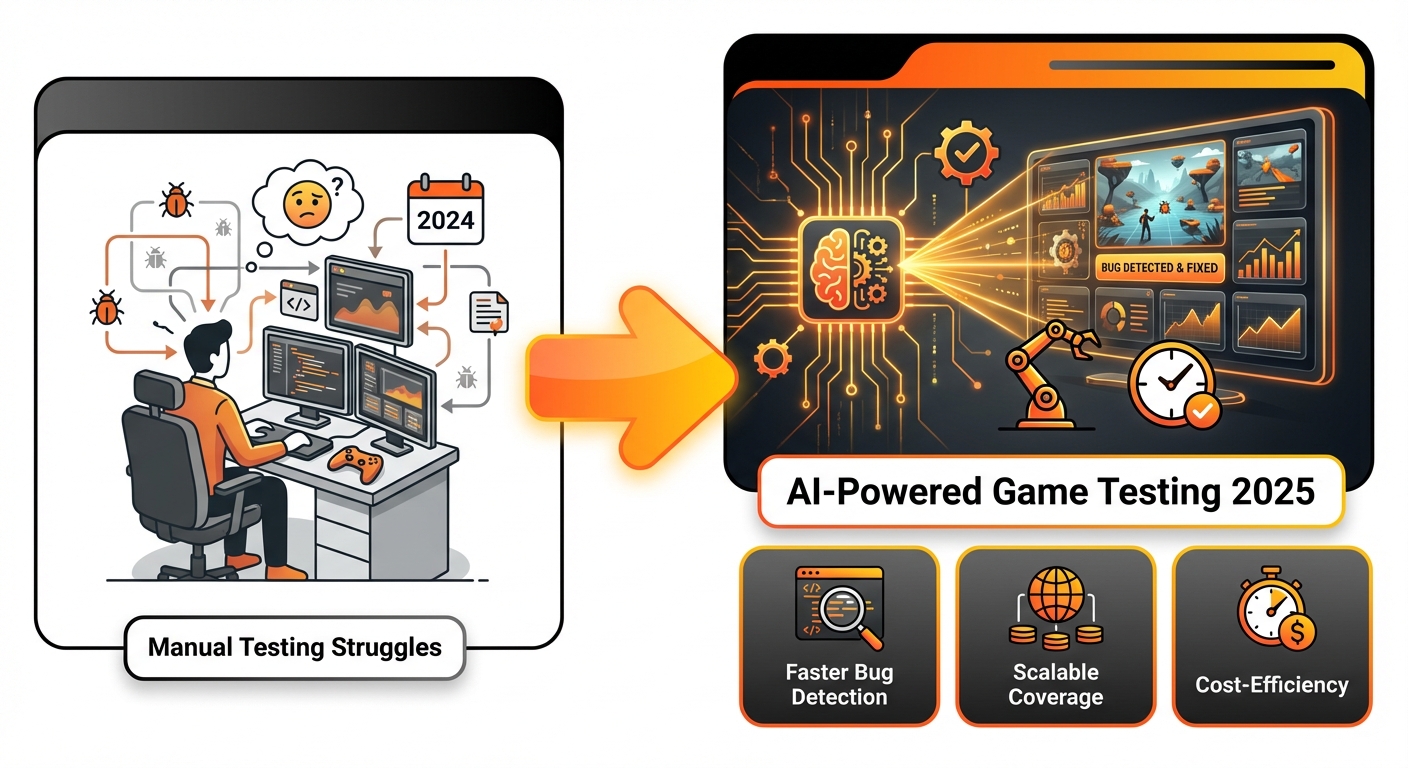
The shift towards AI in testing isn’t just a trend; it’s a fundamental change driven by clear, measurable benefits. As game worlds become larger and systems more complex, manual testing struggles to keep up. AI provides the scale and intelligence needed to ensure quality.
Unprecedented Speed and Scale
AI agents can operate 24/7 across hundreds of virtual machines simultaneously. A testing cycle that might take a human team weeks to complete can be condensed into a matter of hours. For example, an AI can test every inch of a new level for collision bugs, running a character into every surface from every conceivable angle—a task no human team could ever perform exhaustively.
Discovering the “Unthinkable” Bugs
Humans test with inherent biases based on how they assume a game should be played. AI has no such preconceptions. It will try bizarre combinations of actions, jump at weird angles, and use items in ways the developers never intended. This exploratory nature is key to finding rare, game-breaking exploits before players do. These are the kinds of bugs that can tarnish a game’s launch and reputation.
Cost-Efficiency and Resource Optimization
By automating the most repetitive and time-consuming aspects of QA, studios can significantly reduce costs. More importantly, it frees up human testers to focus on what they do best: evaluating the subjective qualities of a game. Is it fun? Is the story engaging? Does the gameplay feel right? This allows smaller studios and solo developers to achieve AAA-level quality assurance, especially when paired with modern `game design software for beginners` that streamlines other parts of the process.
How Does AI Game Testing Automation Work?
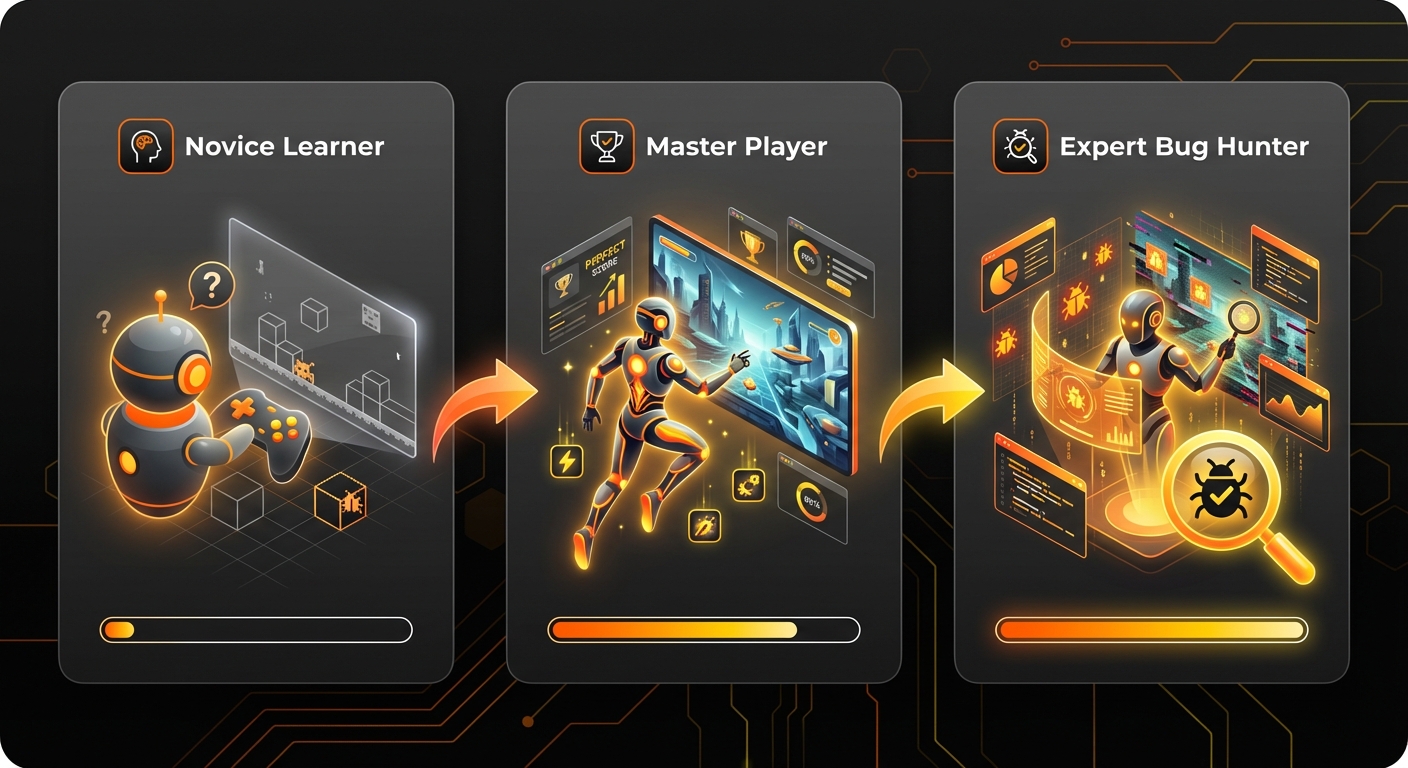
While the technology is complex, the process can be broken down into three main stages. It’s a journey where the AI goes from a complete novice to a master player and, finally, an expert bug hunter.
Step 1: The AI Learns to Play
Most systems use a technique called Reinforcement Learning (RL). The AI agent is placed in the game environment with a specific goal (e.g., maximize score, reach the end of the level, defeat an enemy). It learns entirely through trial and error.
- When it performs an action that gets it closer to its goal, it receives a digital “reward.”
- When it fails or performs a counterproductive action, it receives a “penalty.”
Over millions of these cycles, the AI builds a sophisticated understanding of the game’s mechanics and develops optimal strategies to win.
Step 2: The Exploration Phase
Once the AI has mastered the game, its objective can be shifted. Instead of just trying to win, it’s incentivized to explore. The new goal becomes maximizing coverage—visiting new areas, triggering new animations, and interacting with every possible object. It actively seeks out parts of the game it hasn’t seen before, mapping the entire