How to Create Games with AI: A 2026 Step-by-Step Guide
The dream of building your own video game—once reserved for expert programmers and large studios—is now more accessible than ever. As of 2026, artificial intelligence has fundamentally reshaped the landscape of digital creation, turning complex development cycles into streamlined, intuitive processes. If you have a story to tell or a unique game mechanic in mind, learning how to create games with AI is your key to bringing that vision to life without writing a single line of code.
This guide will walk you through the essential steps to build, refine, and publish your own game using the power of modern AI tools. Forget the steep learning curves and technical barriers of the past; the future of game development is here, and it’s powered by your creativity.
Why Use AI for Game Creation in 2026?
Before diving into the steps, it’s important to understand why AI has become such a game-changer. Traditional development is notoriously resource-intensive, requiring expertise in coding, art, sound design, and project management. AI-driven platforms automate or significantly assist with these tasks, offering several key advantages:
- Speed: Go from a simple idea to a playable prototype in minutes, not months. AI handles the backend logic, allowing you to focus on the fun.
- Accessibility: No coding knowledge is required. If you can describe your idea in plain language, you can create a game.
- Cost-Effectiveness: AI reduces the need for large teams and expensive software licenses, making game development affordable for individuals and small teams.
- Creative Empowerment: AI acts as a creative co-pilot, helping you brainstorm ideas, generate assets, and overcome creative blocks.
Step 1: Ideation and Concept Development with AI
Every great game starts with a compelling idea. In the past, this was a manual process of brainstorming and documentation. Today, AI can act as your creative partner to flesh out your initial spark of inspiration.
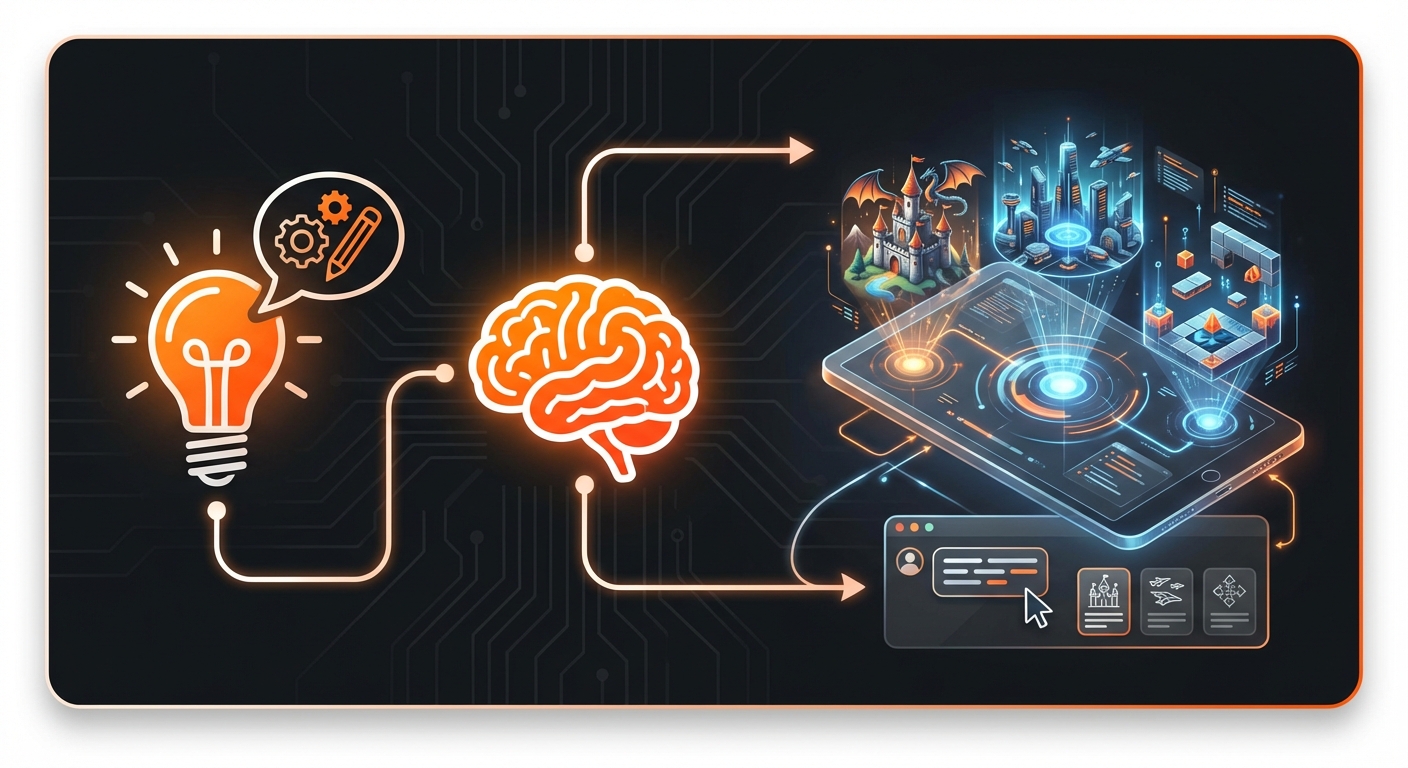
Use generative text models to explore possibilities. Instead of just thinking about a concept, you can prompt an AI with queries like:
- “Brainstorm five unique game mechanics for a puzzle-platformer set in a library where words come to life.”
- “Generate a character backstory for a rogue AI that has escaped into a fantasy world.”
- “Outline a three-act story structure for a mobile game about a chef who battles food monsters.”
Pro Tip: The more specific your prompts, the more detailed and useful the AI’s response will be. This initial phase helps you build a solid foundation and clear vision for your project before you even begin development.
Step 2: Choosing the Right AI Game Creation Platform
With a clear concept, your next step is selecting the right tools. The AI game development ecosystem in 2026 is diverse, but for beginners and creators focused on speed, no-code generative platforms are the clear winner. These platforms are designed to transform text prompts directly into playable experiences.
When evaluating platforms, look for key features:
- A powerful, no-code editor for easy iteration and customization.
- A large, high-quality asset library for characters, environments, and effects.
- Chat-based editing to make changes using natural language.
- Instant preview and deployment to see your changes live and share your game easily.
Platforms like MakeGamesWithAI are built specifically for this purpose, integrating all these features into a seamless workflow. They provide an all-in-one solution that’s perfect for those just starting out. For more on how AI is empowering new creators, our AI Game Creation for Hobbyists: A 2025 Guide offers foundational insights that are still highly relevant today.
Step 3: Generating Your Core Game and World
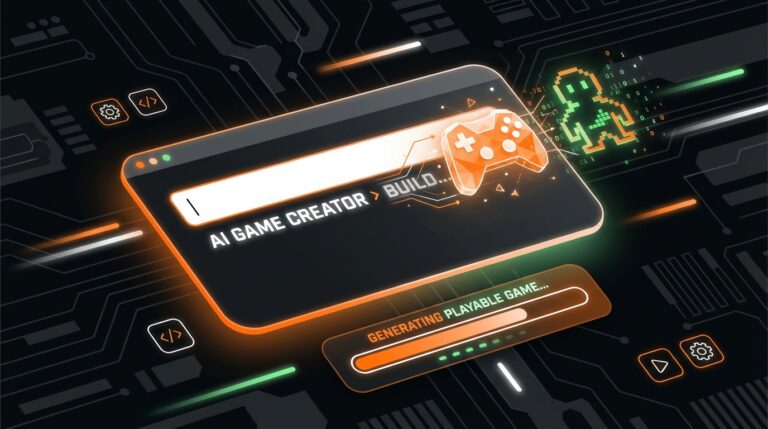
This is where your idea becomes a reality. Using a generative platform, you’ll provide a high-level prompt that describes the game you want to create. This prompt should include the genre, setting, core objective, and main character.
For example, a strong initial prompt might be:
> “Create a 3D endless runner game set on a futuristic, neon-lit highway. The player is a robot on a hoverboard that must dodge flying cars and collect energy orbs to maintain speed.”
Within seconds, the AI will generate a playable scene based on your description. It will create the environment, implement the player character with basic movement controls (e.g., left/right movement, jumping), spawn obstacles, and set up the collection mechanic. This first version serves as your interactive canvas—a process that once took weeks of coding is now instantaneous, perfectly illustrating the power of AI for quick game prototyping.
Step 4: Iterating and Refining with AI Tools
The initial AI generation is just the starting point. The real magic of modern game creation lies in iteration. Using chat-based editing, you can refine every aspect of your game with simple, conversational commands.
Fine-Tuning Gameplay
Don’t like how something feels? Just tell the AI what to change:
- “Make the player’s jump height 20% higher.”
- “Increase the movement speed of the flying cars.”
- “Add a double-jump ability for the player.”
Customizing Assets and Aesthetics
Your game’s look and feel are crucial. AI tools can help you modify existing assets or generate entirely new ones. You can use text prompts to alter textures, change color palettes, or even design unique characters. The process of AI character creation for games has evolved significantly, allowing for deep customization with minimal effort.
Warning: While AI is powerful, your creative direction is essential. Continuously play your game and make small, incremental changes. The goal is to use the AI as a tool to achieve your specific vision.
Step 5: Testing and Polishing Your Game
No game is complete without thorough testing. AI can significantly accelerate this phase by running automated playthroughs to detect game-breaking bugs, balancing issues, or performance drops. This process, covered in-depth in our guide to AI game testing automation, helps catch technical problems so you can focus on the user experience.
However, automated testing does not replace human feedback. Play your game yourself and, more importantly, have others play it. Watch where they get stuck, what they find fun, and what frustrates them. Use this feedback to make final polishing tweaks to level design, controls, and overall difficulty.
Step 6: Publishing and Sharing Your Creation
Once you’re happy with your game, it’s time to share it with the world. Platforms like MakeGamesWithAI offer instant publishing, allowing you to generate a shareable link with a single click. You can send it to friends, post it on social media, or embed it on your website.
Consider adding features like a global leaderboard to foster competition and engagement. Publishing is no longer a complex, multi-step process; it’s an integrated part of the creation workflow. After you’ve published, don’t forget the final step: promotion. Getting your game in front of players is key, and there are many effective strategies explored in our AI Game Promotion Tips for 2025.
Common Mistakes to Avoid
Learning how to create games with AI is straightforward, but a few common pitfalls can hinder your progress:
- Vague Prompting: The AI needs clear instructions. “Make a fun game” is not a useful prompt. Be specific about genre, mechanics, and aesthetics.
- Accepting the First Draft: Never settle for the initial generation. The best games come from iteration and refinement. Use the AI to experiment with changes.
- Neglecting the ‘Fun Factor’: AI can build mechanics, but it can’t guarantee fun. You, the creator, must playtest and ensure the core gameplay loop is engaging.
- Forgetting Your Vision: AI is a powerful tool, but it’s there to serve your creative vision, not replace it. Stay true to the game you want to make.
Expected Outcomes: Your First Game in Hours, Not Years
By following this step-by-step process, you can transform a simple idea into a fully functional and shareable game in an astonishingly short amount of time. You will have a tangible project to show for your efforts and gain invaluable experience in the core principles of game design—all without the technical overhead of traditional development.
This revolutionary approach democratizes game creation, putting the power to build new worlds directly into your hands. If you’re ready to start your journey, platforms like MakeGamesWithAI provide everything you need. With the Creator Plan, you get unlimited game creation and access to a massive library of premium assets, making it the perfect launchpad for your first—or next—hit game.