What Is AI Game Development? A 2026 Guide
The world of creative technology is undergoing a seismic shift, and the gaming industry is at its epicenter. You’ve likely heard the term ‘AI’ associated with smarter enemies or realistic dialogue, but in 2026, that’s only a fraction of the story. So, what is AI game development? It’s the revolutionary practice of using artificial intelligence not just as a feature within a game, but as a fundamental tool to create, design, and accelerate the entire development process.
This article will demystify this powerful trend, breaking down how AI is reshaping the way games are made, from initial concept to final launch. We’ll explore its core components, why it matters for creators of all skill levels, and how you can get started today.
What is AI Game Development, Really?
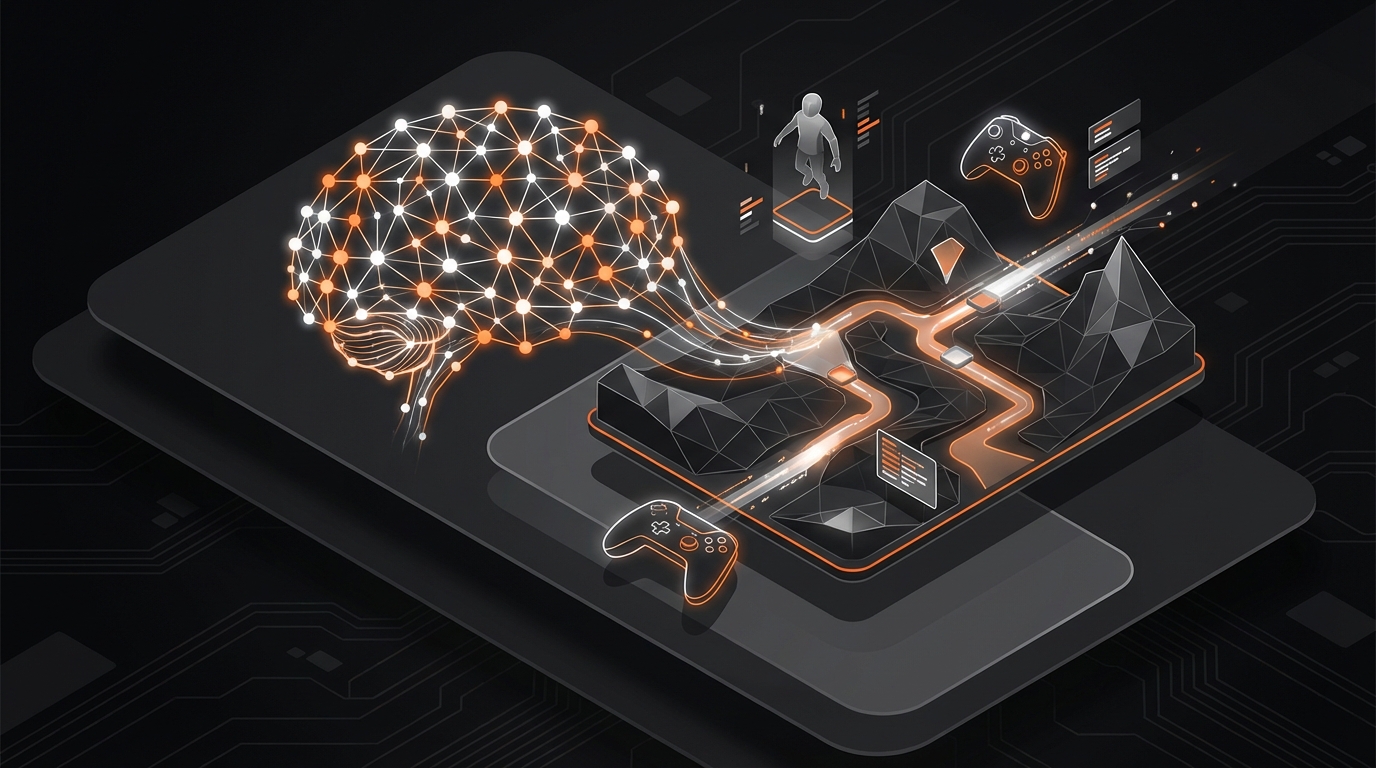
At its core, AI game development refers to the use of artificial intelligence and machine learning models to assist or automate tasks in the game creation pipeline. Think of it less as a robot that builds a game for you, and more as an incredibly skilled and versatile co-pilot. The human creator is still the visionary—the one with the idea and the passion—but AI acts as a powerful partner that handles the complex, time-consuming, and technical heavy lifting.
This marks a significant paradigm shift. For decades, AI in gaming meant one thing: creating non-player characters (NPCs) that could react to the player. Today, that’s just one application. The real revolution is in AI for game creation, which empowers developers by:
- Generating assets like characters, environments, and music from simple text prompts.
- Writing and debugging code or, in some cases, removing the need for code entirely.
- Designing complex levels and game systems procedurally.
- Automating the testing process to find bugs and balance gameplay.
Imagine a painter who, instead of mixing every color from scratch, can simply ask an assistant for the perfect shade of ‘sunset orange’. The painter’s artistic vision remains central, but the process becomes exponentially faster and more fluid. That’s the essence of modern AI game development.
Why AI in Game Creation Matters in 2026
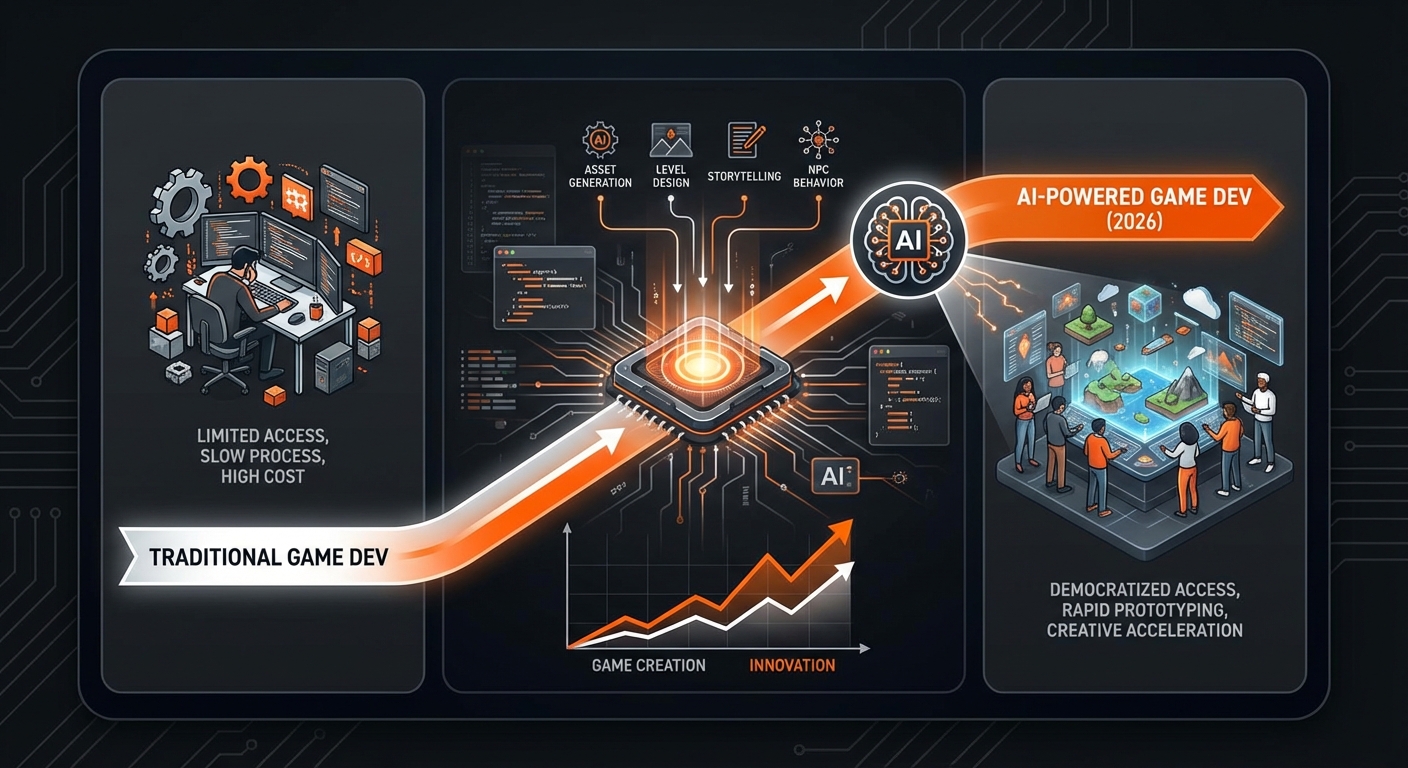
The rise of AI-powered game development isn’t just a niche trend for large studios; it’s a democratizing force that is fundamentally changing who can create games and how quickly they can do it. Its importance stems from four key benefits.
1. Democratization of Creativity
Historically, making a game required deep technical expertise in programming, 3D modeling, and animation. AI-driven tools are dismantling these barriers. Now, anyone with a compelling idea—an artist, a writer, a hobbyist—can bring their vision to life. Platforms like MakeGamesWithAI are built on this principle, translating natural language ideas into playable games, making game creation accessible to everyone. This is a game-changer for solo creators and enthusiasts, as outlined in this AI Game Creation for Hobbyists: A 2025 Guide.
2. Unprecedented Speed and Efficiency
Game development is notoriously slow and expensive. AI dramatically accelerates the workflow by automating repetitive tasks. Need a dozen different tree models for your fantasy world? An AI can generate them in minutes, not days. This rapid iteration is especially crucial for prototyping, allowing developers to test ideas almost instantly. By quickly building and testing concepts, creators can find the fun faster, a process detailed in our guide to AI for quick game prototyping.
3. Amplified Human Creativity
Contrary to fears of replacing human developers, AI is proving to be a powerful creative partner. By offloading tedious technical work, AI frees up creators to focus on what truly matters: storytelling, innovative game mechanics, and crafting a unique player experience. It can even act as a brainstorming partner, suggesting new ideas for quests, characters, or level layouts that a developer might not have considered.
4. Hyper-Personalized and Dynamic Worlds
AI allows for the creation of truly dynamic game worlds that can adapt and change based on a player’s actions. Imagine a game where the world, its quests, and even its characters are generated in real-time to create a unique experience for every single player. This procedural content generation (PCG), powered by sophisticated AI, leads to near-infinite replayability and is a core element of the future of AI game development.
The Core Components of AI-Powered Game Development
To truly understand what is AI game development, it helps to break it down into its key technological components. These are the engines running under the hood, transforming creative ideas into interactive realities.
Generative AI for Assets
This is one of the most visible applications. Using generative models, developers can create a vast array of game assets from simple text or image prompts. This includes:
- 2D and 3D Models: Generating characters, props, and entire environments.
- Textures and Materials: Creating realistic or stylized surfaces for 3D objects.
- Music and Sound Effects: Composing adaptive soundtracks or unique soundscapes.
- Character Dialogue and Narrative: Writing branching dialogues and quest descriptions.
For a deeper dive into this specific area, see our complete guide on AI character creation for games.
AI-Assisted Coding and Logic
For many aspiring creators, code is the biggest hurdle. AI is changing this in two ways. First, AI code assistants can help professional developers write boilerplate code, find bugs, and optimize performance. Second, and more radically, no-code platforms use AI to translate plain English commands into functioning game logic. On the MakeGamesWithAI platform, you can simply type, “make the player jump higher when they collect a coin,” and the AI implements the logic for you, no programming required.
Advanced Procedural Content Generation (PCG)
Traditional PCG uses algorithms to create game content like levels or maps, but the results can sometimes feel random or generic. AI-driven PCG is far more sophisticated. It can learn from existing designs to generate content that is not only new but also coherent, aesthetically pleasing, and aligned with a specific artistic style. This allows for the creation of vast, yet believable, game worlds.
Intelligent Testing and Balancing
Before a game is released, it must be rigorously tested. AI agents can be trained to play a game thousands of times faster than human testers. They can explore every possible path, identify game-breaking bugs, find exploits, and provide data that helps developers perfectly balance the difficulty and game mechanics.
AI Game Development in Action: From Idea to Game in Minutes
Let’s make this tangible. Imagine you have an idea: “a cozy puzzle game where you play as a cat organizing books on a magical library shelf.”
Here’s how it would unfold on an AI-powered platform like MakeGamesWithAI:
- The Prompt: You type your idea into the editor.
- Instant Prototype: Within seconds, the AI generates a playable scene. It creates a cat character, a bookshelf environment, and draggable book assets. It even implements the basic puzzle logic of fitting books into specific slots.
- Chat-Based Iteration: The game is good, but you want to refine it. You use the chat editor: “Change the art style to Ghibli-inspired watercolor.” The AI updates the visuals. “Add a power-up that temporarily highlights the correct book slot.” The AI adds the new mechanic and a glowing particle effect.
- Instant Publishing: Once you’re happy, you click a single button. The game is instantly published online, complete with a global leaderboard for players to compete for the fastest puzzle-solving times.
This entire process, which would have taken a traditional team weeks or months, can now be accomplished in an afternoon, all without writing a single line of code.
Key Takeaways
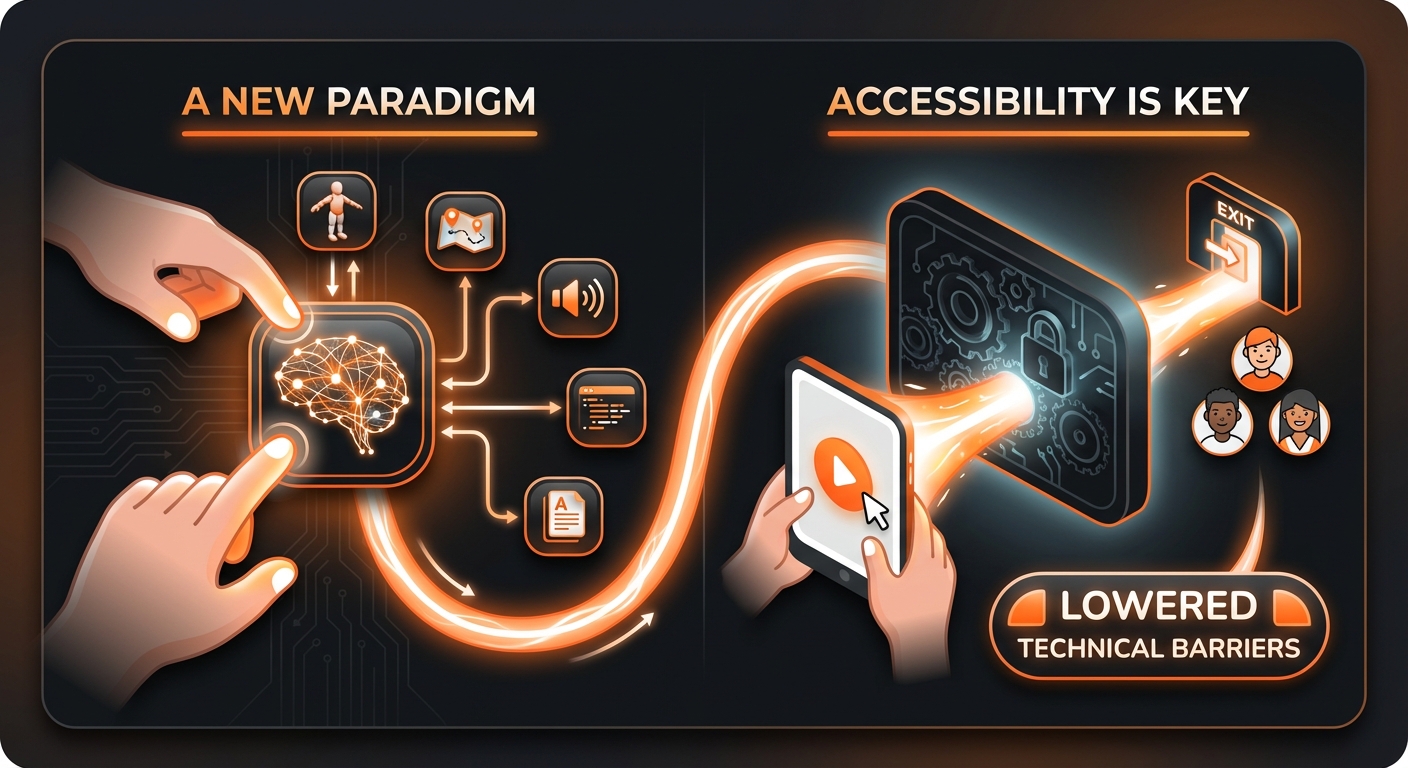
A New Paradigm: AI game development uses AI as a core creation tool, not just an in-game feature. It’s about how games are made*.
- Accessibility is Key: It dramatically lowers the technical barrier to entry, empowering artists, writers, and hobbyists to become game creators.
- Speed and Power: The process accelerates development from months to minutes, enabling rapid prototyping and iteration.
- Core Technologies: The field is powered by generative AI for assets, no-code logic systems, advanced PCG, and automated testing.
- It’s Here Now: This is not a future-gazing concept. Platforms exist today that put these powerful tools directly into the hands of creators.
The Future is Now: Start Your AI Game Dev Journey
Understanding what is AI game development is the first step toward embracing the most significant shift in digital creation in a generation. It’s a movement that is transforming the industry from one of gatekept technical knowledge to one of open, accessible creativity.
The tools and technologies that once seemed like science fiction are now practical, user-friendly, and ready for you to explore. If you’re inspired to turn your own game ideas into interactive realities, there has never been a better time to start. Exploring a platform like MakeGamesWithAI is the perfect first step, removing the traditional barriers and letting your creativity lead the way.